May 1, 2026 at 5:55 a.m.
Deer management unit 116 CDAC meeting
With the statewide Citizen Deer Advisory Council (CDAC) meetings wrapping up, the Department of Natural Resources (DNR) Deer Advisory Committee will soon review CDAC harvest quota and season framework recommendations. Towards the end of May, the DNR administration will review harvest quota and season framework recommendations as well, before the final proposal is made to the Natural Resources Board (NRB). The NRB will approve final deer season structures during their scheduled June 24 meeting in Kenosha.
The DNR’s website describes CDACs as councils that “work with local department staff to schedule meetings, provide community outreach and an opportunity for public input, review population data and deer impacts on forests and agriculture, develop three-year recommendations on unit population objectives and create annual antlerless harvest quotas.”
Last year, the Northern Forest Zone and Central Forest Zone of the state went back to habitat-based Deer Management Units (DMU), while the Southern and Central Farmland zones continued with county boundaries for DMUs.
Oneida County is divided into DMU 116, DMU 121, and DMU 120, while Vilas County is split between DMU 117, DMU 121, and DMU 122.
The meeting for DMU 116 was held at the Michael K. Timmons Community Center in Woodruff on April 27 at 6 p.m. Agenda item number two at the meeting was a review of the 2025 season structure and results, given by the DNR wildlife management liaison for the council, Curt Rollman.
Rollman shared data in the current unit boundaries, and described some of his own interpretations to the council and audience members. Hunter harvest, non-hunting mortality, and habitat were some of Rollman’s main talking points.
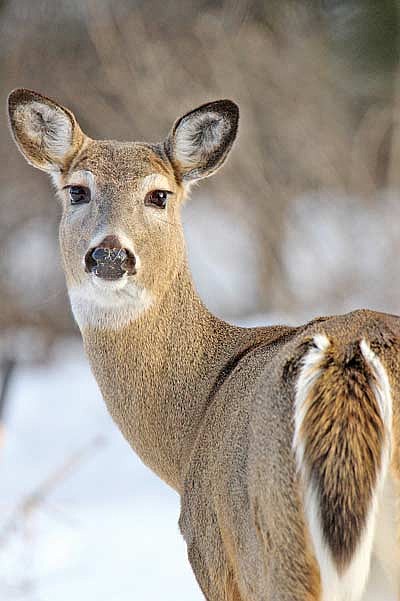
Last season, DMU 116 saw a little over 1,200 deer harvested in it, with just over 900 bucks. Public land harvest was roughly a third of private land harvest. Harvest density was 1.4 bucks per square mile, and 0.5 does per square mile, roughly three bucks for every doe.
“For the buck harvest density ... this isn’t perfect, but it can be kind of a proxy for population,” Rollman explained. “Everybody has a buck tag in their pocket when they’re out hunting, so everyone has that opportunity to harvest a buck.”
New cases of chronic wasting disease were also covered by Rollman, with five new cases last season.
In addition, he shared data on wolf and deer population dynamics, and other non-hunting mortality like severe winters that can release a multitude of factors influencing the deer herd.
Habitat type throughout DMU 116 was the last thing Rollman covered, as well as some of the management being done to improve habitat nutrition and acreage. Much of the habitat work being done is trying to provide additional forage for deer throughout the unit.
After Rollman and agenda item two, agenda item three gave each CDAC representative a moment to provide a short summary of the recommendation feedback that was sorted by their stakeholder group.
John Fetzer, who represents hunt/conservation clubs, started the short summary portion of the meeting saying he bird hunts in DMU 116 weekly, and talks to folks in cabins who live in the area, and ultimately recommended to drop the private land hunting tag number to 500 and public land to 100.
The next short summary of stakeholder engagement came from Lakeland Times publisher Gregg Walker, who represents the deer management assistance program. Walker highlighted the loss of local hunters due to lower numbers. He advocated again for historical boundaries of units that were strictly habitat based, and recommended a quota of zero for public and private land in DMU 116.
Tourism stakeholders were represented by Balie Strasburg, who agreed with Walker and also recommended the zero/zero quota. Strasburg, along with Walker, are board members for the Northwoods Youth Deer Hunt Challenge, and Strasburg said they have seen a decrease in deer entered into the youth event by 75 percent. Strasburg also added that groups aren’t coming to the Northwoods in the numbers that they used to.
Matt Carothers provided the last summary, and he represents the forestry stakeholder aspect of the CDAC, including many private landowners. He also recommended a quota of zero for public land, but was more torn for a private land number.
A motion was eventually made to recommend a zero/zero quota for DMU 116.
The original motion failed 3-2, but it was motioned again later on in the meeting, and passed unanimously, so a final recommendation by the DMU 116 CDAC was settled on as a zero/zero private/public quota to now be sent for review to the deer advisory committee.
Throughout the meeting, public input was accepted from the four audience members who attended in person.
The neighboring units of 121 and 122, who met jointly, saw a similar attendance outcome. Their final quota recommendations were quotas of 695 (3,500 tags) for DMU 121 and 330 (1,600 tags) for DMU 122. DMUs 120 and 117, which make up most of the rest of Vilas and Oneida counties, met on April 29 after conclusion of press time for this edition.
Blake Richard may be reached via email at [email protected].
WEATHER SPONSORED BY
E-Editions
Latest News
E-Editions
Events
May
To Submit an Event Sign in first
Today's Events
No calendar events have been scheduled for today.

Comments:
You must login to comment.