April 10, 2026 at 5:45 a.m.
From block to block: Time Capsule Decoys
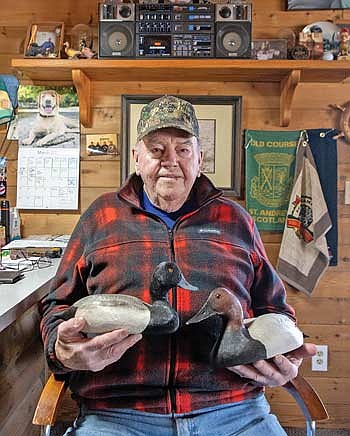
“You got some history there, young man,” Kenley Cordts, 90, of Tomahawk told me as a I leafed through a book titled “Ducks and Men: Forty years of co-operation in conservation.”
The book, copy written in 1978, tells the story of Ducks Unlimited Canada (DUC), and the beginnings of its integral part in conserving continental waterfowl populations.
Two of DUC’s earliest employees knew Cordts the only way waterfowlers know how: through the stories that bloom from mornings of hunting over “blocks,” known more commonly as decoys.
The true hardcore waterfowlers know the lingo of tossing out the blocks before first light, a tradition that started when the earliest decoys were only a pile of twigs and grass tied together.
Eventually, Cordts and DUC employees Tom Heape and Mel Pavlick, along with many others throughout the years, spent falls in the legendary waterfowling country of the Carrot River Triangle in western Manitoba.
Most of the history I learned, however, wasn’t in print that was bound to a book, but in a voice with more than double the years held in that book’s pages. It was in the stories that sprouted from flipping through old photo albums, and it was in the tupelo wood that garners the gathering of all voices that make waterfowl hunting what it is.
Cordts grew up in Pekin, Ill., on the bending banks of the Illinois River, yet another pin on a map of top waterfowl destinations across the continent. The Illinois River holds a lot of the ring-necked ducks, or “blackjacks” as they have been nicknamed, that eventually wing here to, and through, the Northwoods.
After recalling evening drives with his mom and dad through the bottomlands of the river’s floodplain, Cordts could remember seeing tornadoes of ducks grinding down on a cornfield to gobble up their evening meal. “Thousands and thousands and thousands of ‘em,” he said.
Cordts’ hands began a carpentry apprenticeship in 1953, but his mind has always been mended to the cattails, ducks, and the camaraderie that accompanies first light in the duck blind.
“Even to this day, I’ll pick up an empty shotgun shell and smell it,” Cordts said.
He permanently moved to his home here in the Northwoods in 2001. Before that, he’d spend up to 27 weekends in a row driving north to the place he first built in 1989.
Inaugural duck hunts and firsts are a memory of a lifetime for a lot of young duck hunters who have been in Cordts’ shoes, or waders and boots rather.
“I remember to this day,” Cordts said as he motioned how he sat between his dad and his uncle, “that duck came in and was sitting there and [his dad] said ‘OK, there’s your duck.’” A young Cordts fired a shot out of his Stevens single shot 20-gauge, which “kicked like a Missouri mule.”
“I just fell in love with it and kept it up,” he said. “I enjoy being there and just watching the birds. Shooting ... is secondary.”
Cordts kept that mentality in all his waterfowling years as he had companions by his side the whole way, two-legged and four-legged.
His black labs, Little Joe and Pal kept those bonus memories safe in their mouths when they’d bring back mouthfuls of feathers to slide beside the other photographs in Cordts’ countless photo albums.
His fondness of waterfowl continues today in those stacks of photo albums and within his hand-carved decoys.
As a Ducks Unlimited (DU) chairman in the 1970s, Cordts founded the chapter in Manito, Ill., just a few miles from Pekin, that’s still operational today. The Manito chapter banquets would collect nearly 300 guests and donors on an annual basis.
Before several DU events, Cordts organized for Jim Robison, of Wings in Wood Wildfowl Sculptures, to bring carvings for auction so banquet goers could donate money to DU’s main mission of habitat conservation by purchasing the carvings.
Robison was then the one to show Cordts the ropes for carving the decoys he does today, and his knack for carpentry helped him pick it up like learning the alphabet.
With a solid block of wood, Cordts says first you have to “rough it out.” He uses tupelo wood, which is tightly grained and a popular choice among many carvers. Tupelo is a type of cypress that can be found in the southeast. Jelutong is another common choice, a wood that originates in Asia.
The head and body of the decoy start off as separate entities, before Cordts attaches them together as he creates the initial shape.
He uses a stenciled outline to shape the body, a mold of sorts. The shape for the outline primarily forms as if you were looking straight down on the bird, getting the edges to encompass the figure of whatever species he is working on.
“Blackjacks are my favorite,” he said, but canvasbacks are another high on the podium.
He cuts the body and head shapes out with a band saw, but after that he uses a rotary tools, different sized dremels, and wood burning kits, each stage getting more detailed than the previous.
The larger rotary tool is used for shaving off big chunks of wood, mostly on the body portion of the block, because the head and finer curves of the body are shaped with the dremel.
Both the large rotary tool and dremel can spin at different speeds and hold various bits, giving Cordts room to experiment.
Once the decoy has its shape and the head and body are glued together, the wood burning tool comes out for the most time consuming and tedious step in the process.
“I go a quarter inch at a time,” he said. This gives the decoys a lifelike feathered touch, across the entirety of the block. Cordts even does the bottom of the beak.
Each region of the bird can get different patterns as well, adding to the consumption of Cordts’ time. “You look at the clock and think, ‘Dang I’m getting kind of tired.’ It might be 3:30, 4 o’clock in the morning.”
After catching up on some sleep, he scrapes the charred wood off with a copper brush and adds the finishing paint to give an unsaturated decoy the wild colors hunters hold in their hand when they harvest a live bird.
Usually Cordts can complete a decoy, from block to block, in roughly three weeks, which is about the time he and his outdoorsman counterparts would spend around the Carrot River Triangle near The Pas, Manitoba each fall.
Cordts seals the decoy off with a final time stamp and number, species, and carver name.
Blake Richard may be reached via email at [email protected].


Comments:
You must login to comment.