February 24, 2017 at 2:27 p.m.
Our cordwood sugar house
A unique building for boiling maple sap into syrup
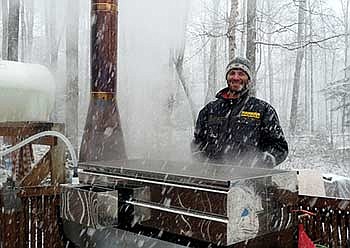
Our cordwood sugar house
By By Ted and Rose Amman-
Background
One goal of mine upon retiring in 2008 was to own a lakefront cottage in northern Wisconsin. Our search began the next year and, after looking at nearly 100 parcels, we found what we were looking for in the fall of 2009. Christmas that year found us closing on a modest two bedroom cottage on Lower Sugarbush Lake in Vilas County.
Our little bit of heaven in the Northwoods came with nearly seven acres of rolling woods. Other than a ready source of firewood, I didn't see anything unique about the trees but my forester son pointed out that scattered among the birch, balsam and hemlock were numerous sugar maples. He asked if I had considered tapping some of these maples for sap and cooking it down to syrup. Of course I hadn't but this sap to syrup process sounded interesting. The next spring, he found a used flat pan for cooking and I purchased a couple of dozen buckets, taps and droplines. For cooking, I put together some cement blocks, lined them with firebrick and attached a stovepipe. Then we sat back and waited for Mother Nature to provide the raw sap.
In 2012, our first season, spring weather was as fickle as ever. An early March blizzard dumped 24 inches of snow. The following week, temperatures climbed into the 60s and the snow melted nearly as fast as it had accumulated. And so it went, cold and snowy followed by warm and sunny then repeat the cycle until spring arrives for good in late April or early May.
In those first couple of springs, as we waited for the sap to run, we gritted our teeth when it snowed and smiled when the sun came out. We improved our technique, gradually upgraded our equipment and enlarged our operation. The end product, quarts and then gallons of clear, delightfully tasting maple syrup, was worth it. However, on days when we shivered in the cold rain or wet snow, I began to consider options for a sugar house where we could cook the sap indoors.
Researching sugar shacks
While researching "sugar shacks," we saw everything from lean-tos on the back of a garage to elaborate barns designed and constructed for cooking sap. Initially, we considered a 10x16 shed with standard studded walls and rafters. However, we wanted our "sugar shack" to be unique not just some typical outbuilding or woodshed. My wife came across a photo of a "cordwood" garden shed on the Internet. This process of building walls using cordwood looked fascinating and the end product certainly was eye catching.
We learned that cordwood construction, a very old style of building, was experiencing a resurgence in popularity among do-it-yourself homeowners. We picked up a copy of "Cordwood Construction - Best Practices" by Richard Flatau and were quickly sold on the idea of building our own "cordwood sugar shack".
Laying the groundwork
During the winter of 2014-15, we purchased three full cords of northern white cedar, fully dried and cut to length. Spring of 2015 was an excellent year for maple syrup. We tapped 100 trees and produced nearly 40 gallons of very fine syrup. After pulling taps and cleaning up, we cleared and levelled the area chosen for our "sugar shack." However, when I scratched a 10x16 outline in the dirt, it looked small. Since we had plenty of open space, our shack "grew" and ended up 16x24.
In wood, moisture leads to rot. To keep our cordwood dry, we first put down a concrete slab.
Then, using large cedar corner posts and white pine beams, we put together the framework. On top of this we set and secured factory made trusses.
When the roof and gable ends were added, it began to take shape though at this point, it resembled a park shelter more than a sugar house.
Next came two courses of split face cement block. In addition to adding interest, these blocks keep the cedar cordwood well above ground level moisture from rain or snow. When the two courses were in place, we liked the look so much that we added a third.
Cordwood wall building - first summer
By late summer, we were ready to start on the cordwood walls. After looking at other cordwood buildings, we decided that a 50/50 ratio of cordwood rounds versus splits looked best. The cordwood is set in a mortar consisting of sand, cement, saturated softwood sawdust and lime. Saturated sawdust slows the mortar set and thereby reduces the likelihood of cracking and shrinkage. We allowed space for a window in each wall section.
To add color and interest, we placed colored glass bottles (wine, whiskey, gin, etc.) in each wall. On these bottles, we cut the neck off and then matched the bottom six inches with a similar sized clear glass bottle. Glass is a conduit for light and the colored bottles added a pleasing feature to an already unique wall.
We made good progress on the walls through August but the threat of frost in late September brought our wall building to a halt. This mortar mix becomes crumbly and loses strength if exposed to freezing temperatures before it is dried. With the walls of our "sugar shack" three quarters done, we closed it up for winter in mid-October.
Before freeze-up, we landscaped around the back and sides, leaving extra room on the north for sap storage drums and a feed tank. The front wall was complete and most of the side walls were finished. To secure the building from critters looking to hibernate during the winter, we closed up the back and side openings.
Over winter, we installed a front door and overhead lights - also made out of wine bottles. When spring 2016 arrived, we stored sap outside in barrels next to the building. When cooking time came we fed it inside to our evaporator via a gravity flow system. Cooking went on inside regardless of the weather, a delightful change from previous years. By the time the sap stopped flowing, we had boiled nearly 2,000 gallons of sap into 38 gallons of syrup - another successful season.
Wall building - second summer
When consistent warm weather finally arrived in early June, it was time to return to wall building. We were pleased to note that hardly any cracking or shrinkage occurred on the walls that were completed last year. With experience and confidence gained from the previous season, the remaining walls went up rapidly. Initially the mortar color from last year to this year was quite apparent. However, as the fresh mortar dried and aged, that color variation disappeared. In out of the way places, we inserted shelves (that ran through the wall), and antler sheds.
The back wall, with two windows and a doorway, went up quickly. The end was in sight. We kept the fresh built walls covered until the mortar was set and dried, which takes about two weeks. When fully dried, these 12 inch walls of cordwood and mortar are solid and have remarkable insulation value.
By the end of June, our cordwood walls were complete. With the installation of the rear door, our unique "sugar shack" was finished. We now have a very special sugar house. From here on, we will be indoors, out of the weather, while making fine maple syrup.

Comments:
You must login to comment.