March 17, 2026 at 6:00 a.m.
Rhinelander Mayoral Candidate Forum
The men who would be mayor
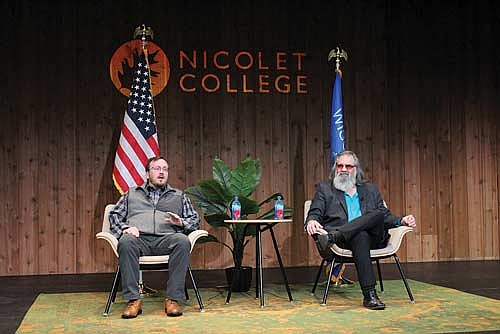
In preparation for the April 7 spring election, Rhinelander voters had the opportunity to compare and contrast the pair of candidates who hope to helm the city at Thursday night’s Rhinelander Mayoral Forum.
Incumbent Kris Hanus and challenger Tom Barnett were moderated by WXPR news director Katie Thoresen and WJFW evening anchor Dan Hagen, whose organizations teamed with Nicolet College to present the event in the college’s Lakeside Center auditorium. The League of Women Voters of the Northwoods kept time.
The candidates delivered 60-second opening and closing statements, with 90 seconds allowed for their responses to questions from the moderators and audience. Here are some of the highlights.
Opening statements:
“There are multiple reasons why I decided to run for a second term,” said Kris Hanus, who noted he doesn’t plan to seek a third term. “We right now have a ton of projects in the works, from utility projects on our west side to projects we have in the center of our city around our downtown, two new wells as well as treatment of wells. On top of that we have multiple TIF districts that we’re in the process of making, as well as housing projects that we desperately need … It’s a lot to get on-boarded on, it’s a lot to be involved in, and I don’t want to see those projects fall behind or not happen based on a change in leadership.”
District 1 alderperson Tom Barnett, who owns a small art studio in downtown Rhinelander, said, “I love Rhinelander’s potential ... When I look into Rhinelander’s future I envision a Rhinelander that is thriving, energetic, with events and attractions that boost our local tourism dollars. I also see a Rhinelander that is continuing to build and strengthen our infrastructure and finding clean water … The greatest thing about Rhinelander isn’t its local government. The greatest thing about Rhinelander is its people and its community … I know that through creative determination they’ll keep this city moving forward.”
What do you see as the mayor’s role in the city?
“The mayor’s role is a leader,” said Barnett. “It’s to foster leadership into the community, to make sure that city council has all of the information it needs to make honest and educated decisions when they’re voting on certain subjects in the city.”
Hanus sees it as two-fold, the first being “to bring suggestions from the staff and the public to (the city council) as a whole; they are the decision-makers. The mayor is overseeing things in day-to-day operations, from our city administrator down to our part-time summer help. The other part of the city mayor position is also being a key point for economic development, for working with developers as well as other community groups in our town … to bring the best ideas forward. That way the city council can make the best decisions possible.”
What’s your vision for the city of Rhinelander, not just right now but 10 to 15 years in the future?
“The biggest issue we’re facing right now is housing,” said Hanus. “We need more housing and it’s something we’ve got to partner with our partners to make that happen. We also need to work at ways to take our downtown to the next level, to continue the growth of small businesses and the engine and the heart of our downtown. We also need to work at economic development and our infrastructure.”
“I see a vibrant and thriving Rhinelander,” said Barnett. “I want to foster in change that is going to boost our economy and there are ways to do that … it’s working with our organizations and making sure that we have economic development in mind, and helping us out with that there are a lot of civic leaders that will help foster in that change.”
What do you see as the biggest challenge facing the city right now?
“…Definitely our infrastructure, clean water,” said Barnett. “The PFAS is extremely important to get fixed … it’s not going to happen overnight, but creative new ideas and out of the box thinking are going to help foster in some of that. I believe that there are things that can be done that we need to at least try. Some may not work, some may. I think it’s worth trying different options and opportunities to make sure that those things happen.”
“The biggest challenge on all fronts is getting resources and capital into the city,” said Hanus. “This has got to be done through partnerships with the county, partnerships with the state, local businesses, organizations, as well as the federal government. What we raise for taxes in the city is just over $5 million, but the city’s budget is much higher. We do that through our partnerships, we do that through bringing resources in and partners in that will then … help us.”
What do you think is the city’s role in helping meet the housing needs of this city?
“One is connecting the correct people together,” said Hanus. “A good example (is) Tony (Pharo) of (Oneida County) Economic Development with some developers, that way you can work to get grants and funding into the city. … It’s also about promoting why it’s good to build in this city, the need that we have, the mandate we have, where the city’s going. When you see infrastructure improvements, when you see new businesses coming in, people want to move here.
“…There’s a lot of opportunities out there that can be had and I think looking into those opportunities is extremely important,” said Barnett. “I would work very strong with the economic development corporation in finding the proper grants, finding the proper partners in making sure that that workforce housing comes in. There are a lot of opportunities out there to look at new creative ways also to bring in all sorts of different housing for all different types of people.”
Many municipalities, including Rhinelander, have faced budget challenges, especially as cost per services continue to rise. What do you see as a long-term solution to this issue?
“A long-term solution … is to continue trying to find creative grants,” asserted Barnett. “…I think that having a dedicated grant writer is a positive for the city. I think that it’s a need … having a dedicated grant writer takes the pressure off our department heads and actually brings in a person who knows how to find every single penny. Why would we leave free money on the table? Even if it’s $10, the city needs every penny, and finding those grants is a full-time job.”
“One, you’ve got to control your expenses,” said Hanus. “You have to look at creative ways to provide the same service or better service at the same cost. …. Our city administrator as well as myself looks at that weekly if not every day. The second issue is, how do you get more revenue? You do that by expanding your city, you do that by bringing in new business. … As we continue to grow the size of our city, provide more jobs and economic impact, that will bring in more resources and capital into the city, which will help of course being able to pay for our police and fire, for our administration, as well our street plowing and maintenance of our roads and utilities.”
Rhinelander wells 7 and 8 were shut down in 2019 because of PFAS contamination. Last October the city council approved spending just under half a million dollars for the design of a PFAS water treatment facilities for our wells among a few other things. The money should be reimbursable through this state’s safe drinking water program. How should the city meet long-term water needs?
“Based on what we have in development in the city based on what type of businesses operate in the city, we see massive change in water usage,” Hanus said. “Our paper mill’s a good example, at times they use a huge amount of our water. We need to, one, have enough quality of water, that way what you had coming out of the tap you could trust and save … Two, we’ve got to make sure we have enough capability to produce enough water.”
“I was lucky enough to serve as an alderperson under the man that probably knows more about PFAS in this town than anybody ever will, Mayor Chris Frederickson,” Barnett said. “I would bring him in as a trusted consultant on what we can and cannot do as far as mitigating the PFAS issue. Building that plant is definitely something that needs to happen to mitigate the issue but I would lean heavily on his knowledge because like I said, there is nobody that knows more about PFAS than him.”
We see a pretty big staffing shortage when it comes to Rhinelander Fire Department, police department, as well as city streets department. What could be done to mitigate that?
“We have a couple options,” said Hanus. “One, funding through the grant system is a way to do that. That’s only going to be a short-term fix because that’s usually only a couple-year cycle. The biggest way to find a solution to that is, one, increase the revenue you have through economic development, or two, city council has to decide where they want to cut the funding from a different budget.”
“I think through the grant system like Kris said,” agreed Barnett. “Year to year the grant system is challenging because you have to continually be searching for them, you have to continually be writing for them, and even then it’s not a guarantee that you’re going to get them. But having a professional dedicated grant writer who is constantly … looking for grants, is important because it will keep everything afloat until we find that budgeting.”
Since you’re both business owners in the city of Rhinelander, how do you handle potential conflicts of interest and make good ethical decisions?
“Over the last four years I’ve made that a priority,” said Hanus. “… The position of mayor I think has less potential conflict than an alderman, just because you’re not in a decision-making position, where alderman, you set the policy, you set the budget. … One could make the argument that if downtown succeeds, neither one of our businesses are going to succeed too so it’s a conflict to pump money downtown. But … as long it’s helping downtown succeed and grow, I don’t see it as a conflict.”
“…I make sure that I’m very careful on any decision, even as an alderperson, that I’m making,” said Barnett, “because even setting policy could garner a side eye of possibly being unethical, and my integrity is extremely important to me…. I plan on bringing the most transparent communication I possibly can to the city by holding monthly social media events, monthly town hall meetings where I can address everything that’s being asked ... I think that if every business is succeeding in this community it will be really hard for it to be an unethical thing. And that’s my goal is to make everybody succeed, and when everybody’s winning, how can that be unethical?”
One of the problems really affecting America right now is mental health. We spend the majority of our dollars in crisis mode … how would you envision going downstream on the mental health issue and taking care of our citizens?
“I think that’s a two-prong attack,” said Hanus. “One, you’ve got to have the resources in place able to help them, and I think partnerships and working more with the county, there’s a way to do that. I think the other issue is uplifting the community … having proper green space, we can get out and be one with nature. Up in this community we think of green space as something that’s all around us but it’s not, it’s disappearing every day… (this is) why I’ve been so active in investing in our parks over the last couple years through grant processes and partnerships.”
“That’s an extremely important subject to me,” said Barnett, “because at my studio I work with a lot of at-risk children and teens who struggle with these exact issues, and I see their families struggling with them as well. And I know for a fact … that there is a lot of untapped grants out there that can help with that issue, it can bring in mental health professionals that will help us. … The problem is that we don’t have the resources to bring those professionals here and they’re leaving. … We need grants that are going to be able to supply the funding that’s going to bring those health professionals into our community and keep them here to help our community.”
There has been some discussion about selling Northwood Golf Club. What do you see as the future of that property?
“I am not in favor of selling that property at all,” said Hanus. “That is a thousand-acre green space that we will never see again if we sell it. … That land is not only golfing (but also) multiple different events … I think that’s something that needs to become the crown jewel of this city. It’s something that we’re looking at how to make that more profitable … I think as more people come out there and explore what we have out there, I think you’re going to see it be more of a neutral or profit center. The weird part about the way we do our city government is we do not look at what Hodag Park costs the city or Pioneer Park costs the city, the city golf course land is the closest to net zero out of all our green spaces, but ironically there are some who see that as the first one we should chop.”
“…There’s a lot of misconception out there that I said let’s get rid of the golf course,” said Barnett. “I never said let’s get rid of the golf course. I was in favor of stopping it, and the reason for that is because it’s taxpayer funded, I mean, it comes out of taxpayers’ money, how we budget it and fund it. And I think that obviously we’re not going to be able to sell it, that’s just not going to happen, but I think we do need to think of outside the box in more creative ways of bringing things out there during that off season so that we’re not losing so much money every year on it. … We need to think outside of the box to help make that golf course a lot more successful and not just focus on the summer months.”
How do you see parks and culture fitting in Rhinelander as it pertains to tourism but also for local health and economy as well?
“I think it’s huge,” said Hanus. “…This is something I think through ArtStart partnerships with, and through the chamber, we’re looking at a mural that should be going up this summer. So I think downtown beautification with art is huge, I think art in public buildings is huge, and I think this is where partnerships as well as pointing it out and letting people know is huge. The room tax committee is moving forward with wayfinding signs which we’re looking to incorporate that kind of art in there too, that way it helps guide people downtown to our parks and buildings in a form that is more than just this way signs. So I think it’s crucial at all levels that we incorporate it. I mean, we’ve all been in communities where you see the heavy art side of it and they’re doing well, there’s people want to be downtown, they want to be walking, they want to be in our parks, and I think those partnerships are how you get there.”
“This is extremely important to me, being an artist myself,” said Barnett. “I think art beautifies it downtown, I think art brings people downtown, and right now we have an arts commission but they have met very infrequently and I think that’s because our local government does not work with them as much as they can. I think that we need to be a much more proactive government that works with our local arts and culture community because it’s that kind of beauty that’s going to bring people into town to beautify our city and it’s going to raise our tourism economy. You see Wausau hanging colorful umbrellas down one street and it brings in thousands and thousands of people and all those local businesses thrive because of it. …We should be fostering creative artists to come in and putting up displays and establish places where people can get their picture taken in front of … it’s important for our economy and it’s important for our small businesses to thrive in this community. We need to do more with that.”
Some of the hardest-won wisdom in our lives comes from making mistakes. I’m curious if there’s anything that you look back on in your time in city government that you wish you would’ve done a little bit differently and you learned from it and you carried that wisdom forward into some positive direction.
“Well, it’s going to be interesting, my statement, based on your connection and where we’re at: the whole potential site for a new well,” said Hanus. “That is something I think the media got out in front of us before we had decisions made, and the way we handled that wasn’t the best it could be. I think we should have been more in talks with the full board at Nicolet College versus just a couple members, I think that’s something we should have brought the neighboring houses and homes involved in earlier than we did, but there’s something that’s probably one of my biggest regrets as mayor the last four years is we weren’t more up front with that. … At the end of the day, level heads came together and we found a better solution which is creating the two wells that we have currently offline, moving in that direction, but it’s something that I learned a ton from, and going forward if I’m still able to serve as mayor or in any capacity, it’s something I have learned from.”
“I am very well known by a lot of people never to be so proud that I can’t say that I’m wrong about something,” said Barnett. “If someone can prove me wrong on a point that I feel strongly about or even not strongly about and it’s a valid argument I am very open to changing my mind on things, and yes I do have regrets, I have regrets on things that I have voted yes on, I have regrets on things I have voted no on, everybody does, everybody will, everybody who’s going to serve in the future will also have those regrets. One of my biggest regrets is not being more informed on how the share ride program cancelling was going to affect so many people, and if I could do it again my vote on that would be a resounding absolutely not to get rid of that share ride program. I later on had a long conversation with the owner of the taxi service who informed me of all the things that happened to make that decision that I was unaware of. I wish I would have been more diligent on finding out the entire situation before making that vote.”
Closing statements:
“Rhinelander is not limited by its challenges,” said Barnett. “It is poised, it is ready to move forward, and I think through creative and outside of the box thinking, we can get there. We can bring those events to town. We can grow Rhinelander in a positive direction, and tonight you heard from two people that I think both want to move Rhinelander forward and it just depends on how we do that. I think that the community knows what they want, I think they know who they want to lead, and that decision is up to them. I am humbled and thankful that I’m even sitting here offering my services to run for mayor, and I know the city of Rhinelander will make that right decision when the time comes, so thank you.”
“It’s been my honor to serve as mayor for the last four years,” Hanus said. “If you guys think I did a good job, I would be honored to serve again for another four years. Mr. Barnett is right; (with) either one of us as mayor, the city’s still going in the right direction, we’re going to be moving forward. Tonight you have heard a couple different options of how we plan to move forward. We have a lot of projects in the works on many different levels. The one thing I can say is that day one you’re going to have the same mayor as you did on the last day of my first term, a hundred percent up to speed, knowing every little detail of every project, pushing this city forward, and that’s good and bad. On one hand, fresh ideas will help move the city forward too. Mr Barnett, you’re currently on the city council. If you were not able to win for mayor you get to sit on city council for two more years, I hope any ideas you have or if anyone in the public that you bring it forward, that way council can keep it moving forward at a faster pace. So thank you all for coming out, and thank you for voting for whoever you do vote for tonight.”
Ardith Carlton may be reached at [email protected].
Comments:
You must login to comment.