April 24, 2026 at 5:45 a.m.

Riding the trails: Could UTVs be an effective autism therapy?
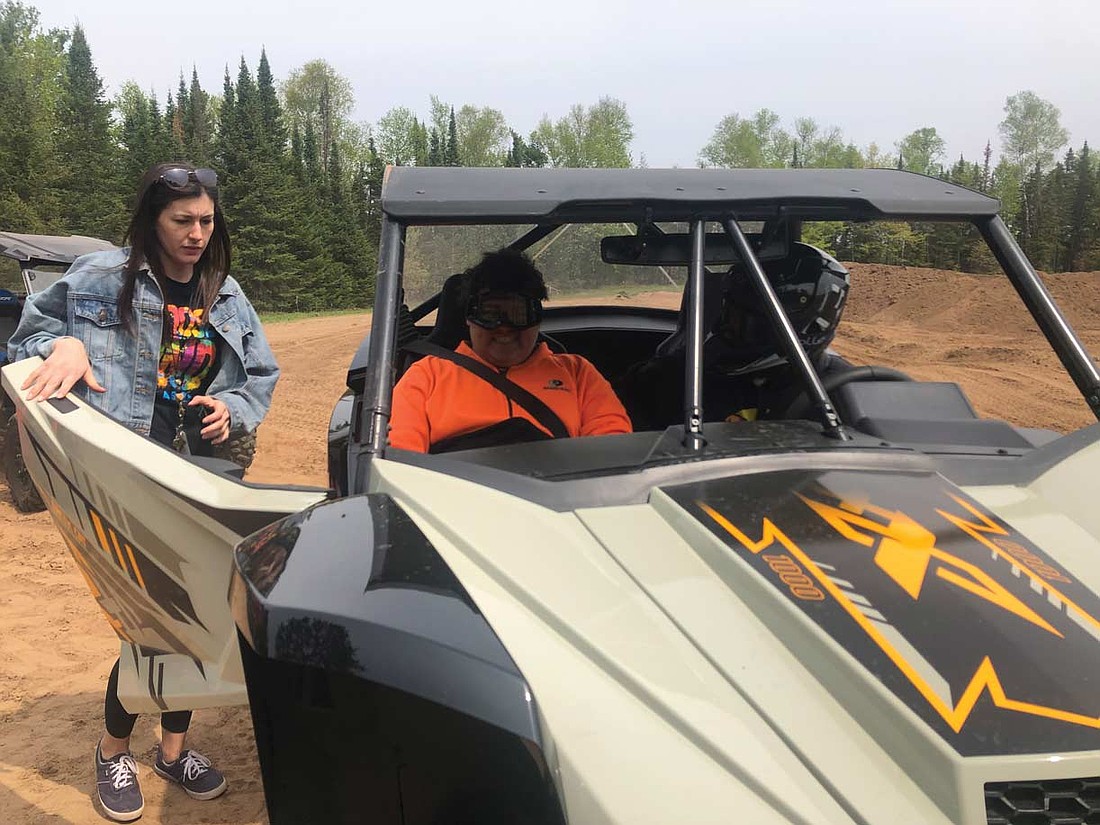
Breanna Semmerling, left, is excited to go on a ride in a UTV with Area 31 lead guide Chayce Walker, right. (Contributed photograph)

By Kimberly Drake, Special to the Lakeland Times

Imagine riding in a four-wheel, all-terrain vehicle through the wilderness on a rugged, backwoods trail. For most people, the roaring engine, the twists and turns, and the back-to-nature feel of the adventure would be exhilarating, almost therapeutic. But for someone with autism spectrum disorder (ASD), one might assume the noise, dust, and bumpy terrain would be overwhelming, creating an experience that’s far from beneficial.

However, for many autistic students at Lakeland STAR School/Academy and Rising STAR Transition Center in Minocqua, quite the opposite is true. Something discovered by chance after students attended a 2023 staff-and-student appreciation outing at Area 31, a local UTV adventure facility.

STAR’s outing to Area 31 on that early spring day included students with varying levels of ASD—Level 1 (requiring support or “mild autism”), Level 2 (requiring substantial support or “moderate” autism), and Level 3 (requiring very substantial support or “severe” autism). During the event, Area 31’s lead guide, Chayce Walker, gave rides to individual students.

While students of all support levels enjoyed the rides, Walker and the attending staff noticed something extraordinary happening with some level 3, mostly non-verbal students. Despite the engine noise, rough terrain, dust, and wind, they became unusually calm and regulated.

One non-verbal student arrived at Area 31 that day supported by two paraprofessionals. He wore headphones to block sound and was experiencing behavioral challenges due to dysregulation.

“We weren't sure how it was going to go. And I'll never forget this. We put him in the front seat, and he's on the brink of a meltdown,” Walker told this reporter. “Once I turned the machine on, he just stopped. And then, after riding for about 15 minutes, he took his headphones off and sat there in a calm, almost ‘zen-like’ state.” The staff was “blown away” by what they witnessed, Walker added. 

 “He never took his headphones off, ever, except maybe in a quiet room, and he pretty much just threw him out the window,” Walker said.

The remarkable calmness and regulation observed during rides prompted more outings to Area 31. As time went on, STAR staff noticed that the positive effects of UTVing lasted for days. They began scheduling rides on Mondays or Tuesdays, so some students could feel more regulated throughout the week.

Soon, more UTV-related benefits emerged. For example, during his first excursion, the student who was able to remove his headphones initially refused to wear goggles. However, during the second ride, he put them on without hesitation. “All the kids started putting their own goggles on, buckling themselves in, being more independent,” noted Walker.

Eventually, this particular student learned to say “ready, set, go” to indicate he wanted to go faster. During rides, Walker has also witnessed other non-verbal students attempt to form words and sounds.


Why would riding in a UTV help autistic individuals?

Stephanie Cull, principal at STAR, told this reporter that UTVing as an activity can help regulate some autistic students due to differences in how autistic individuals process sensory input, especially in the vestibular and proprioceptive systems, which control balance, body awareness, and alertness. Some individuals need more movement to feel regulated, while others can become overwhelmed. But for many, movement helps the brain organize itself, leading to improved focus, behavior, and regulation.

“After UTVing, we have observed students fall into a much more calm and relaxed state for the remainder of their school day, which results in them being more focused and able to access their programming,” Cull said.

Cull and STAR’s occupational therapist, Sara Kulton, said that, in many ways, UTVing can function similarly to vestibular therapy activities (such as swinging or spinning), which are often used intentionally in occupational therapy sessions. Riding in a UTV provides continuous movement, changes in speed, and terrain variation, while also delivering deep proprioceptive input through vibration and bumps.

“The movements from the UTV require students to engage various muscle groups to maintain posture, stability, and overall body support,” Kulton told this reporter.

Still, UTV rides may not benefit all autistic individuals. “While most of our students really enjoy UTVing, there have been instances where it may not have benefited particular students, and this depends heavily on their individual sensory profile,” Cull said. “We have found that sometimes this type of input has the opposite effect. Fast movement, noise, and vibration may feel overwhelming or even distressing. Too much or unpredictable input can push a student into dysregulation rather than calming them.”


The therapeutic potential of UTVing

Currently, there are no specific studies that have evaluated UTVing as a therapeutic intervention for autistic individuals. However, the benefits observed in STAR students are compelling.

“From an occupational therapy perspective, the UTV outings we attend at Area 31 are a highly beneficial therapeutic tool,” Kulton said. “They provide […] input that can improve regulation, attention, and participation in daily living, educational, and vocational tasks for students with ASD.” Kulton added that UTV outings can help support autistic students because it’s a fun, real-world activity that promotes inclusion and meaningful engagement.

“Additionally, UTVing has challenged many students to step outside of their comfort zone and try something new. This has increased their confidence and willingness to participate in more activities,” Kulton noted.

Walker believes that while autistic students are used to riding in vehicles like cars and trucks, there’s something different, almost transformative about riding in a UTV. “Our jump course is all belly drops as you go off the jump’s edge; it’s G forces, turning left and right,” Walker said. “The students must stay kind of strong in the unit. It's more intense for kids who have never experienced it. It changes them.”

According to Cull, UTVing can be a highly effective therapy tool and strategy to support regulation for some students with autism. “Our goal is always to help students feel regulated, confident, and successful, and this is one more tool that can support that mission,” Cull said.

Despite its potential therapeutic benefits, accessibility might be a challenge for some students as few schools have a UTV facility nearby. Creating a UTV simulator, like a driver’s ed simulator, could be an option. However, Walker believes it would be difficult to duplicate the intensity of a real ride through the woods. “You’re on rough trails, smooth trails, and there’s the sound of the engine, vibrations through the vehicle,” Walker explained. “As you go through the woods, you run into different air temperatures, hot then cold, mud and leaves come through the side windows. It’s a different feeling and would be hard to reproduce in a simulator.”  


Other ways UTVs could help

After his experience guiding STAR students, Walker believes UTVs could be utilized to teach some autistic students who need less support how to operate a vehicle before they enter a driver's ed program.  

“I think a controlled, safe driving course set up on the [Area 31] property could help some autistic students learn how to operate a vehicle, because it's challenging to learn driving skills in a car out on the road.”

Walker said he would like to work with a UTV manufacturer to develop a side-by-side with car-like features. It would be governed to control speed, and have a passenger-controlled kill switch, mirrors, turn signals, a backup camera, and other features that closely mimic a vehicle.

While the idea is still in the early discussion phase, Walker feels that this type of hands-on training could help students obtain their driver’s licenses and foster the independence needed to get to work or school. “They need to be able to travel, especially in rural areas where taxis or transportation don’t exist or are hard to access. So, I think that using UTVs to teach this skill is an option to pursue,” Walker noted.

In the end, the benefits of UTVing, as witnessed by STAR staff and Area 31’s lead guide, are purely observational. Still, its potential as a therapeutic intervention for autistic students is noteworthy.

 “While UTV outings are not a one-size-fits-all solution, they represent a creative and meaningful way to meet the diverse sensory needs of students on the autism spectrum,” Cull said.

Lakeland STAR School/Academy is a charter school in Minocqua serving autistic and neurodiverse students in grades six through 12. Rising STAR Transition Center serves students ages 18 to 21. This reporter is a member of STAR’s governance board.

Kimberly Drake is a health journalist whose work appears in The Epoch Times, Healthline, Medical News Today, and GoodRx. She can be reached at [email protected].


Comments:

You must login to comment.

Sign in
RHINELANDER

WEATHER SPONSORED BY

Latest News

Events

April

SU
MO
TU
WE
TH
FR
SA
29
30
31
1
2
3
4
5
6
7
8
9
10
11
26
27
28
29
30
1
2
SUN
MON
TUE
WED
THU
FRI
SAT
SUN MON TUE WED THU FRI SAT
29 30 31 1 2 3 4
5 6 7 8 9 10 11
12 13 14 15 16 17 18
19 20 21 22 23 24 25
26 27 28 29 30 1 2

To Submit an Event Sign in first

Today's Events

No calendar events have been scheduled for today.