July 25, 2025 at 5:55 a.m.
One-way, no way: Brown Street angle-parking plan hits a dead end
Recently, the Rhinelander city council has floated the idea of making North Brown Street a one-way street, with angle parking on both sides. The idea came up because, next year, Brown Street is slated to be resurfaced and restriped.
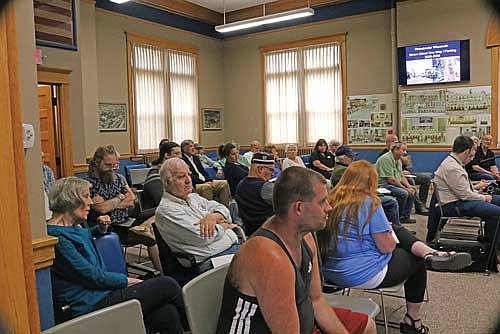
While that is being done, the council also wanted to look to the future of the downtown area. The council voted to hold a listening session to learn more about what residents and downtown business owners felt about the idea. That listening session happened Monday night, and many residents and several local business owners came to express their desire not to see any changes in Brown Street.
Mayor Kris Hanus said one of the reasons the council was looking at the change was the possibility of the need for additional parking downtown in the future. The city currently has Tax Increment Financing (TIF) money generated in the downtown Tax Increment Financing District available that would need to be used, and completing this project in 2026 would make use of that money, which can only be used for infrastructure projects, and allow for the perceived need for more parking downtown in the future. Lights on Davenport Street would also be replaced as part of this project, so they match the lights downtown, he said. The idea for the one-way street was to start at Northwestern and have traffic flowing only north up to Jet’s Dairy Bar. The project would include only top coating the street and repainting the lines, whether or not Brown Street was moved to a one-way street, or if it stayed the same. The cost would be $20,000 to $30,000. The move to a one-way would increase the parking by 30 spots, meaning $1,000 per parking spot. Hanus said new parking could not be built for anywhere close to that cost.
Since the last Brown Street project almost 10 years ago, over 60 percent of the businesses have turned over. Much of this has increased the need for parking, as people visiting restaurant and bars are often spending more time downtown than they had when other businesses were downtown and, also, as buildings fill up with businesses, that also means more traffic.
When the parking lots on Courtney Street need to be resurfaced, he said, the city would be required to create green space as part of that project. This would mean losing 27 parking spots when that project was completed.
Hanus also said the future of certain parcels within the city were unknown. For instance, he said, the city is currently looking at building a new city hall as well as a police and fire station. Those would be located outside the downtown district area. Whoever might buy the city hall, for instance, will want parking, so the nearby parking would go with that building, leading again to less public parking by an estimated 30 spots. He said these were things the crowd should keep in mind when thinking about the Brown Street parking question.
Also, Hanus said, when the police and fire station move, that area will be redeveloped. There was uncertainty how much additional parking would be need based on how that was developed. He estimated a need for 10-30 additional parking spaces would be needed for that space.
He also spoke about the current State Theater building, saying his hope was that building would be a functional site for something in the next ten years, meaning a need for even more additional parking. There were also a few buildings downtown with second floors that could and should be remodeled to add more housing. All of this together, he said, could mean a 67-157 parking spot shift in the next ten years.
Hanus said there were some concerns with this idea as well. Hanus said one of the biggest obstacles was change itself, as it takes a few years for people to get used to change. With angle parking on both sides of the street and a one lane street, vehicles backing out at the same time had the potential to back into each other. There was also the potential to lose some downtown revenue with the loss of southbound traffic. He then opened the meeting up to comments from the audience.
Rick Covin, one of the owners of Dinky Diner, started the conversation, pointing out the uncertainties of the future. He said much of the loss of parking spots based on the police and fire station and other things moving, was a complete unknown. He said he did not see the urgency behind creating more parking. He said the need he has seen, based on talking with his customers, was more cut-outs for handicapped access so people did not have to walk the end of the street to push a wheelchair onto the sidewalk. Covin said he was not in favor of the one-way street on Brown. He said he would lose business by losing southbound traffic.
Covin and many others mentioned the lack of signage for public parking spaces as well. The feeling was that there was more parking available than people understood, especially in the case of visitors.
Zach Hext, owner of Magic Man Games, was another business owner who was in favor of more signage for public parking. His customers spend long periods at his business, he said, and having signage for public parking would allow more people to know where they could park and come and spend some time at businesses downtown. He said he also believed a one-way North Brown Street would be detrimental to downtown businesses. He touched on several issues such as speeding and cars backing into each other as well.
“Most everyone thinks this is a bad idea,” he said. “And I think that we should look at a longer-term solution.” The TIF money, he said, could be used for four-way stop signs to slow traffic down as well as signage directing people to parking lots. Hanus said he was not sure if parking lot signage would qualify under the TIF, but he would bring it up to the city council.
Abby Lukowski, from the Northwoods Alliance for Temporary Housing spoke as well. She said Fredrick Streets and other corresponding streets had a great deal of foot traffic, and a one-way street on Brown Street, in her opinion, would increase inattentive driving and traffic moving even faster than it does now. When the previous work was being done on Brown Street, she said the city placed barricades on Fredrick Street to slow people down, and she did not want to see that become a continual issue.
Lukowski concluded by saying the city may be a bit too late for Brown Street itself. With the decisions already made to expand sidewalks and create bump-outs, she said the decision had already been made and this topic should have been addressed during the original planning. She said the time to increase parking downtown had passed. She implored the city council to do their homework and complete a feasibility study if they decided to move forward.
Ruth Hempel, owner of Fourth Floral, was also part of the planning team when the last construction was done on Brown Street. She gave an historic perspective on why the redesign was created the way it was. The idea was to make the downtown more walkable. She said, at the time, the downtowns that were thriving were pedestrian friendly.
Eventually, the conversation turned to walkability of the downtown as well. Hext said the downtown was starting to come back and be revitalized, and he did not want to see that hampered in any way.
Nate Shepard of The Hilgermann Center for Community spoke about walkability as well. He said many people in his generation would rather walk or bike to visit places than to drive. That said, he did not feel as though people having to walk from the Courtney Street lots, for instance, was not a concern. Young families were most concerned about safety of walking than the distance they had to walk. He envisioned Brown Street as a street for visitors to “mosey down” and wander into shops. He did not feel as though converting the street to a one way was the best path.
Hanus said he would bring the two main threads he gathered from the meeting to the full city council, many members of which were present. He said he would bring the idea of signage pointing to public parking that visitors may not otherwise find, and he would bring up the idea of four-way stops at intersections on Brown Street that are currently only controlling east to west traffic.
The next city council meeting will be at 6 p.m. on Monday, July 28, 2025. The matter will be on that agenda for council members to contemplate and on which they could make a decision, or ask for more input.
Beckie Gaskill may be reached via email at [email protected].
Comments:
You must login to comment.