August 19, 2025 at 5:40 a.m.
Road woes: Lynne town board grapples with much needed maintenance to Willow Road
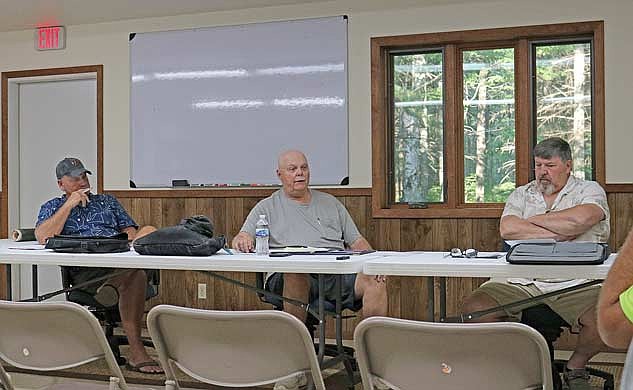
With 56 percent of county forest logging happening in the town of Lynne, according to town board member Jeff Brown, it is no surprise that Willow Road is in need of some major repairs. The heavy logging trucks traveling that route frequently have taken their toll, leaving the town to wrestle with how to get those repairs completed.
Brown brought up a recent Lakeland Times story about crack sealing done in Minocqua. He said the Fahrner bid for that project had come in 20 percent lower than the bid from Pitlik and Wick. With that difference between two contractors, Brown said he felt they should get a bid from Fahrner as well. He said he would look for a per mile bid from West Road to the town line.
Town treasurer Dave Klemm provided several options to the board for repairing the road. He included not only the bids for lane wedging the road from American Asphalt and Pitlik and Wick, but also costs for the town to repair the road themselves. He also included full costs, if the town decided to repair the full profile of the road. He also included information about chip sealing only from Pitlik and Wick. He presented this in a spreadsheet for board review.
“The next columns,” he said of the spreadsheet, “after giving some thought and talking to some people, are other potential costs that we may incur for each option.” He used the wedging option as an example. With just wedging the sides of the road, there was a need to crack seal and flex patch. Without that the wedges would be gone the first spring. He said the town also needed to do something with the shoulders. He put a number on that, but warned it was not a definitive number, at $2,500.
“That’s just a guess,” he said. “With a little research, it’s a bit uneducated, but I felt good enough to write it down.” Klemm said he also added a contingency of 10 percent to each option into his spreadsheet. Alternatively, he said, he could change up the number if the board decided, for instance, to complete only four miles of repairs.
Brown asked whether there was an idea of funds the town already had available versus what it might need to borrow. This could give an estimate of a potential tax increase per $100,000 of property value.
“Apparently, with this kind of project, even though we’re limited on how taxes can be increased, for improvements to the road that we’re considering, it can be passed on to the tax payers over the usable life of the improvement,” Brown said. With wedging the road, he said, the life expectancy would be considered three to five years. Repairing the entire width of the road from center to the edge, the life expectancy could be five to eight years. He asked if there was enough information for the town to know how they felt about the options.
“I can’t tell you how I feel about it,” Klemm said. “But I can tell you, I did do a little homework. Most of the municipalities go to the state trust fund to get loans, right? Their current rate, up to five years is 5.5 percent, up to eight years is 6 percent. For the longer loan, they’re incurring a little more risk.” He also added that these rates were not set in stone. Should the town decide to take out a loan, at the same time, they must pass an increase in the tax levy to cover that loan amount and interest over the term of the loan. That tax levy, he said, would be the collateral for the loan.
If the town were to take out a loan at the current interest rates, if the town were to take a loan of $400,000 for a term of five years, it would increase taxes $204 per $100,000. That, he said, would be approximately a 59 percent increase. But, because the town only gets 25 percent of the taxes they levy, the increase would only be to that 25 percent. Therefore, the impact per property owner, with everything else being equal, would be near only 22 percent.
“But the hard dollar amount is still there,” Brown said, regardless of the percentage. He also mentioned the school referendum that recently passed, meaning there was another increase coming.
“Right now, you guys, the reason we want to offer you something like that to think about is — yikes. Those are big numbers to think about,” Brown said.
“Eight is something I think we could get to,” Klemm said. “Most loans for municipalities they kind of limit to five years, but I think we can justify this on an eight-year useful life.”
There was then some discussion about how much the town would put down. This would be based on the balance of the general reserve account, and what should stay in that account, based upon how much the town spent each year. He said most municipalities will hold back 25-40 percent of their yearly expenses. For the Town of Lynne, that would be approximately $500,000. He recommended holding back at least 40 percent of that, but cautioned board members to also keep in mind the age and condition of their road crew equipment as well as any other known expenses, such as crushing gravel.
“The road, I look at it as the single largest asset that we have,” Brown said, stating that the town may want to look at keeping half of what was in the reserve account currently.
Brown said board members had talked about the DYI option, saying there was some trepidation about the repercussions of that type of repair not working.
“The problem that I’m seeing is repetitive 80,000-pound trucks on a road with no base that’s good, so that’s why I’m scared,” he said. He asked Klemm to review the costs of the various other options again.
Klemm said the DIY option came in around $540,000, where the high bid was $780,000, a difference of approximately $240,000. The American Asphalt bid, he said, came in at $640,000 with contingency and other estimated costs. The second bid from American Asphalt for the full profile, including his estimates of any additional costs that may be incurred, came to $750,000. This included Klemm’s estimated costs for shouldering as well as a contingency of 10 percent.
There was then some discussion about the five-year and eight-year options. There would be more interest payable, in total, on an eight-year loan, but the principle would be spread over a longer term.
“The impact of that, if I take out a $400,000 loan for five years, my annual payments are about $92,000,” Klemm said. “If I take out a $400,000 loan for eight years, my annual payments are around $63,000. So, you’re paying some more, but the impact goes down dramatically, if you can convince someone to give you an eight year loan.”
Klemm also had the numbers for a $500,000 loan for eight years, again cautioning that he had not talked to a loan officer, so interest rates may vary somewhat. This option, he said, with the town kicking in $250,000 of the full profile bid, including his estimated expenses, would mean $175 per $100,000 of property valuation. The total annual payments would be approximately $79,000.
The discussion moved to requesting the county to come out and give their thoughts on the road and the best way to proceed.
“The county, essentially, has as much at stake in this — it’s their wood,” Brown said. He said the town may want to think about moving Willow Road to a Class B roadway, essentially imposing weight restrictions on the road that would preclude heavy trucks from traveling the road. Both Oneida and Price County, he said, haul wood using Willow Road.
There was some concern over how a weight restriction might impact a property owner who may be building or who may have some other need for a heavy truck to travel that road. Brown said it would involve some sort of permitting process. He said it would not mean that heavy trucks could not travel that road, but they would need to pay for a permit to do so.
“We’re getting a beating from the whole works,” he said. He said Oneida County forest administrator had given him numbers for the last five years of what the county had paid back to the town in stumpage. “It’s $75,000. We’re not fixing our gravel roads for that. So, the damage that gets done by these loggers when they are just logging is costing us a bunch on top of what we’re seeing on top of that.”
“I want them [the county] to know that we are stuck,” Brown said further. “If you were us, what would you do? If this was a county asset and the town was beating on it, you’d have something happen.”
There was some discussion revolving around other stakeholders such as the Timber Producers, who may support the town’s efforts, as it was in their best interest to have a good road on which their trucks could haul. There was some feeling that a permitting system might be best to put in place before repairing the road.
Klemm wrapped up the discussion with items for the board to think about. Those included how much they were willing to raise taxes, how much reserve money they might be willing to use and then researching where they might be able to find money for the project, and who may be willing to partner with the town to get repairs made.
“At this point in time, we know what our options are, somewhat know what the costs are, it’s find the money, right?” he said.
Metallic exploration, prospecting and mining
Board members had little information on the state of metallic mining and how the county’s new comprehensive plan might affect that. There was a wish or someone from county government to come to a board meeting and explain the changes to that plan where metallic mining was concerned.
“Last month we touched on for a minute, getting Bob Allmekinder to come and give us an update,” Brown said. “Bob Allmekinder has not responded to three of my emails to visit his own constituents and to learn about what we’re doing down here.” He said, if the board decided to go forward with changing the jurisdiction of Willow Road to a county trunk highway, by this time next year, the county board should be made aware of that intention. He said he was frustrated by the lack of communication from the county in regards to the Lynne deposit.
The next meeting of the town board will be held at 6 p.m. on Wednesday, Sept. 3.
Beckie Gaskill may be reached via email at [email protected].


Comments:
You must login to comment.