August 15, 2025 at 5:50 a.m.
Hazy prognosis
“Smoke ‘em if you got ‘em” — used to be the saying, but Canadian wildfires may have removed some agency from that sentence, as recent research suggests it may be more accurate to say “smoke ‘em if you go outside.”
Berkeley Earth, a nonprofit research organization, released research in 2015 detailing air pollution and cigarette equivalence. That study gained attention earlier this year as Canadian wildfires once again plagued the Midwest this summer.
“It has a lot of similar effects you would see to smoking tobacco products.”
Maddie Holmstad, Oneida County environmental health specialist
There’s even a website, jasminedevv.github.io/AQI2cigarettes, that uses this data to offer an air quality index (AQI) to cigarette equivalent.
According to the calculator, an eight-hour shift for an outdoor worker in 170 AQI conditions (which the Northwoods has reached this summer) has the equivalent health effect of smoking 1.5 cigarettes.
“I think longterm exposures are — maybe not quite as serious — but similar to smoking tobacco products … it has a lot of similar effects you would see to smoking tobacco products,” said Maddie Holmstad, an environmental health specialist at the Oneida County Health Department.
While the effects of prolonged exposure to wildfire smoke conditions have yet to be extensively studied, scientists are urging individuals to limit their exposure during poor air quality conditions based on available health research.
What scientists do know is that wildfire smoke contains harmful particulate matter (PM), measured in micrometers. The most common matter gaged by scientists is pm2.5, or particulate matter that is less than 2.5 micrometers in size.
“You can’t really see it [pm2.5] with the naked eye, but when it’s in a high concentration you can see it — it’s that haze in the sky — and that’s what you’re breathing in,” Holmstad said.
Particulate matter can be a mixture of things, Holmstad explained, and that depends on what source it’s coming from.
“While we can’t chemically see what’s in the particulate matter, a lot of it is that smoke and ash you get from a campfire because these smoke plumes are coming from the Canadian wildfires,” she said.
When inhaled, the tiny particulate matter goes into your lungs and can cause symptoms like coughing, trouble breathing, scratchy throat, runny nose, irritated sinuses, stinging eyes, wheezing and shortness of breath.
“For people who are more sensitive and have underlying health conditions, like heart and respiratory conditions, it’s especially dangerous for them because they’re already compromised so it can lead to affects like bronchitis and reduced lung function,” Holmstad said. “If you have asthma it increases your risk for asthma attacks.”
Inhaling particulate matter, which directly affects the lungs, can lead to heart effects.
“We need to be able to have good lung function to get oxygen into our blood and when that’s reduced it increases the risk of heart attack and stroke for people with heart conditions,” Holmstad said. “That’s our biggest concern, especially with what’s becoming long-term exposure.”
Unfortunately, options for mitigating poor air quality exposure are limited. The best option is to stay indoors if the AQI reaches an unhealthy level for one’s personal health history. AirNow.gov shares up-to-date AQI information for your area, as well as information on how the AQI score affects human health.
Holmstad said N95 masks are an option, as they’re rated to be safe for particulates down to 0.3 micrometers.
“It should theoretically be able to filter everything, so long as it’s properly worn,” Holmstad said.
When staying inside during particularly poor conditions, Holmstad suggests refraining from activities that “dirty” the air, such as vacuuming, burning candles, frying foods or using gas appliances.
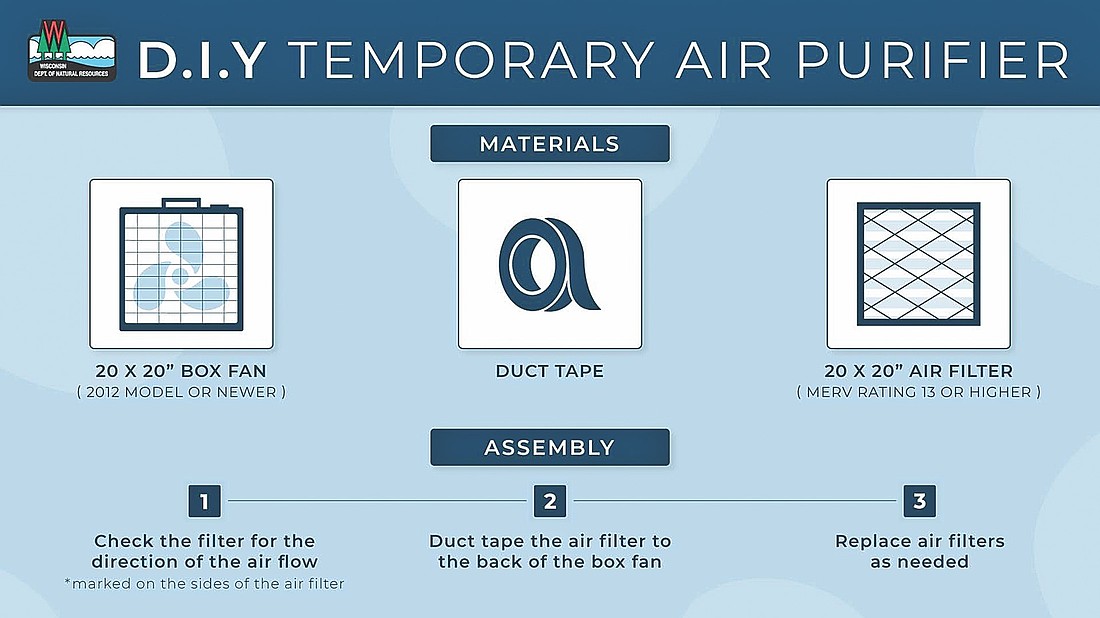
If indoor air quality feels affected by the wildfires, Holmstad refers individuals to the Department of Natural Resources website, which features instructions for building a DIY air purifier using a box fan and air conditioner filters.
If people are going to spend time outdoors during poor conditions, Holmstad said morning hours tend to be better.
“As the atmosphere warms up during the day it traps in gasses and particulates, whereas when it cools off at night it recirculates through the atmosphere,” she said. “In the early morning it doesn’t look so bad, unless the air quality is very poor all week.”
For more information on AQI levels, forecasts and respiratory health, visit: www.airnow.gov.
Michael Strasburg may be reached at [email protected].
Activity Guide
Under the Air Quality Index (AQI) Code Orange (levels 101-150), groups that are sensitive to the pollution should limit exposure by reducing prolonged or heavy exertion outdoors.
If AQI levels raise to a Code Red (151-200), the Code Orange advice applies to everyone, while members of sensitive groups should avoid long or intense outdoor activities and consider rescheduling or moving activities indoors.
If AQI levels raise to a Code Purple (201-300), the Code Red advice applies to everyone, while members of sensitive groups should avoid all physical activity outdoors.
Sensitive groups: people with heart or lung disease, older adults, children and teenagers and pregnant women. People with asthma should follow their asthma action plan and keep quick relief medicine handy. For people with heart disease, symptoms such as palpitations, shortness of breath or unusual fatigue may indicate a serious problem and they should contact a health care provider.

Comments:
You must login to comment.