August 12, 2025 at 5:55 a.m.
Crescent plan commission delves further into zoning for town
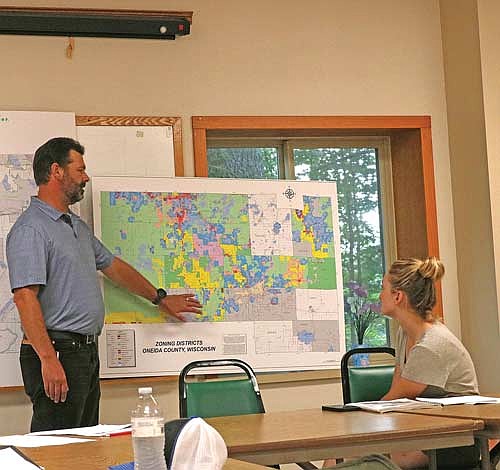
Scott Ridderbusch from Oneida County zoning came to talk to the town of Crescent plan commission last week at their regular monthly meeting. Currently, most of the town is zoned general use. This generalized designation allows for any allowable use within the county, something that has been of concern to many residents who wish to have firmer protections for some of their land within the township.
With that in mind, the plan commission had asked the county zoning department to have a representative attend a meeting to help the committee members better understand zoning and the different uses allowed under each designation. Ridderbusch appeared to help explain the use designations in the county and to answer further questions the plan commission might have.
Ridderbusch said Oneida County was one of the first counties in the country to adopt zoning. The forestry district was the start of that within the county. Through the years, he said, towns adopted county zoning. The town of Crescent, in 2007 or 2008, he said, adopted the county’s zoning, with the majority of the town being general use after that time. The town had previously been unzoned, meaning any entity could come in with any sort of business, enterprise or other use with little to no recourse to halt that development. This had happened in the town of Nokomis, he said, where a large campground had wanted to build, although the town was not happy about it, the entity met the criteria of having 20 acres and 500 feet of lake frontage and, because the town was zoned as general use, it was an allowable use, meaning there was nothing the town could do to block the conditional use permit for which the campground applied.
This caused Nokomis to start to think about changing their zoning, as well. This also necessitated a change to the town’s comprehensive use plan. The same would be the case for the town of Crescent.
The general use designation is now part of the town of Crescent’s comprehensive use plan. If the town would look to re-zone different areas of the town, that would also involve a rewrite of the comprehensive plan. The petition to rezone for a town also includes public meetings, he said, where residents have the ability to weigh in on how their properties would be rezoned.
The committee asked for clarification on what general use meant. Ridderbusch went through the uses allowed under various use classifications, starting with forestry. For instance, he said, Forestry 1A did not allow for full time residence, only seasonal use. Forestry 1B allowed all uses allowed in Forestry 1A, but also allowed for year round residence, with each use building on those below it.
He then turned to single family use, which allows for several different uses, and is the most restrictive residential classification. Permitted uses, administrative review uses and conditional uses are available for each district. This highlights under what type of permit certain uses can take place in a zoning district.
From there, the multi-family use district allows for all uses under a single-family district, but then also adds additional uses in each permit type. Residential and farming use districts then piggy back on multi-family district uses, adding more in each category.
With each district, certain uses are added, he said. This culminates in the general use district designation. This makes general use the least restrictive district designation. Ridderbusch said the zoning department had tried to keep up with technology by adding uses as they come to light, such as the installation of a solar panel field. Article II of the county’s Chapter 9, he said, dealt with all of the uses allowed under each permit type for each district designation.
“So, what would it take for us, looking at the map there, to go from all gray to more green?” asked town board member Mike Pazdernik, meaning to rezone parts of the town to something other than general use.
The zoning document, Ridderbusch said, identified each 40-acre government lot and its district designation. In a petition to re-zone, the town would need to look at what use would be appropriate for that parcel, coming up with a designation for each 40 acre parcel. The issue with that would be if there were smaller lots and a resident or residents did not agree to the rezone to the designated district. In some cases in the past, certain parcels had been carved out, but that was not how the county wanted to do things. The town, for the most part, would need to get buy-in on use designations for 40-acre parcels.
“Any rezone petition is a lengthy process,” was Ridderbusch’s short answer, pointing to all of the criteria of designations, public meetings and the redrafting of the comprehensive land use plan to match the new zoning districts.
Committee member David Holperin provided the plan commission with a few pages of the Pine Lake zoning district designations as well as all of the district designations for Crescent. In Pine Lake, he pointed out, there were many more district designations. The plan commission, he said, or some other committee appointed by the town board, could go through each section and line by line, look at the district designation and decide on the best use designation for that parcel, removing it from the general use category to something more appropriate. From there, he said, meetings could be held where the public could give their input.
Pazdernik asked about shoreland zoning. Ridderbusch said shoreland zoning was a different thing altogether. Shoreland zoning applied to construction of a home or land disturbance around a lake. It applied to 1,000 feet around a lake or 300 feet from a river, he said, and the county’s zoning could not be more restrictive than state regulation as set in 2015. Development such as a home built past that mark would fall under the zoning set for that parcel.
The matter was informational only, so no decisions were made at the meeting. However, committee members did thank Ridderbusch for his explanations and said they better understood the work before them, should they move forward to overhaul the zoning designations in the town.
“I don’t think this is a rocket science project,” said town board member Jonathan Jacobson. “It’s tedious for sure.”
Other business
Another matter before the board was a permit application for a business that was to be located at the site of a previous gas station and convenience store on the corner of U.S. Highway 8 and South River Road. Ridderbusch reviewed the application with the plan commission, as there were many questions of the exact nature of the business, business hours and other matters. The permit application, he said, had been revised, as others had said the application was too lengthy. Plan commission members felt there was a lot of information they would like to have, which could have been answered by the potential retail store owner, who was not present at the meeting. Ultimately, however, the permit application was voted 4-1 to be sent to the full town board.
Committee member Niina Baum also spoke about the possible website revisions, which was a topic at the last plan commission meeting as well. The idea was to revamp the website to include a more interactive map of recreational use areas, points of interest and historical markers within the town. She said she would continue to work on this, as she had had difficulty setting a date to talk with the current web host provider. Baum said she would have more information at the next plan commission meeting. That meeting is scheduled for 7 p.m. on Wednesday, Sept. 3.
Beckie Gaskill may be reached via email at [email protected].


Comments:
You must login to comment.