August 30, 2024 at 5:45 a.m.
Meeting on Lac du Flambeau road issue draws large crowd to Woodruff
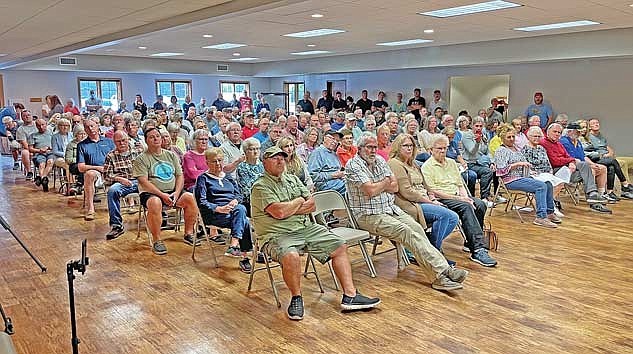
On Aug. 23, the Lac du Flambeau town board took another shot at asking elected officials at the state and federal level for help in resolving its dispute with the Lac du Flambeau Band of Lake Superior Chippewa Indians over expired road easements.
The expired easements at the center of the controversy are on tribal land on Annie Sunn Lane, Center Sugarbush Lane, East Ross Allen Lake Lane and Elsie Lake Lane.
The tribal council is seeking nearly $10 million from the town to resolve the issue.
Town chairman Matt Gaulke set up the meeting and invited the tribal council, Gov. Tony Evers, U.S. Senators Tammy Baldwin and Ron Johnson, state Sen. Mary Felzkowski, state Rep. Rob Swearingen, Congressman Tom Tiffany and representatives with the Board of Commissioners of Public Lands, the Department of the Interior and the Bureau of Indian Affairs (BIA).
Swearingen, Felzkowski and Tiffany were in attendance while Baldwin and Johnson were represented by members of their respective staffs.
Also at the meeting was Tom Germain, executive secretary of the Wisconsin Bureau of Public Lands (BCPL).
During his brief presentation to provide some background, Germain explained some of the 75,000 acres the BCPL has “is this area” and that he’d been contacted by Lac du Flambeau town attorney Greg Harrold as the road issue was “heating up” and there were inquiries regarding land for the tribe.
“He said ‘If the tribe is interested in land in this area, would it be possible?’” Germain said. “I said ‘Some of our lands we’re holding for timber production. Do we want to sell those? Not particularly.’ But we understand how serious the problem is here and we want to make sure we’re playing our part to help resolve things.”
He said what the BCPL couldn’t do was give land away, as the entity is a trust fund manager.
“All of our trust assets are dedicated to producing for our ... public education beneficiaries,” Germain said, adding that BCPL land could be sold. “We’d have to have it appraised and sold at appraised value.”
At this point, there are no “parcel or parcels” of land that have been identified, he added.
“But like I told attorney Harrold, if some type of agreement comes up between the town and the tribe and the title companies ... we’re interested in playing our part there,” Germain said. His remarks received a round of applause.
He asked if anyone had any questions but Gaulke said the meeting agenda didn’t include public comment and if anyone had any questions for Germain, he indicated they would have to ask him outside the meeting.
That’s when the meeting got contentious as former tribal chairman and current Vilas County supervisor Tom Maulson stood up and spoke from the audience.
‘We’ve gotta talk’
“I got a question,” Maulson said.
“We’re not taking questions at this time,” Gaulke told him. “I don’t have public comment on the agenda, Tom.”
He continued to try and explain but Maulson would have none of it.
“Let us talk,” he told Gaulke. “There are tribal members here, from Lac du Flambeau. I’m a former chairman. I went through this. If you want to drag me out, go ahead.”
Gaulke tried to regain control while Maulson continued to try to say what he wanted to say.
“Talkin’ to these here gentlemen that say they’re controlling the land,” he said. “They don’t have control of our lands on the reservation. What makes you think you have that? We’ve gotta talk. People gotta talk and that’s where it is. I think we’ve got tribal members here. I’m here because I’m interested. I’ve been through this.”
Maulson aimed his next comment at Germain.
“Like I said, you said you can’t give land away,” he said. “That was our land years ago, way before all of us who are here. You all ... somebody stole it from us.”
Sitting behind Maulson was Lac du Flambeau resident John Bernard, who rose to speak.
“Are you going to let him talk or aren’t we going to have a perfect meeting here?” he asked Gaulke.
“No!” Gaulke responded.
Maulson turned to Bernard and told him to sit down.
“Come on,” Gaulke said. “We’re done. Tom!”
“You sit down, Tom!” Bernard yelled at Maulson.
Maulson told Bernard to sit down again.
“Tom!” Gaulke yelled.
“No!” Maulson yelled back.
“Otherwise, I will have to ask the police to remove you,” Gaulke said. “This is a town board meeting. We can talk some other time.”
“This is in Woodruff!” Maulson said.
“We used this venue because it’s bigger,” Gaulke said.
“We don’t wanna talk anymore, Matt,” Maulson said. “That’s your job. You’ve gotta talk with us.”
“We’re trying to do that, Tom,” Gaulke said. “That’s enough. Now, let us continue with our meeting.”
“You work for your people and we work for our people,” Maulson said.
He took his seat and the rest of the meeting was peaceful although while the exchange was happening, Woodruff police officers were notified and two stood at the back of the meeting room.
When Harrold spoke, he said a title insurance company involved in the matter had agreed to pay the $50,000 payment to the tribe for an access permit for the Aug. 12 to Sept. 12 time frame. Gaulke made an announcement at a previous town board meeting the town wouldn’t be making the payment as there was no money to do so.
In response, tribal chairman John Johnson, Sr. sent a letter notifying the town that if no payment was received by the end of the day on Aug. 23, access to the four roads would again be restricted.
Gaulke later read four questions that would be submitted to the lawmakers and asked that the town receive responses in the next two weeks:
1. Would you support legislation to facilitate the transfer of land to the town as part of the dispute settlement that would eventually conveyed to the tribe?
2. Would you support legislation for appropriations of monetary value to assist the town in a settlement with the tribe?
3. Would you be able to facilitate law enforcement intervention or an injunction to ensure the barricades (on the roads) are not erected until a resolution is reached?
4. Would you commit a written response in two weeks regarding these issues especially of the defined piece of land or defined monetary value was confirmed?
No extortion
Tiffany said he would get responses to the questions in writing to the town within the requested two weeks.
He also said he’s been “very disappointed” with the BIA.
“These roads, which are titled ‘Indian reservation roads,’” Tiffany said. “Those are public monies that go into those roads. They should not, I believe, they cannot, be legally barricaded under federal law because whenever there’s federal funds that are used for something like this, they cannot be closed off in such a way. So, I believe what happened there was illegal, the Bureau of Indian Affairs was not helpful in regards to it.”
He also mentioned what he referred to as the “Biden-Harris” Department of Justice (DOJ) “coming down against the town.”
That was a reference to a lawsuit filed against the town by the DOJ in connection with the road issue.
“It has made the town’s position very difficult to be able to advance,” Tiffany said, adding that he’s also disappointed that attempts at mediation, which have bipartisan support including that of Evers, have failed.
“Let’s get to the table and negotiate this,” Tiffany said. “The tribal council has not accepted mediation.”
He said he needs to “see details” regarding possible land possibilities.
“I will not simply stand for extortion and allow this to happen,” Tiffany said, a comment that was met with applause. “I would hope that we would get an agreement but it has to be reasonable.”
Swearingen and Felzkowski each said they’ve remained on top of the issue and represent both tribal and non-tribal members.
Despite the absence of Evers or anyone from his staff at the meeting, Felzkowski complimented his efforts to meet with tribe on the matter but also said with $290 million in federal funding still available to the state through the American Rescue Plan Act (ARPA), Evers “could end this tomorrow.”
Lac du Flambeau town supervisor Bob Hanson echoed Swearingen and Felzkowski by saying he and Gaulke as members of the town board represent the tribe as well as town residents.
“A majority of the population, a majority of the electorate, in the town of Lac du Flambeau, is native people,” he said. “So, we are kind of in the position of fighting against ourselves. We have people who we represent who are suing the town and in a sense, they’re suing themselves. It’s a peculiar situation in every corner.”
Hanson said he was “disappointed” the Woodruff town hall was “being used as a political platform” for the meeting.
“I think we need to stick to the issues at hand here and not try to make political points,” he said. His comments were also met with applause.
Gaulke, who was born and raised in Lac du Flambeau, closed out the meeting on a personal note.
“I, for one, have had a very difficult time with this whole situation,” he said. “A lot of the people we’re dealing with both with the town and the tribal council, I was in grade school with. I was in high school with. I consider them friends of mine and for this issue to tear this community apart the way that it has, really hurts me personally.”
Brian Jopek may be reached via email at [email protected].

Comments:
You must login to comment.