December 15, 2017 at 4:32 p.m.
DOT outlines options for intersection
Officials say  roundabout design would be about $1 million cheaper
DOT outlines options for intersection
Work on the reconstruction is scheduled to begin in the spring of 2019.
Representatives from the Wisconsin Department of Transportation (WisDOT) and Ayres Associates, the engineering firm designing the project, spent approximately 90 minutes explaining the project, answering questions and listening to feedback from those in attendance.
The biggest takeaway from the session is that the estimated cost for a redesigned intersection with traffic signals would be between $3 million to $3.6 million where a roundabout would cost from $2 million to $2.5 million.
The Department of Transportation will not make a final decision on the fate of the intersection until February and is actively seeking public input.
According to Andy Dana of Ayres Associates, the DOT identified several reasons the intersection needs to be reconstructed.
"One of the primary needs is the pavement is in bad shape," Dana said. "There are potholes, large cracks and joints are starting to wear out. Just from a pavement standpoint, this really needs to be done."
Dana also said there have been several right angle or "T-bone" crashes at the intersection as well as concerns about right-hand turns at the intersection.
"The merge there is quite short and there have been a few rear-end crashes at this location and there have been concerns about near misses," he said.
From 2012 to 2016 there were 39 crashes with one fatality in the intersection, he said. The pattern of these accidents shows that when people are making left-hand turns at the intersection, they can't see traffic coming from right angles to them, and they pull out in front of the oncoming vehicles.
"Any way you look at it, that is where we have had a lot of injury crashes," Dana said. "They (T-bones) are the hardest hitting of all the accidents."
The other concern is motorists using the free flow right-turn lanes who can't see oncoming traffic often rush into their intended lane of traffic and are forced to slam on their brakes or are either rear-ended or sideswiped.
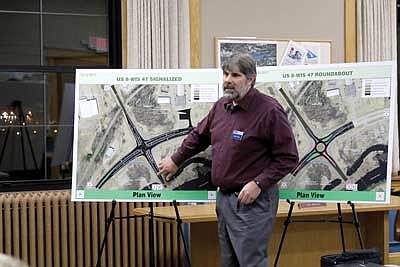
The options for the reconstructed intersection include a modified intersection with traffic signals, but with improved sight lines for both right-hand and left-hand turns, or a roundabout. If the signaled design is chosen, it will include longer turn bays and merge lanes while the free flow right-turn lanes will be eliminated.
Dana said the reconfigured turn bays would provide a better view of oncoming traffic for motorists turning left.
The removal of the free flow right turns would result in a channelized turn lane that is adjacent to the intersection, he added.
"It does a couple things," Dana said. "One, it slows people down. The other thing is when they come up, they have better visibility. Because when you think about it, when you're coming in, you have to look way over your shoulder to see if anyone is coming when you are going through one of those free flow right turns. If you are going through the channelized (turn lane), you're looking up more at a 90 (degree angle). So it's a lot more comfortable, a lot easier to see if someone is coming in."
In order to extend the turn bays back from the intersection, some driveways will need to be relocated and the median will need to be extended, he noted.
Because there are bridges on Highway 47 on either side of the intersection, the turn bays there can't be extended as far as would be ideal, Dana added. This will have a few negative drawbacks on the signalized design.
"The main one is we're not going to have as much acceleration space when someone comes in here and wants to turn," he said.
According to Dana, another consequence will be traffic could start backing up in the turn bays and getting into the free lanes. He later clarified that this wouldn't be a problem now but could develop in the future.
Another problem he mentioned was that people occasionally hit signal poles.
"In the last five years, there have been seven hits of signals where they have had to go through and do some work on them," he said.
Dana said the roundabout option would cut down on accidents by minimizing the number of conflict points where they could occur. There are 40 conflict points in a signalized intersection as opposed to 10 in a roundabout. He added that the collisions in a roundabout would more likely be sideswipe-type accidents rather than the more serious T-bone crashes.
"The roundabout also does two things to increase the efficiency of the intersection. When there is a red light, you have to stop whether there is somebody there or not. With the roundabout, traffic continues through," Dana said. "With the roundabout, there won't be traffic signal maintenance."
The roundabout would cost significantly less to build because there wouldn't be as many access modifications needed. The state could also forego repaving the longer approaches or installing concrete medians if the roundabout option is chosen. There is also cost savings in not having to install and maintain the signals and their associated wiring.
Dana noted that one thing that is considered when redesigning an intersection is traffic operations.
"When we look at traffic operations, what we look at is level of service, it's kind of a report card," he said. "If you remember from back in school where you had A-F, well we have A-F but we included E. Both intersections are pretty good, the roundabout is a little bit better."
A computer simulation of the intersection showing traffic flow through both configurations demonstrated they would be able to handle the present traffic level and anticipated increases in the future.
In either option, Dana said the grade of the intersection would have to be raised to allow for better water drainage under the pavement.
WisDOT will make the final decision by February, with permitting documents to be filed with state and federal environmental regulators by the end of March. The final plan will be completed in the summer of 2018 and construction will take place in 2019.
During the question- and-answer session, someone asked how many roundabouts are in the state and how many of those are on highway intersections like the one in Rhinelander. According to the WisDOT website, of the 383 roundabouts in the state, 220 are on the state trunk system and 163 are on local highways since the first one was built in 2004.
An attendee also asked if there have been any fatalities in a roundabout in Wisconsin. WisDOT project manager Dan Erva said none have occurred.
"There are geometric elements that slow the driver down as they approach the roundabout," Erva said. "There are crashes that do occur with a roundabout, but they are sideswipe and those type of crashes."
Erva said the fact that drivers have to reduce their speed as they approach and enter is the biggest safety benefit to roundabouts. When a roundabouts first opens there tends to be some fender benders, but those typically decrease as drivers get accustomed to using them, he added.
"That's the trade off, the minor property damage-type crashes versus the fatalities," he said.
The proposed design for the Rhinelander roundabout is a single lane as opposed to a multi-lane, which tend to be used on higher traffic intersections and do have an increased number of sideswipe collisions.
"Here you have only one lane entering and one lane circulating, so it's really simple," Erva said. "And if there is nobody there, you can just go right through. When you get to a multi-lane and you have multiple streams of traffic coming in, it tends to be a little more complicated."
If the roundabout design is selected, Erva said WisDOT would offer additional public meetings that would be more educational in nature. The department has brochures that explain how to drive in roundabouts and that information is also available on its website, he added.
"I actually work at the highway department, so I actually get to hear some of those crashes," said one audience member.
He agreed that the best way to make the intersection safer is to slow the traffic down.
Some drivers are distracted by cellphones and other things and in the morning people rush to beat the light and this complicates matters for highway department workers driving big trucks trying to access Kemp Street, he added.
"Whatever you build there, you've got to slow the traffic down before it gets there," the man said.
If the signalized design is chosen, and the posted speed limit is 25 or 45 "people are going to drive how they feel along that road" unless law enforcement is stepped up, Erva responded.
"It's pretty wide open, right? So they are going to continue to drive the same speed," Erva said. "Roundabouts are really the one way you can truly slow down every driver who is going through that intersection. This is designed so that if you are going through the intersection, you're going between 15 and 25 miles an hour."
He added that roundabouts in rural, high speed intersections have the most impact on safety. He said Wisconsin is one of the leaders nationwide in the use of roundabouts.
"The rest of the Unites States is just now catching up," he said.
Another concern that was raised with the roundabout was whether they can accommodate large vehicles such as logging trucks.
"Every one of these entries is designed to accommodate the large logging trucks," Erva said.
Even the longer tractor-trailer combos can safely negotiate the design, he noted. This is accomplished by the use of a mountable ring of pavement that trucks, busses and vehicles towing campers can easily get onto as part of the center island design. This ring is 4 inches higher than the road surface and has sloped curbs that allow it to be safely accessed, if needed, without causing vehicles to tip or become stuck.
The median on Highway 8 approaching the roundabout from the east also features this design so that really large vehicles with escort vehicles can turn short of the roundabout with the escorts blocking oncoming traffic. So even a house could be moved through the roundabout safely.
Of the people in attendance who spoke, all made positive comments about the roundabout design. Most said they have had experience with roundabouts in other parts of the state.
"I wish we had this group at all our presentations," Erva said.
It was repeatedly stressed by both Dana and Erva that public input would play a part in whichever design is selected.
"At this point, we're looking at both of them still," Dana said.
People wishing to weigh in on either of the intersections design may do so online through Dec. 30. Go to the department's website http://wisconsindot.gov.
Click on the "projects by region" link under key department initiatives and select northcentral region and then select the intersection project.
Comments:
You must login to comment.