September 5, 2015 at 9:41 a.m.
The trip of a lifetime
Hodags vs. the World players, parents and coaches reflect on England trip
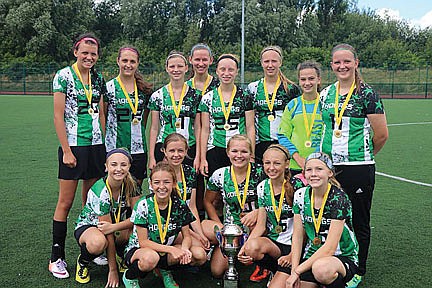
The trip of a lifetime
The Hodags vs. the World girls' soccer group toured England for a better part of a fortnight. Along the way it played four games, saw some of the most hallowed ground in soccer, got a taste of life in the city, created new friendships and strengthened existing ones.
"You know it started with a friendship," said the group's coach, Chris Frederickson, referring to a connection with a physical education teacher from England who spent a summer in Rhinelander coaching soccer that helped propel the group on its journey. "But then also among the group we grew deeper too because when you spend that much time together, there's needs and necessities and other things that you have to fill in for each other. Then you're experiencing really, really, really neat things together. You get to witness them together."
Frederickson coached along side his wife, Kim, who too came back from the trip with a different perspective.
"For me on the sideline, it was a simply amazing experience to watch all the girls and all the team went through - from seeing their pen pals in person for the first time to training with the Everton coach and watching that take place and their movement throughout all of that, to playing the game, even against their pen pals, playing the game and then attending games - it was an amazing experience I think all the way around," she said. "Stronger bond, I think, between the girls and even the parents and the chaperones with people that went there was a definite bond there that will definitely be continued."
"It was definitely something that's unforgettable, something that we all shared together," said Gwen Frederickson - Chris and Kim's daughter and one of the members of the 13-player roster. "I can't really imagine sharing it with anybody else."
Soccer: English vs. American
There were several unknowns for the team before leaving on the trip. Chief among them, at least in terms of competition, was how would a group of 12 teenage girls from Rhinelander, plus one from Milwaukee, would fare against girls from schools in England, where soccer is as much a part of the culture as 4 p.m. tea and fish and chips.
One thing the Hodags found out right away: the Brits aren't dainty when it comes to playing soccer.
"More physical, a lot more physical actually," said Brooke Mork, one of the players on the team. "They were good teams, tough."
"Definitely interesting," Gwen Frederickson said of the contrasting the styles of the Americans and the Brits. "Like the atmosphere and the different kinds of fields. They have much better fields than we have and they definitely play a different style. Over here we play more on the ground and a lot of passes on the ground and they like to play up in the air, passes in the air."
The Hodags went 2-2 on their trip, defeating Wright Robinson University twice and losing to Manchester Communication Academy and Loass FC in London. Chris Frederickson said the Hodags had the edge in pure physical ability while their British opponents were more technically sound.
"You watched some of their skills and you thought, 'Oh no, they're going to beat us,'" he said. "And then you watched some of their athleticism when they were warming up and, just as a coach I thought we might be able to run right around them. When you combined the two - because it's a cerebral game - they were just really close matchups. It was fun seeing the contrasting style match up."
Wright Robinson was the team the Hodags most connected with. Prior to the trip, the girls established pen pals with members of the team. Wright Robinson created the Anglo-American Cup, a trophy for the sides' second meeting, won 4-0 by the Hodags.
Though the U.S. Women's National Team claimed the Women's World Cup in June, taking away a soccer trophy from English soil was quite an accomplishment.
"We took the cup. Ray and Wayne were their coaches. I actually didn't know how gracious they were going to be at first when we won," Chris Frederickson said.
"They did not like to lose," Kim Frederickson interjected.
"In England they like their football and they were actually worried about their headmaster because the headmaster was vacationing in Australia, but he said, 'We have to be able to win.' They didn't win, so now they had to explain to him why they didn't win," Chris Frederickson added.
Making friends
Though rivals on the pitch, the girls from Rhinelander and Manchester's Wright Robinson hit it off immediately. The groups exchanged jerseys, celebrated birthdays together and played games such as dodgeball and bubbleball in the school's gymnasium.
"Against Wright Robbie it was really fun because we interacted and different things after our games," Brooke Mork said. "We had pen pals from there, so we were talking to them before and after - still am talking to them."
Mork's mother, Jenny, was one of the chaperones for the trip. She said, aside from the thousands of miles separating their addresses, there really was not much different about the groups.
"It was neat to see teenage girls are the same there as here," she said. "They talk about the same little things. They giggle the same way. That was pretty amazing to watch them interact like that. After the game they all got together like they'd been friends forever. There was no continental divide at all. That was pretty amazing to watch and see."
"Their hospitality is second to none," Chris Frederickson added. "We were welcomed a ton by their culture, the people that embraced us. I know my daughter's pen pal and their parents and us really got along well. I don't think we'd have a problem exchanging our daughters for even weeks at a time, if that was the case, just because that concern and care was there. The human spirit is alive and well and that's kind of cool."
Bridging the gap
Inside the Football Museum in Manchester sits an exhibit on the women's game. Prominent in the display is a picture of a women's team during the World War I era overlayed by a quote from the Football Association's (the sanctioning body for English soccer) minutes during a 1921 meeting that states, "...the game of football is quite unsuitable for females and ought not to be encouraged."
Though sentiments have changed greatly in the near century since that line was penned, disparity is still apparent between men's and women's soccer in England.
"The difference being that having a female team there instead of a male team is even training - and I think the girls got to see it even at the pro level - it's different," Chris Frederickson said. "There's definitely an issue of gender equity that we gain from here. The BBC recorded us one day and they talked about gender equity and us coming over there to play."
"You could definitely tell that their women's sports aren't where to we are, equality-wise," Jenny Mork said. "I could definitely tell that. Even when we playing the different teams, the parents weren't there watching. It was more like a school function type of things versus I think in the United States you get a lot of that (parental) backing at every age."
The Hodags group helped to try to change that between the games and a training session it had its first full day in Manchester with Abbey Hey Academy.
"When we helped Abbey Hey out those little girls had the American flags that we gave them," Brooke Mork said. "They were waving to us when we were leaving. That was really cute. They came and watched us a Wright Robbie and that was really fun."
The success of the English Women's National Team, which took third in the Women's World Cup this summer, has helped to bridge that gap, as evidenced when the team toured the facilties at Manchester City.
"(Our tour guide) looked at me and said, 'We took notice of the fact that the World Cup was watched by more people than anybody else, and it was women's soccer,'" Frederickson said. "They understand that the shift of equality is happening and making that move appropriately or in advance."
Landmarks of the game
Imagine an international fan of American football coming to the U.S. and touring Lambeau Field and Solider Field. That's what it was like for the Hodags as they visited the homes of some of the more famous clubs in English soccer. The group tour Old Trafford, the home of Manchester United; The Etihad Stadium, home of Man U's cross-town rivals Manchester City and visited the grounds of Everton, another Premier League team based outside Liverpool.
"It was pretty inspiring to think that we got to tour that and that could be us one day, training there or playing on those fields," Gwen Frederickson said.
"The training (at Everton), that was really fun," Brooke Mork added. "A lot of cool drills, we were all laughing and having a good time, but training at the same time. Looking at Manchester United's stadium was really cool experience and then Man City was pretty cool just looking at everything."
Not only did the group train with the Everton ladies, they watch a training session for Manchester City's ladies' club. Jenny Mork said the difference in training at that level was apparent.
"When we were watching the professional girls that played in Canada (in the Women's World Cup) it was really interesting and I pulled (Brooke) aside and I'm like, 'What do you think? Could you do this every day?' Because every drill they're 110 percent," she said. "There's no hands on the hips. It's total focus on what the coaches are saying. It was pretty phenomenal to see that in action at the next level."
Best memories
There was so much packed into 12 days, it was hard for those we talked to, to pick one favorite memory.
"First meeting my pen pal," Gwen Frederickson picked as her favorite moment. "The first actual (experience) talking to her. It was weird because you expect them to be different. Like I expected my pen pal to be really tall, but she was actually my height, which is quite short. It was interesting."
"Probably looking at the old buildings, that was really fun," Brooke Mork said. "Just seeing all the old stuff inside and actually walking into place you see on TV."
"Two things for me," Kim Frederickson said. "One was just watching my daughter and all the girls I've spent a lot of a time with since they were 8 and 9 embracing a new culture and just watching them take that all in. That was big for me. Then the other one was being told I have a beautiful accent."
It took a lot to get the group to England. It started last fall as a dream which quickly grew into a slew of fundraisers and events. The group raised more than $30,000 to fund their trip. The journey to get to England was the reward for Chris Frederickson.
"I think my favorite part was sharing how we got there with both Wright Robinson and with Manchester Communication Academy," he said. "... When we stopped to share how we got there, the commonality is people really don't think big until they're given that opportunity to think big. When we stopped after the first game of the two with Wright Robbie, it was just on the sidewalk before we got on the bus and I stopped them and I said, 'If you guys want to come and play over here, we'll make sure it happens.' They kind of gave you this quizzical look and I said, 'Honestly this started because of one friendship and now we have 19-20 friends. How much more can we do?' When people think together and work together and support each other, really there is no limits to what you do. It is our next - challenging them to have their own next no matter what it is. It's pretty empowering, the human spirit of supporting each other is still alive and well. To me, that was fabulous."
What's next?
Through the entire process Chris Frederickson's mantra in terms of goal-setting has been meet, exceed, next.
"They met it just by showing up," he said of the team's goals. "They exceeded it when we walked five miles and still played a game (against Loass). They exceeded it when they won the cup. They exceeded it when we did tons of things there that kind of left me baffled. Now what their next is, is the challenge of knowing what else to place. I posted (on Facebook) the other day about the transition from coach to fan. Now I'm their biggest fan. To tell you the truth, that gives me great joy. I'm no longer responsible and I also know they will embrace their next. It's not anything that you have to worry about challenging themselves. They'll grab it and embrace it. It will be fun to watch that."
So what's next? That depends on who you ask.
For Gwen Frederickson, next is taking strides to improve herself as a player.
"To make varsity (for girls' soccer) this year as a freshman," she said. "That would be cool. To get some amazing camps maybe for myself, maybe bring some teammates with me."
For Brooke Mork, it's the hope of one day returning to the land that created a lifetime's worth of memories.
"I kind of want to go back to Liverpool again because we didn't get a lot of time to spend there and it was just fun shopping and everything in the little time we had there," she said.
Chris Frederickson said he has loftier goals.
"I think our next is to keep challenging, keep looking for more nexts," he said. "I think we'd like to run a fundraiser. One of the last days we were there we went through the slavery museum and it was powerful because slavery's still happening, which you wouldn't think so. I thought I was pretty disconnected from that issue and when I looked at it, it was pretty impressive. I thought we've proven we can raise funs, let's do it one more time for some good, something really valuable too, to teach girls that part of giving back. I think they learned the giving back part of it, but at the same time, send it home. There's things we can do and we can make a difference."
Talks are already in the works to host should one of the teams the Hodags played on their trip come up with the funding to come to Rhinelander next summer.
"The next probably will be bring Wright Robbie here, helping them see their dream out and what a Northwoods experience is like. We always worry that it doesn't match up to what they have over there," Frederickson said. "We can't match a 2.5 million-person city, you know, but what we can do is give them our fish and chips - which is different than theirs - get them kayaking, take them to a beach, see some wildlife, experience what the Northwoods has."
Jeremy Mayo may be reached at [email protected].
Comments:
You must login to comment.