October 2, 2015 at 2:08 p.m.
Plaid Clad Rambler
Ingredients for consistent grouping
Plaid Clad Rambler
By the time I graduated college, I had deafening tinnitus, 20 extra pounds around my middle and an inability to multitask. It hasn't been so bad. I am now a better listener, I live a simplified life, and I'm a better archer.
Allow me to explain for those of you wondering why being bad at multitasking has made me a better archer.
I grew up a gun hunter. My first rifle was a 12-gauge pump, my second was a .30-06 pump and my third was a lever-action Marlin .22LR. It's a southpaw arsenal.
I grew up deer and squirrel hunting in Waushara county. As I have mentioned before in this space, I was a wildly unsuccessful deer hunter (cursed, one might say). But it isn't too difficult to drop bushy-tails out of the treetops with a 12-gauge. There is no finesse involved in hunting squirrels with a 12-gauge. Success only requires that one's barrel is pointed in the general direction of a squirrel-bearing tree when the trigger is squeezed.
Archery has had a steeper learning curve in my experience. Everything from foot placement to head angle needs to be identical arrow after arrow after arrow. The bow hand needs to be relaxed with the grip anchored in the base of the palm. The bow arm needs to be extended, but not hyperextended. The bow arm shoulder needs to be low. The drawing elbow needs to be on the same plane as the arrow. The draw has to engage the correct back muscles. The back needs to be straight, not hunched or exaggerated. Drawing hand anchor points on the face need to be consistent. And then, finally, you get to look through your sight.
I missed a buck last year. It was inexcusable. The buck was maybe 20 yards away, broadside. It was a dream shot. How do you miss a target that big at only 20 yards? You forget one - just one - of the fundamentals of good archery. My bow may not have been level. I may have punched the trigger. I may have been white-knuckling the grip. It could have been anything.
The fact is, I deserved to miss that buck. I hadn't been practicing as much as I could have or should have that summer and my missed shot was the result.
This year, however, I have been shooting at least once a week the whole summer and have seen the fruits of my labor. I have my pins dialed in at 10-yard increments from 20 to 50 yards and I am easily grouping in two inches at 20 yards, three inches at 30, four inches at 40 and five inches at 50.
What does this have to do with being a bad multitasker?
I finally learned that, while I knew all the fundamentals of archery, they had not become second nature. I was still thinking about each element. I was concentrating on my draw cycle. I was focusing on keeping my bow level. I was overanalyzing my anchor points. I was concentrating on keeping my arm steady.
The problem is our brains are wired to focus on one thing at a time. Anyone who has experienced a panic attack knows what it's like to fully feel and know multiple things simultaneously. It's overwhelming, crippling and terrifying. Coping and management techniques help sufferers refocus on one thing at a time.
It was only after a season of practicing for hours a week that I became comfortable enough with my bow to know what it was doing without thinking about it. I don't think about my stance because my body knows how it's supposed to stand. I don't think about my draw cycle because my shoulders know the motion. I don't worry about my anchor point because my jaw takes care of it for me. I don't have trigger anxiety because my knuckle does the same slow squeeze every release. This relieves me to concentrate on the target.
Fundamentally, it has been an exercise in teaching my body the movements and then trusting that it knows what it's going to do. It's like breathing, typing, and riding a bike. If I spend too much time thinking about everything that goes into my draw cycle, my accuracy suffers.
To demonstrate that, I started doing an exercise where I release one arrow at 50 yards, one at 40 yards, one at 30 yards and a final arrow at 20 yards. Theoretically, the shots should become easier as I get closer to the target. But invariably, my worst shots were at 30 and 20 yards. It was so consistent that I thought my pins needed adjusting.
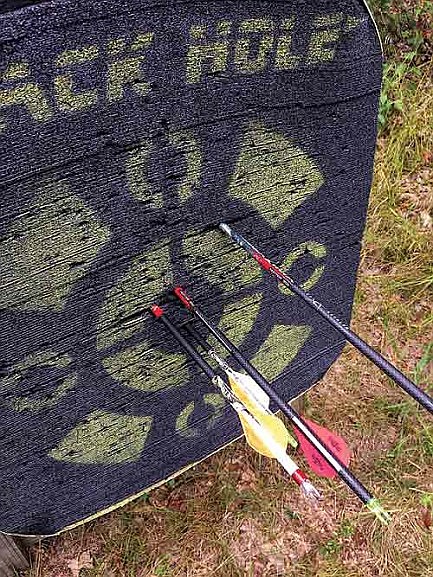
I released four arrows at 30 yards and four at 20 yards and they were grouping just fine. I concluded that my errant arrows at 20 and 30 yards were the result of psychological pressure. I was psyching myself out. I felt the pressure of grouping all four arrows, and I overanalyzed my form. The picture with this week's column is of one such four-arrow set. The three grouped arrows were released at 50 yards, 40 yards and 30 yards. I choked at 20 yards. Go figure.
My recipe
I'm not going to pretend that I have the solution to perfect consistent archery or that any part of my technique is unique. Most of my method has been learned from hours of reading and watching archers like Levi Morgan talk about their method. What I do have, however, are a few pointers for those who, like me, are new to archery and are struggling to obtain consistent grouping.
Remember, this all took weeks of practice and repetition. At the end of the day, consistent practice is the only way to make consistent groupings.
• Breathe - My routine begins before I even raise my bow arm. I start by taking several slow, deep breaths. I quickly learned that taking big breaths once my bow was drawn decimates any stability in my upper body and sends me chasing my pin all over the block. Filling my lungs with oxygen before I draw keeps me steady.
• Position - I position my bow-holding palm before the draw. By having my grip firmly anchored before I'm drawn, I have one fewer element to concern myself with once I'm aiming.
• Balance - Whenever possible, I shoot without my quiver on my bow. Other people may disagree with this method and will convincingly argue that shooting with your quiver attached will make you a better archer in similar shooting situations. That may be, but I would add that this creates unnecessary bow torque unless there is an offset stabilizer on the bow.
• Fuhgeddaboudit - Once drawn, I completely forget about my whole back arm. What this means in practice is that I'm not pulling against the back wall. I know it's unorthodox, but I completely do away with the notion of releasing the arrow with back tension. It makes no sense to me. Releasing with back tension adds an unnecessary variable. Instead, I maintain enough pull to keep it drawn and then I anchor. My trigger is being slowly pulled the moment my pin is on target.
• Focus on fur - What all of this allows me to do is to focus on the only thing that matters: what's behind my pin. If I can only concentrate on one thing at a time, I want that one thing to be my target. I focus on my arrow destination and allow my body to recall the motions practiced hundreds of times this summer. It takes trust just like a skydiver learns to trust that the same thing will happen every time he or she pulls the ripcord.
So far, this method has proven to be downright surgical on the shot block, but only time will tell if it harvests success this season.
Ryan Matthews may be reached at [email protected].

Comments:
You must login to comment.