March 20, 2015 at 1:35 p.m.

An oral history of the '96-'97 RHS basketball team
An oral history of the '96-'97 RHS basketball team

Editor's Note: In conjunction with the 100th anniversary of the WIAA state boys' basketball tournament, the River News has dug through the archives to retell some of the stories that outline the history of high school basketball in Rhinelander. This is the final piece of a three-part series.

Look at it this way, if a few years constitutes a dry spell, the Rhinelander High School boys' basketball program was in the middle of a perennial drought.

It was the fall of 1996 and as the world looked ahead to a new millenium Hodag basketball was still stuck in the days of sock hops and drive-ins.

Rhinelander hadn't made it to the state basketball tournament since 1950, despite seeing some remarkable teams filter in and out of the old gymnasium.

Each year, no matter how stacked the team was and no matter who manned the bench, the Hodags checked out before making it to Madison.

For a community as proud of its basketball as Rhinelander, that didn't sit well. There was even talk of a curse.

The program's most recent favorite to make it to state had come and gone just a year before. The group was flush with talented seniors like Jay Bennett, Curt Johnson, Ryan Monroe, Jason Doering, Jesse Lehman and Jeff Eckert. In to replace them was a large collection of question marks, aside from returning junior Troy Doering.

Out also was coach Jack Bennett who left to take the head coaching gig at the University of Wisconsin-Stevens Point. His replacement in Rhinelander was 27-year-old alumnus Rich Fortier. Couple a rookie coach with an inexperienced roster and the consensus expected a down year.

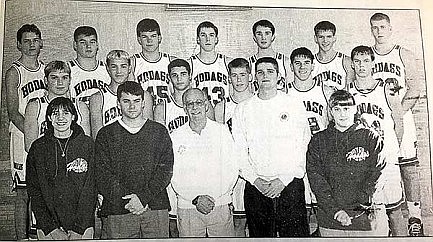
What unfolded over the course of the '96-'97 season, under the most unlikely circumstances, took a band of unknowns and cast them as one of the most significant and memorable squads in program history.

The season began in the fall of '96. With a new coach and retooled roster, no one was sure what to expect.

Chris Makris, senior point guard: The year before was the team that everyone expected break through and get to state. We had a lot of really good players that year and a lot of us hadn't played a lot of varsity basketball because of it. There were so many seniors that year that played, it didn't give a lot of us a ton of opportunity. That team lost to Antigo in the first round of the playoffs.

Teague Orgeman, sophomore guard: We were definitely in flux, because Jack Bennett had just left to take the UW-Stevens Point job. They had a really talented team in '96. I think they got beat in the regional round. It was really up in the air. My impression heading in was we had one starter set with Troy and the rest of it was a complete unknown, especially with Rich coming in. We didn't know what our offense was. We didn't know what our defense was. We had no idea. There was a lot of uncertainty.

Rich Fortier, head coach: I was a young, dumb, punk kid. I was just a young kid who didn't know much about anything. I was only 27 years old. It seems like a lifetime ago now. I knew we had lost a ton of guys off a pretty good team the year before. I don't think there were a whole lot of expectations except that we had the great Troy Doering. He was our ace in the whole all year long.

Troy Doering, junior guard: This was the first time Rich had a head coaching job at the high school level. He came in with a lot of enthusiasm for that opportunity. Rich was much more of a coach that would allow you to find your way throughout a game. Coach Bennett was much more about structured offense. He had a certain way to do things. Rich let us loose.

Orgeman: At the time, (Fortier) was kind of finding his way, just like we were, even with stuff like how to model practices. He designed them off of what he experienced at UW-River Falls, so he ran college-tempo practices. A lot of high school practices have a lot of guys standing around or guys sitting down. We had strict rules right away. No one sits. There was a lot of shuttling around. There was just a lot of movement. He was learning on the job as we were learning. It took us awhile to get our feet under us.

Liam Marlaire, Daily News sportswriter: Right when you saw the team, before the regular season even started, you could tell there was something special there going on, especially with Troy. They worked really well together. You could tell really early on that if they clicked, they had a shot to be really good and go to state.

Makris: Expectations weren't high. We were picked to finish around seventh in the Valley, but we knew we could play. We had qualified for state at Badger State one year. The grades above us and below us were supposed to be the better years, but we had guys who knew how to play and had been together a long time. We felt like that was finally our opportunity. We wanted to earn our stripes and prove them wrong. None of us thought we were going to be the team that broke through though.

Rhinelander opened up the season with a 62-40 loss on their home court at the hands of Stevens Point. It was the first of an up and down campaign, especially early in the season, that left spectators scratching their heads at times.

Fortier: We started off horribly. I still remember we lost our first game 62-40 to Stevens Point and at home no less, so that was the welcome to varsity basketball moment. We got our butts kicked. We slowly built our way up though. It was a couple steps forward and a couple steps back the whole way, which is pretty typical of team that doesn't have a lot of experience. That's what we were. We were a bunch of guys who hadn't played in the rotation before, other than Troy.

Mike Cheslock, senior forward: I remember being very disappointed after that loss. We all knew we were much better than what we had shown. We learned from it, and coach Fortier made sure we didn't panic. We went right back to the drawing board and started to prepare for our next opponent. We chalked up that blowout loss to lack of experience. We made it a goal to continuously improve throughout the season.

Orgeman: I wasn't playing much yet. A lot of my memories from the early parts of that season were from my spot at the end of the bench. We got beat by some really bad teams early on. We got blown out by Point and I remember our low point was when we got beat by a Wausau East team who won no more than four conference games that year, and we got beat at home. There was a constructive but very pointed team meeting after that Wausau East loss. It was one of those "Alright guys, no ideas are bad ideas. What do we do here?" meetings. That was rough. We had some good Rhinelander teams in the few years before that, so we weren't used to losing those games.

The loss to Wausau East came just days after the Hodags made a trip down to Stevens Point and avenged their season opening loss, making the loss to the Lumberjacks even more frustrating. Rhinelander dropped to 4-5 overall and was searching for answers. Next up was Valley leading Antigo.

Orgeman: They were a typical '90s Antigo team. They were big and could shoot. They had a couple of guys in Matt Fermanich and Steve Syrjala who you couldn't give a look to. They were deadeyes. They were ranked in the top 10 in the state and deserved it. The were guard heavy, but a lock down defensive team. They deserved to win the conference that year.

Fortier: (Antigo) whooped us. They really kicked our butts in that first game we played them. In fact, I got a technical that game. It was my first technical as a coach. I was ticked off and I earned it. I knew I was going to get one and I got one. I was mad. They beat us by something like 25 points. We only lost by five at the end of the year when they came to our place.

Cheslock: They were all great players. They also lived and died by the 3. Matt Fermanich was a great all-around player and could shoot the lights out. Steve Syrjala was deadly from 3-point range. Brett Bartletti and Nate Hayes were excellent guards. They even had a big guy named Fred Nieforth who wasn't a scorer but could rebound and block shots underneath. They were extremely talented.

Doering: I played against a lot of those guys growing up. They had Fermanich and Syrjala who were very offensively skilled players. Their coach, John Mielke, had been around for a really long time and he was a great coach. They were fine-tuned to go deep in the playoffs, just like we were the year before. We struggled during the regular season. During that year, there were certainly growing pains, but as the year progressed, we were able to figure out how to build some team chemistry and play with each other. That catapulted us into the playoffs.

Makris: It just took us time to get our feet wet and play in front of the crowds in the Valley. As the year went on and we played people a second time, we felt more comfortable. We knew each other better. We always had the talent. It just took us a little while to figure it out. Those were the old days in the Wisconsin Valley Conference. You were playing the big boys.

Rhinelander finished out the regular season with an 8-8 record in the Valley, 10-10 overall and received a first round bye in the regional tournament. In the regional final, they hosted Green Bay East.

Makris: Coach Bennett was the one that really put us back on the map as a basketball town. One thing that people don't realize about our trip to state is that he fought to get things switched around in the playoffs. Rhinelander didn't have a bye and they didn't have a home game in the playoffs for a number of years, so he fought to get Rhinelander back in the situation where we would get that bye and home game. We were the team that really benefitted from that.

Cheslock: That was our regional game. It was a Saturday afternoon game. The environment was very relaxed. If our season had ended that day, we would've chalked it up as a successful and fun season. That relaxed feeling actually made us play better. It was after that game we knew that we were playing our best basketball at the right time.

Orgeman: Against Green Bay East, Troy fouled out, which was always a problem for us because he was by far our best player. We had a game earlier in the year though against D.C. Everest that we won in overtime after Chris Makris hit a 3. Troy had fouled out before in that game. I remember talking about it in that Green Bay East game and saying, "Alright, we've been here before. We have to play this stretch without Troy, but we can do it."

I remember we ended up hitting a bunch of free throws down the stretch to win it. By that point, we knew we weren't struggling anymore. We were beating some good teams and we had all settled into the really narrow, defined roles we had on the team.

Rhinelander advanced to the sectional semifinal game where Valley champ Antigo was waiting for them. The Hodags were finally clicking on all cylinders though, led by Doering's stellar play They had played the Red Robins close in Rhinelander toward the end of the regular season, so they knew they had a puncher's chance.

Fortier: I remember having the boys over and showing them the tape. I told them, "Guys, we can do this. There's a couple missed box-out here, there's a few missed free throws there. There's some dribble penetration there. That's how close we were to beating these guys the last time." I think we felt like we could compete.

Makris: That was down at Brown County Arena down in Green Bay. I remembered as a kid going down there to watch some of the Hodag teams battle with the Appleton teams and it was the biggest place I had ever seen back then. It was always a dream to play at Brown County Arena.

Orgeman: We were in that nothing-to-lose mentality. It had been a few years since Rhinelander had even been to a sectional. Antigo was definitely better than we were. They had beat us twice already. It was one of those things where the more you play a team, if you're the less talented team, that plays into your hand. They really didn't try to push pace at all either. If you hit some shots, you can stay in the game with them. We were loose going in. No one expected us to win so there was no pressure on us. We played free.

Makris: There was such a big rivalry with Antigo. We had beaten them in football for the Bell that year and that carried over to basketball. There was no fear of them but they knew they were more talented. Troy absolutely went crazy on them. To play our rival at Brown County Arena when they're ranked in the top 10 in the state was one of the most exciting times we could dream of.

Fortier: It was on a neutral floor and we built a lead. It wasn't a big lead, but it was a small, working lead of five or eight points. We zoned them the whole game long and Troy Doering made play after play. We had him lead us to the promised land and beat them. I remember he hit a ton front ends on one-and-ones.

He was fouled repeatedly. He penetrated and they couldn't stop him. They just missed enough shots for us to win. I know the kids were excited about that win, but I don't know that we were surprised. We felt like we could play with them and we did. That was a pretty talented team we beat, but by the end of the year, we were pretty good ourselves and we felt like we belonged. But we still had one more night.

Rhinelander knocked off Antigo in the sectional semifinal 45-42, handing the Robins only their third loss of the season. The Hodags faced Pulaski the very next day, this time with a trip to state on the line. The school's first trip to state in 47 years.

Orgeman: I remember knowing nothing about Pulaski. I don't think we had seen any tape. We really weren't threatened. It was weird. We were used to playing in tight games. It was close in the first half for awhile and then we just ran away with it. We had gone through all that struggle before that. We had pulled off this huge upset over Antigo, who was by far the best team in our sectional. Of course we were going to win. Weirdly enough, although no one expected us to be there, we knew we were going to win that game.

Fortier: They went up 8-0 on us to start the game. Dustin Priebe hit two shots in a row for us to kind of calm us down. I think by halftime we were up by six or seven. At one point, we were up 40-19 and we cruised 49-36. You don't even have to check, I can tell you that's the truth. That night, we played all man. We played zone the first night and man the second night.

Their best player was a guy named Danforth and Troy, who was second team all-state that year, voted by the coaches, got in a scrum at the bottom of a pile. Troy came off and wasn't happy. We calmed him down, but Troy didn't have that great night against Pulaski. We probably saw Troy score 25 or 28 points that first night against Antigo, but I don't think he had more than 10 or 12 that second night against Pulaski. The rest of our guys filled in and did a good job. We played a pretty good Pulaski team that didn't think they were going to lose to us either and we kicked their ass.

Cheslock: It was an amazing feeling. I was not at all prepared for the attention we were getting, but it was still fun. I get a proud feeling whenever I think of our class being the first team in 47 years from Rhinelander to make it to state. There have been two other teams since then to make it, but we were the team that broke the dry spell. We opened the flood gates, so to speak. I am very proud to have been part of that.

Rhinelander punched its ticket to the state tournament, but still had work to do. That meant preparing for an impending matchup with the talented Milwaukee Washington and it was all hands on deck.

Orgeman: Rich had gotten over those first-year coaching jitters by that point and we knew we were going to play a Milwaukee Washington team that was unlike anyone we had played before and was better than us. One thing that's neat about Rhinelander basketball is that the entire community is involved and guys who played in past years still come hang around practice. I remember Rich going and rounding up guys like Jim Flory, Tim Howell and Todd McEldowney, and we'd play five on seven to try to simulate the kind of speed we would see. We knew they'd be quicker, bigger and stronger than we were used to.

Fortier: I remember Bob Hanson, the superintendent, gave me either a half day or a full day off to prepare for Milwaukee Washington. When you get that far in a season, you've done the basketball stuff. You don't have to go out and practice your dribbling and your shooting. We've done that for four months. It's more about keeping yourself focused and in the moment. We didn't know it was coming and Rhinelander didn't know it was coming. It was so new to everyone, no one knew how to handle it. We didn't know to be worried or nervous. We were young and stupid, and that was part of the magic of it all.

Orgeman: The community was great. Everyone was incredibly supportive. There were a lot of guys who lived in town who were on that (1950) team who were really complimentary. We definitely got the sense that we were a part of this long, traditional history.

I have a memory of John Kotz actually coming to a shootaround. We didn't all know exactly who he was, but we learned that he was a great player on the '39 state championship team and was actually credited with creating the one-handed push shot. I remember him just appearing in the bleachers. It was pretty cool. These old timers kind of appeared. It was a neat thing for a bunch of 16-year-olds.

Milwaukee Washington boasted several quality players, most notably Robert Jackson who would later go on to play at Marquette University during the team's run to the Final Four. Rhinelander knew they had their hands full, but their entire run thus far had been improbable. They knew they had a shot and were determined to enjoy the ride.

Fortier: I remember (assistant coach Mike Velis) and I peeing in the urinals at the state tournament and he said to me, "I don't know what the big hype is. So far, this has been pretty easy." I laughed. We were all laughing at what had occurred. We were looking at how far we'd come since the beginning. It went pretty quick.

Marlaire: It was crazy. People really got behind those kids. There were quite a few fans down in Madison and that was nice to see. One of the things was, because of the success Troy and Jason Doering had, people weren't shocked to see them down there. No one every put anything past the Doerings. Rhinelander fully supported that team and we taught Madison what a Hodag was.

Orgeman: I had been going to the state tournament with my family since I was six. I always wanted to get there. It was the last state tournament at the old fieldhouse, which made it kind of surreal. Getting there was not a goal we realistically had in our minds in the start of the season. At the old fieldhouse, you had to walk through the crowd to get to your locker room and I remember it being 20 people deep of people encouraging us.

Makris: Growing up in Wisconsin, all the games are on television. I remember staying home from school and watching those games, thinking how incredible it would be to play there. It was surreal knowing we were going to state. Kids dream of that.

After taking a 14-10 lead after the first quarter, Milwaukee Washington and its star center Jackson, who scored 29 in the game, proved too much for the Hodags. Rhinelander lost 55-43.

Doering: Milwaukee Washington had some athletes and they were definitely more talented. Robert Jackson was the big advantage. I thought we stayed with them for the most part, but just couldn't get it done at the end. Playing in front of that crowd was certainly memorable though and a great experience for Rhinelander.

Orgeman: The '97 team was by far the least talented of the three varsity teams I played on. That's not really a criticism, it's just that the '97 team was defined by something other than talent. We had one outstanding player, Troy Doering, and he was outstanding. I played in the '99 WBCA All-Star Game with a bunch of players who played for Division 1 college programs, and Troy was better than every one of those guys. But the rest of us were role players who committed to doing the one or two specialized things we were each supposed to do.

Fortier: I think we were all too young and inexperienced in the high school basketball world to understand what we had done. Looking back now, I can sincerely appreciate what an achievement that was for our guys. We didn't know any better, but we weren't supposed to be there. No one thought that a team who went 10-10 was going to make it there. We benefited from a lot of different things that broke our way, and of course we had the great Troy Doering who is one of the better Hodags to ever step on that floor.

Marlaire: Troy is, to this day, the best high school athlete I've ever seen in my life. He was a quiet leader and what he did for the football team was really amazing. He carried that right into basketball. They had other good players, but he carried the team on his back. I don't know what he was listed as, but he was a short guy. He was just an amazing all-around athlete. He was quite the leader.

Doering: Anytime you can go to state, it's memorable for sure. It doesn't happen too often. It was an exciting time for us and the city of Rhinelander. Going through the prior year and the deflating loss against Antigo in the first round of the playoffs, beating them was kind of restitution.

Makris:If you ask people to rank the best teams in that 10 to 15 year period, we might be 10th or 15th, so it was an incredible run. Not to take away anything for the teams that made it to state after us. They were really good teams and probably more talented than us, but I'm of the belief that if we hadn't made it to state, none of them would have made it. It's nothing against them. We just kind of overcame that mental block and that hurdle that let the other teams think they could do it too. We made it a realistic goal.

Andy Hildebrand may be reached at [email protected].

Comments:

You must login to comment.

Sign in
RHINELANDER

WEATHER SPONSORED BY

Latest News

Events

April

SU
MO
TU
WE
TH
FR
SA
29
30
31
1
2
3
4
5
6
7
8
9
10
11
26
27
28
29
30
1
2
SUN
MON
TUE
WED
THU
FRI
SAT
SUN MON TUE WED THU FRI SAT
29 30 31 1 2 3 4
5 6 7 8 9 10 11
12 13 14 15 16 17 18
19 20 21 22 23 24 25
26 27 28 29 30 1 2

To Submit an Event Sign in first

Today's Events

No calendar events have been scheduled for today.