September 24, 2014 at 3:21 p.m.
Local group helps fight Ebola crisis in Africa
Local group helps fight Ebola crisis in Africa
Prom made his first trip in 1991 to Zimbabwe. It was there he witnessed firsthand the need to educate the continent's youth.
"Right now, over half the population in Africa is 25 or younger," he said. "Whoever is able to help develop the minds and thinking process of the young people will impact the next generation in Africa. A lot of people aren't doing that, including the churches. I sensed that I had an opportunity because of the time I spent working with teenagers here since 1981, to really impact young people in another part of the world. Doors just started exploding open."
So WILD was founded and Prom and his group started creating contacts in Africa.
"A lot of churches are not connecting with the younger people," he said. "They aren't being developed as potential leaders. We help develop that from a Christian perspective. We've been invited to go to 10 to 12 countries and it's growing. We've never gone into a country where we weren't invited, and we're being invited all the time in all parts of the continent. They're realizing if they don't train and develop their young people, they're going to lose them."
With the deadliest Ebola epidemic in the continent's history currently under way though, Prom said the focus has shifted from leadership to survival.
Close to 3,000 people have already died from the Ebola outbreak and while the World Health Organization said it hopes to contain the outbreak within nine months, the most recent projections claim it could last anywhere from 12 to 18 months and infect hundreds of thousands of people.
Prom said he was in Africa as recently as this summer and at that time the Ebola crisis was barely a blip on the radar. That's how fast it's grown.
"I was in Liberia in the first part of June," he said. "There was already some discussion about small outbreaks here and there, which is not uncommon. It's not unusual for small health crises to develop. It wasn't until I got back that organizations like the World Health Organization started saying that it could be a real epidemic."
As he watched the crisis unfold, Prom knew he had to come up with a way to lend a hand. Fortunately, others within his organization had some knowledge on the subject.
"I started thinking of all the people I work with," he said. "I've been to Liberia a couple times and we're working with people from the Ivory Coast and Sierra Leone. I know those people. They're real. They're like you and me. Our regional director who oversees West Africa is a physician's assistant, so he not only understands the spiritual side of things but the medical side as well."
Ebola is not an airborne disease. It spreads through contact with bodily fluids like blood or vomit. It does survive for some time on surfaces though. Health care workers and family members taking care of the sick are especially vulnerable due to consistent sustained contact with the disease. That's why a clean, decontaminated environment is so important to containing the breakout.
Much like the flu, symptoms manifest themselves about a week after exposure. In just over half of victims, Ebola will take a critical turn, causing people to hemorrhage. They may vomit blood or bleed from their eyes, mouth or even skin. Eventually, blood vessels in the body begin to leak fluid, dropping blood pressure below stable levels, resulting in massive organ failure.
Prom said there's a relatively simple way to combat the disease though.
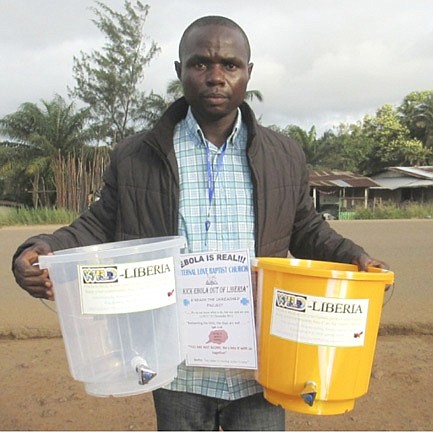
"Six weeks ago, (our regional director) told us the government mandated that there should be a bucket of chlorine in every home," he said. "When you live on less than a dollar a day though, and most of your money goes toward food, that can be pretty tough to afford. Plus, the prices have quadrupled at the same time. We did some research and found that it's a legitimate solution."
It works and instead of gathering the supplies to send to those in need, Prom said the most efficient way is to simply supply funds to those on the ground.
"It's a fairly easy way for people to help out," he said. "Twelve dollars pays for a bucket with a spout on the bottom filled with chlorine. If people want to help out, they should do so financially. They can get the supplies over there, plus it's employment for Africans. You could send all the stuff over there, it would cost a lot more, and it wouldn't employ anyone. But if we send the money, they can certainly make the stuff they need themselves and it's a lot cheaper. If people want to donate through us, they can visit our website, wildleadership.org and donate through Paypal, or they can give us a call, too."
WILD can be reached at (715) 369-2500.
Andy Hildebrand may be reached at [email protected].

Comments:
You must login to comment.