May 28, 2014 at 5:19 p.m.
Memorial Day 2014: A day to honor and remember
Memorial Day 2014: A day to honor and remember
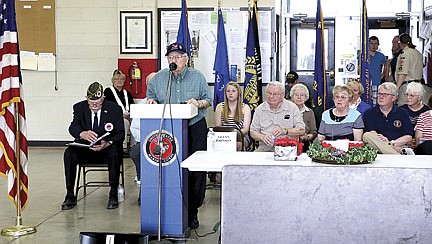
Traditionally, the city's observance starts on the banks of the Wisconsin River where a ceremony is held to honor those buried at sea. The river ceremony is followed by a ceremony at the Oneida County Courthouse to honor all veterans who gave their lives for freedom. The format was different this year, the ceremony took place at the armory, but the results were the same - a solemn, yet upbeat, ceremony remembering and honoring our nation's greatest heroes.
"We must remember what this day is for. Memorial Day is exclusively for honoring those who died serving in uniform during wartime," Master of Ceremonies Ray Zastrow said. "It's a special day set aside for the people that gave their all."
While the location may have been different this year, one part of the ceremony was the same as last year - keynote speaker Glenn Johnson, a U.S. Army veteran and World War II POW, once again took to the podium.
Johnson started his speech last year, detailing his decision to enlist in the army and sharing a few boot camp stories before having to sit down due to fatigue. He returned to finish his story, once again enthralling the crowd with his wit and humor.
Johnson picked up right where he left off last year, beginning his tale by recalling what it was like to prepare for D-Day.
"None of us had ever been in combat before. We finally took off on June 5 and we were supposed to start the invasion on June 6," he recalled.
"There were hundreds and hundreds of airplanes just flying around that evening before we got in our regular formation heading over to France. Going over to France, I looked out the window of the airplane and I looked at the channel and it looked like there were enough boats there to walk across going from one boat to another. It was quite amazing to see."
It was while riding in that plane that Johnson got his first taste of war. He was preparing to jump when the machine gun fire started, the first time he and his fellow patriots had ever been shot at.
"The machine gun fire was so intense that the formations of all of these planes broke up because you've got to realize, this was the first time any of us had been under fire, the first time any of the pilots transporting us had been under fire, so everybody was a little excited and the formation broke up," Johnson said.
"Planes were being shot down all around. It was a little scary at the time, but we finally got out."
Getting out and getting to the right spot are two completely different things in wartime, however.
"We were over six miles away from our drop zone. So all of our preparations and map reading and everything we did were out of the program because none of us knew exactly where we were," Johnson said.
"I connected with about 13 other paratroopers and I didn't know a one of them, but you're depending on each other to take care of one another."
Johnson and his new partners did their best to find their objective point, but instead ended up at place that would become known as Hell's Corners. That's when they ran into some unfriendly tanks.
"We held that corner there for about five days, but at that time we were running out of ammunition and we were running out of food. It was quite scary at the time," Johnson said.
"Then, as we were looking out, we heard this big rumble. I looked up the road and there were three Tiger tanks coming down the road. We had absolutely nothing to defend ourselves against Tiger tanks."
That's when it all went black for Johnson.
"I heard someone yell out that the grenades were coming and that's the last I can remember," he said.
"A concussion grenade landed near me and threw me out into the street and I was knocked unconscious for about three days, or at least that's what they tell me."
And so began Johnson's experience as a prisoner of war. While the next part of his life would prove to be a challenging one, Johnson said it actually started on a humorous note.
Johnson had a bit of a surprise for the Germans who captured him. Army offficials were very worried about the spread of venereal diseases so they sent over large quantities of condoms for the troops. Those condoms were given to certain soldiers to carry over to the front lines to pass out. Johnson was one of those soldiers, only he never made it to the front lines to hand out his bounty.
"I woke up in a German hospital and that was quite interesting," Johnson said with a knowing chuckle.
"Right prior to the invasion, I was what was called a D-Day VD soldier. I had to make sure that all of the troops, before they left on vacation, furloughs or anything, had condoms because they did not want VD in camp. It was my duty to make sure they got passed out. I had them all stuck in my pack, hundreds of them. When I woke up in the hospital, the German officer was standing there with his monocle and medals and everything and he looks at me and says, 'Johnson, one thing I want to know is what exactly you came over here to do.'"
After he was released from the hospital, Johnson was sent to a POW camp where the main point of discussions between the soldiers was how to escape. There was talk of tunnels and great master plans, but Johnson had his own idea - walking right out the front door.
"There were about 120 of us there and they had us doing different kinds of work and such. Then, after Christmas one day, they asked for volunteers to go out in the woods to look for firewood," Johnson said.
"There were three of us that volunteered and went out. Everyone asks how we escaped, thinking about tunnels and barbed wire and everything else, (but) we walked right out the front gate. There were three of us, one guard, a donkey and a cart."
Thanks to a very old guard and a plethora of snow, Johnson and his two new friends were able to get away.
"It really started to snow and I look at George and said if this snow keeps up, I'm taking off because they won't be able to track us," Johnson said.
"So we did. Otto was our guard and he was 70-something years old. I don't think he could have lifted his rifle if he had to, so we felt pretty confident. So we escaped and spent five months having no idea where we were other than knowing we were in Czechoslovakia."
Food and shelter were hard to find while on the run.
"We had nothing to eat, the weather was cold, we had no dog tags or uniforms, but we scavenged abandoned barns and houses for burlap bags to wrap ourselves in. Believe me, they're not very warm," Johnson said.
"For food, we found a lot of rutabaga in these abandoned barns. Rutabaga, I would say, is what kept us alive all that time. I can't look a rutabaga in the face today."
A steady diet of rutabaga kept the trio going for awhile, until they ended up finding a pig roaming around. The only problem was they had no tools to kill it or cook it.
"One day, we caught a little pig. He was fat and oh my goodness he looked good, but we had no knives or tools or anything," Johnson said.
"When you're hungry - this might sound kind of gory - we finally hit him on the head with a stone. We were hungry. We found an old plow shear in a barn and we were finally able to cut a few pieces off and found a kettle and we threw some meat in there and boiled it."
As it turns out, the three should have stuck to rutabaga.
"That was the worst five days of our life after that, we had the GIs (gastrointestinal illness). We couldn't move for five days," Johnson said.
Things started to look up after the pig fiasco, however, as Johnson and his mates were soon united with a pair of shot-down British airmen.
"A British airplane flew over and the Germans were shooting at it and hit it and I saw two parachutes pop out of the plane, so I told the others that I was going to go find those two British airmen because they surely know where we are," Johnson said.
"I found them right away, but it was very lucky they didn't shoot us because we looked like scarecrows - wrapped in burlap bags, I had a beard down to here (pointing to his stomach), we were dirty, it was terrible. They knew exactly where we were and they each had a pistol and pocket knives, so that helped us a lot. About two weeks after that, we got to the American lines."
Given their unkempt state, it took the Americans some time to realize exactly who they were, but once they did, Johnson and his group were finally liberated.
"At that time, all of the German soldiers knew that the war was near the end, so they were discarding their uniforms and dressing up as civilians because they wanted to get into the American area instead of being captured by the Russians," Johnson said.
"They took us into custody. Right away they knew who the British were because of their blue uniforms, but the three of us, they had no idea who we were. We had no dog tags, no uniforms, nothing. They separated us and interrogated us for two days before they realized that we were American troops."
Finally back with his countrymen, it was time to have a good meal which, for those who remember Johnson's speech from last year, is a very important thing for him.
"When I was captured, I weighed 165 pounds and when I was released to the American lines, I weighed 89 pounds," Johnson said.
"When we got to the mess hall, we said we're finally here now and we're hungry. I said I wanted a hamburger steak with some American fried potatoes. I'm telling you, that steak looked like it was two inches thick and I took two bites and I could not eat anymore. My stomach had shrunk quite a bit so I started cutting it up and sticking it in my pocket. The cook looked at me and asked what I was doing and I told him it was for tomorrow. He told me they'd still be here tomorrow, but I said I didn't know that."
Once back on American soil, Johnson's life took a turn for the better.
"Jim James was in prison camp with me and us both being more or less from Wisconsin, we kind of chummed around together. One day he got a letter with a picture from his home and he showed me the picture and his sister Annie was in it. She was quite a nice looking girl," Johnson said.
"I said, 'Boy, oh boy, I think I'm going to marry her,' and he just kind of looked at me with a yeah, sure. Two years later, I married the girl."
Before sitting down, Johnson thanked the crowd for listening and sharing the day with him but certainly it is Johnson, and the other brave men and women who fought in distant lands and never returned home, who deserve our gratitude.
Marcus Nesemann may be reached at [email protected].
Comments:
You must login to comment.