June 13, 2014 at 3:21 p.m.
The legacy of Tommy John in youth baseball
The legacy of Tommy John in youth baseball
There's been an abundance of memorable storylines weaving their way through the first half of the 2014 Major League season.
Five-tool prospects have made their debuts. There have been no-hitters, walk-off wins and bench-clearing brawls. It's the first year of an overdue instant replay system that's been well received around the league, but still there's a black cloud floating over baseball stadiums around the country. Fair or not, it's name is Tommy John.
In only April and May of this year, a whopping 28 professional players went under the knife for Tommy John surgery. Names like Matt Harvey and Jose Fernandez are sidelined with the season-ending injury.
By now, the story of Tommy John and the way the revolutionary surgery has effected baseball is a well documented part of major league history.
In 1974, Dr. Frank Jobe performed the very first ulnar collateral ligament reconstruction surgery on John's left arm, extending his career by 14 years. Since then, hundreds of pitchers at all levels have undergone the surgery to get back on the mound.
Now 40 years later, there's one name that's synonymous with cutting-edge sports medicine. More often than not, if a superstar athlete needs surgery, it's Dr. James Andrews' name mentioned in the very first breath.
In late 2012, along with Dr. Glenn Fleisig, Andrews released a study detailing the meteoric rise of elbow injuries and found that the trend is certainly disturbing among professional pitchers, the root of the problem origionates long before the players start getting paid.
According to Andrews' study, titled "Prevention of Elbow Injuries in Youth Baseball Pitchers," about 15 million people play organized baseball in the United States every year. Seventeen percent, or just south of six million, are made up of youth baseball players in eighth grade or below.
There's no national database that tracks of the number of elbow injuries sustained by pitchers, but it's a widely accepted belief that such injuries are on the rise. Andrews points to several contributing factors that can lead to elbow injuries. At the top of the list is the frequency at which pitchers throw.
In another study Andrews participated in called "Risk factors for shoulder and elbow injuries in adolescent baseball pitchers" in 2006, 140 adolescent baseball pitchers between the ages of 14 and 20 were studied. Ninety-five of the pitchers had been previously operated on for an elbow or shoulder injury. Forty-five pitchers had no history of pitching injuries. Although there was no difference in age between the two groups, the pitchers who had a history of elbow and shoulder injuries reported pitching more innings per game, more pitches per game and more months out of the year. Furthermore, averaging more than 80 pitches per game nearly quadrupled the odds of surgery, and a pitcher who regularly pitched with arm fatigue was 36 times more likely to fall in the surgery group. Also, pitchers who threw competitively for more than eight months out of the year were five times more likely to injure their arms.
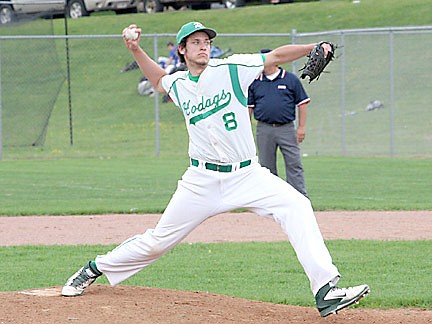
To focus the issue down to a local level, the Rhinelander High School baseball team, which just finished its spring season, keeps detailed statistics on its pitchers' performances.
This year's go-to starting pitcher Kent Mathews appeared in six games and threw a total of 624 pitches, for an average of 104 per game. While that's over the 80-pitch line Andrews outlined in his findings, Hodag pitchers have several other factors going for them. First, they have a coach who's well aware of the risks of pitching with arm fatigue.
"We monitor our pitchers and our pitch counts every week," head coach Joe Waksmonski said. "We try to limit our starters to pitching once a week and if they do come back a second time, it may only be for an inning or two. At the same time, we want our guys to throw some bullpens during practice between starts, whether it's once or twice. We try to give them the weekends off, so they can rest their arms. I really try to ask all the pitchers how their arms are feeling, so I'm in the know. They need to make sure to come to me too, if something isn't right."
Another factor working in their favor is, believe it or not, the long Wisconsin winter. Their season is short, instead of pitching hard for eight or nine months a year, Rhinelander's pitchers are competing for somewhere around five or six months, which allows for plenty of rest.
It has to do with range of motion. Andrews compared youth pitchers in warm climates who pitched around nine months out of the year with cold weather pitchers who competed for far fewer months. What he found was that the warm-weather athletes had greater shoulder external rotation strength than their cold-weather counterparts. This leads to greater strength and range of motion that can put more stress on the arm, making the pitchers more susceptible to injury.
Waksmonski said he makes sure all his pitchers know they need to take plenty of time off in the offseason.
"It's very important to take that time off after the summer season ends," he said. "The literature out there right now says you need to take at least two to three months off during the year. Once Legion ends, we usually give them about three months. Come November, we usually start our open gyms and it would be nice to have guys come in and start playing catch. In December and early January, we want our pitchers to start throwing a little bit off the mound so they can start building that arm strength back up for the spring season."
The WIAA has a list of suggestions for coaches when it comes to protecting their pitchers from arm injuries, many of which were borrowed from the Andrews study.
They too stress plenty of rest. Another wrinkle though is fairly unique to youth baseball. When a pitcher isn't starting, it usually doesn't mean he's sitting on the bench. Instead, he's simply playing another position. That means he's still throwing.
For the most part, that's not a problem, except when the pitcher moves to catcher. Consistent pitching can cause microscopic tears in the elbow or shoulder. Those small tears need rest to heal. The consistent throws made by a catcher may can add to that workload and prevent full recovery.
Waksmonski said its definitely something he keeps in mind when trotting out his pitchers.
"Because all of our pitchers play other positions, they also have to do their throwing work for their positions," he said. "A lot of our guys do all kinds of throwing during the week, whether it's off the mound or positional work, so we have to be mindful of that and make sure we're not overworking them."
Rhinelander baseball has no real history of serious arm injuries. That boils down to good game management, and proper communication between the pitcher and his coach.
On a national scale, it's the hope of doctors like Andrews that taking these steps and forcing pitchers to take the rest they need, that the disturbing trend of Tommy John surgeries spreading throughout every level of the game will begin to reverse and the epidemic will end. If it means watching players like Harvey and Fernandez pitch to the extent of their potential, it's something all baseball fans should hope for.
Andy Hildebrand may be reached at [email protected].
Comments:
You must login to comment.