June 6, 2014 at 4:32 p.m.
A family legacy: D-Day, 70 years later
A family legacy: D-Day, 70 years later
Somewhere near the back of the middle drawer though is an old manila folder, tattered and worn. Scratched in pen on the tab are the words "Tom WWII."
Inside, there are newspaper clippings, the oldest and the brownest dating as far back as 1944, and a few much more recent. There are handwritten letters and old faded photographs.
In the file is the story of a World War II veteran who was fought in Normandy 70 years ago. It's the story of a man I never really knew. It's the story of my grandfather.
When I knew him, he was the bald guy who taught me how to play checkers and slipped me a rolled up $5 bill when my parents weren't looking. He was the guy who snored like a sawmill through every Brewers game we ever watched together.
Later, he was the guy who moved in with my family and didn't have the greatest memory.
From time to time, I would stumble upon a small, dusty container hidden away in a closet somewhere. Inside were his Purple Hearts and his Bronze Star, along with all the other medals he'd earned during the war. To me, they were just shiny trinkets that were fun to look at.
He died on Aug. 12, 1999 of Alzheimer's disease.
There were paratroopers from the 101st Airborne at the funeral, and they laid a flag across his casket, but I didn't really understand what it all meant.
I'm 25 now and have a much greater understanding of my grandfather's time in the military. I've read the books, watched nearly every exhaustive History Channel special and spent countless hours talking with my dad about the last World War and the role his father played in it all.
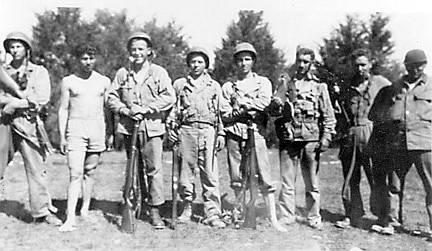
He was a paratrooper in the 101st Airborne division, and that meant he was the best. He trained harder than anyone, and he jumped out of planes. That's about as hard core as it gets.
He was there on D-Day, he was there at Market Garden and he was there at Bastogne, the source of my favorite Christmas stories growing up and the spot where General Anthony McAuliffe, entrenched with the 101st and surrounded by German forces, refused to yield, responding "Nuts" to the German demand of surrender.
It was all secondary though. I never had the opportunity to have a conversation with my grandfather about it, to listen to his firsthand account, and to tell him just how much it meant. I was too young. It was too big. I couldn't understand it.
Inside that tattered manila folder was the next best thing though.
On June 4, 1994, the 50th anniversary of D-Day, The Daily News spotlighted a number of World War II veterans and told their stories. There, on the front page, top of the fold, was my grandfather's story, in his own words and all. The byline reads Tom Hildebrand.
"It was the beginning of the end," he wrote. "United States combat participation in World War II began with Pearl Harbor Dec. 7, 1941. We landed on the Normandy beachhead June 6, 1944. Eleven months later, Germany surrendered to end the war in Europe."
It was incredible. Here in front of me was the firsthand account I had longed for. There was no back and forth, no answers to my many questions, but it was something.
"I was a member of the 501st company, 101st Airborne Division," he wrote. "We were to have parachuted behind German defense lines on the mainland before dawn. I had made 16 training jumps but this was my first combat jump. It was dark, about 2 a.m., three of us landed in a farmer's field behind Utah Beach. We didn't know where we were at the time. A lot of guys died. One-third of our company was killed before even jumping out of their airplane. Their C-47 transport airplane exploded in mid-air when hit by German anti-aircraft fire."
The jump hadn't gone as planned. The 101st was scattered behind enemy lines, many without weapons or means of navigation. They knew there was a rendezvous point though, and they were hellbent on reaching it.
"But the three of us that landed were advancing under support shelling by U.S. Navy," he wrote. "A shell landed short, killing one of us and leaving me unconscious for three days, waking up in an Army hospital in Birmingham, England. The third one of us escaped unharmed, I later learned."
That was his D-Day experience. It was chaotic, harrowing and most certainly terrifying, but he made it through.
"I was a 19-year-old when I was drafted," he said. "A friend of mind from the southside of Rhinelander, Lloyed Dolan, and I went in together. We had both gone to St. Mary's School and Church. But he was killed in combat in Italy. I don't think D-Day should be celebrated because of the kids who were killed there and never got a chance to do anything with their families and to have families. And now, the Germans are our friends. But D-Day was the start of things going our way in the war, and it did. It was a tremendous experience and one I never wanted to repeat."
It was all there, in black and white. I'd heard the stories before from my dad and my uncles, but there was something satisfying about reading my grandfather's words and seeing his byline. Maybe its because I'm a journalist.
It made me think about my own life, and what I was doing when I was 19. He was jumping out of airplanes, and I was jumping off the top bunk in my dorm room at UW-Eau Claire hoping to make it to class on time.
It made me think about my family. He had two brothers, both younger and both deceased now too. He had three sons, my uncles, Gary, the oldest, and Scott, the youngest. Then there was my dad, the middle child, and the one who took over Carpetiers, the family business.
There's a hand-written letter in the folder dated July 31, 1944. My grandfather wrote it to his mother back in Rhinelander. It's strange to read it now because I'm older than the man who wrote it, but it's mostly about family and home, as those letters often were. He left a message at the end for his younger brother Bob Hildebrand, who was still growing up.
"Tell Bob that if he wants fireworks, he should have been with me on D-Day," he wrote. "The most beautiful I have ever seen. There was every color in the rainbow coming up at us, only then we didn't appreciate the beauty of it."
I appreciate it now, a hell of a lot. I hope he knows that.
Andy Hildebrand may be reached at [email protected].

Comments:
You must login to comment.