June 2, 2014 at 3:37 p.m.
Searching for the past in an unmarked grave
Searching for the past in an unmarked grave
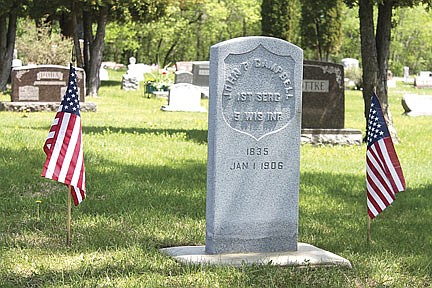
She was looking for an unmarked grave, but by its very definition, it was proving hard to locate. Somewhere among the rows upon rows of headstones rested her great-great uncle, John Perry Campbell, a veteran of the Civil War who died in Rhinelander in 1906 at the age of 70.
"I'm a family genealogist and I was looking for my great-great grandmother," Toser said. "When I couldn't find anymore about her, I started looking for her siblings. It was about two years ago when I started. When I found out it existed, I knew I wanted to locate the grave."
The search began, as it usually does in this day and age, on the Internet. She tracked down his obituary and ordered a copy to be sent to her. That narrowed the search to Rhinelander and Forest Home Cemetery. Next, she contacted an Internet organization called "Find A Grave," but his name wasn't listed.
That's when Tammy Walters of the Oneida County Veteran's Service Office got involved.
"In the fall of 2011, I got an email from Bernie Toser," she said. "She had been doing some research into her family history, and she thought her great-great uncle was buried in Forest Home Cemetery. She thought she knew where he was located, but winter was here and I couldn't go look for the grave. When the snow melted, I went out to the cemetery and spent an hour in the morning looking for the grave, but I couldn't find it."
That's when they hit the dead end. Walters had one more idea though.
"I wrote her and told her I couldn't find the grave," she said. "I didn't hear from her for many, many months. Finally, she emailed me back and said she had tried a number of things to no avail. The only other thing I could suggest was calling the mayor. I knew he was a veteran and I thought he could help."
So that's what she did. She called Mayor Dick Johns and he helped get the ball rolling again.
"They went over to Hildebrand Russ Funeral Home and Dave Russ found the files right away," Walters said. "They called up the sexton of the cemetery and said, 'Let's go get this grave.' They went over there and were able to find it within about 10 minutes."
The grave had been found, but the work wasn't done yet. Walters turned her attention to obtaining an appropriate headstone.
"When Bernie (Toser) called me and told me the grave had been found, I asked her to send me everything she had," Walters said. "I wanted to know everything about when he was in the military, so we could order a gravestone."
Toser had already learned a lot about her great-great uncle through her research.
"He had a rather prosaic life," she said. "He worked in the logging industry in Stevens Point and then he enlisted in the union army. He served for about two years, which was a good length at that time. People didn't serve long periods of time back then."
Campbell was mustered in as part of the 5th Wisconsin Volunteer Infantry Regiment on Aug. 8, 1864 in Stevens Point at the age of 29.
While serving, Campbell's regiment played an important part in the end of the Civil War.
It took part in the Siege of Petersburg, the Battle at Dabney's Mills, the Batte at Hatcher's Run and many more.
On April 2, 1865, the regimnet participated in the assault on and the fall of Petersburg. They pursued Robert E. Lee, the general confederate.
Campbell and his regiment were there when Lee finally surrendered to Union General Ulysses S. Grant at Appomattox Courthouse in Virginia.
Campbell was mustered out on June 20, 1865 in Hall's Hill, Va. and returned to Wisconsin.
"He had a slight injury in the Civil War and received a small pension of $5 a month when he was discharged," Toser said. "He moved to Rhinelander to become a scaler which is part of the lumber industry. He lived there for many years."
Campbell died on Jan. 1, 1906 at the age of 70 years old.
Now armed with enough information on Campbell's military service, Walters could move on with the paperwork and finally get a headstone.
"I sent it out to the national archives in St. Louis and they sent me everything they had on him," she said. "When I finally sent in the request for the gravestone, I learned that they still make Civil War-era gravestones for Civil War veterans. I knew he had to have one of those."
The headstone arrived in mid-May, just in time for the grave-marking ceremony held on Memorial Day. After more than two years of work, Toser's journey into the past of her great-great uncle was finally at an end point.
"We were overwhelmed by the service," she said. "It was all planned locally by the people in Rhinelander and it was wonderful. I was very impressed and I hope it means as much to the city of Rhinelander as it does to me."
It wasn't just Toser who obtained a sense of closure at the service.
"(Campbell) probably didn't have a service back then," Walters said. "From what I understand, he didn't have any family in Rhinelander. Bernie (Toser) kept thanking me for everything I did, but I was the one that needed to thank her. This ranked up there as the coolest thing I've done since I've been (here) and it's the thing I'm most proud of. I'm so glad I got to be a part of it, I even learned a lot more about the Civil War through this process because I was so intrigued with this Civil War veteran. He became my relative and I was so passionate (about) this Civil War veteran in an unmarked grave."
Campbell died and was buried at the cemetery in Rhinelander more than 100 years ago. It's a long time to wait for a proper burial. But thanks to Toser, Walters and the many others who helped along the way, this Civil War veteran finally has the headstone he deserves.
Andy Hildebrand may be reached at [email protected].
Comments:
You must login to comment.