July 25, 2014 at 2:59 p.m.
Martini recognized for river stewardship
Martini recognized for river stewardship
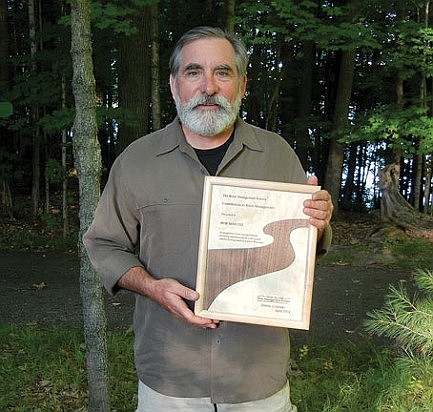
The North American River Management Society a group made up of professionals who study rivers, protect rivers, and manage rivers, chose Martini as the recipient of their Contribution to River Management award.
Entities such as the Park Service, Wildlife Service, state and Canadian provincial natural resources departments, university researchers and others make up the group. These entities work together and share information with each other regarding river health.
"This award was a kind of a career achievement award," Martini said.
Martini managed Wisconsin rivers as river protection coordinator with the Wisconsin DNR for 32 years. Since his retirement from the state, he has devoted time to non-profit organizations such as the Northwoods Land Trust, the Oneida County Lakes and Rivers Association and a number of others.
His passion for rivers started early.
"I just loved them all my life," Martini said. "I started fishing when I was three, four, five and have just been on rivers all my life. I love them. They're more interesting than lakes to me, but I like the lakes, too, obviously."
He does not take lone credit for the award..
"Most of these projects are really a result of a lot of professionals working together," Martini said. "The award has my name on it, but it really is recognizing the work of dozens of professionals. You know, the agencies that worked on these projects -- most of them didn't get any recognition at all."
"These are all team projects over several years. Things like cleaning up the Wisconsin River took 15 years, working with lots of different people," he added.
Public support is important, too.
"The public supported the cleanup of the Wisconsin River. If they didn't, it probably wouldn't have happened. The same is true with dam licensing and all kinds of other water-related other projects."
The Wisconsin River
The cleanup of the Wisconsin River was a huge project.
"When I first started in '76, if you went down to Hat Rapids dam, that whole surface was covered with brown sludge from the paper mill," Martini recalled. "Small animals could walk right across the sludge -- across the (Hat Rapids) flowage.
"Then they sucked it off the surface and pumped it into an unlined pit over the hill, which then contaminated groundwater. The reason they were sucking it off the surface is the turbine wouldn't turn at Hat Rapids dam -- there was too much sludge in the turbine.
"We've come a long way since then. Now we have a balanced fish and aquatic life community in that flowage."
At one point, three 40-mile stretches of the Wisconsin River went to zero dissolved oxygen every year. Sometimes river segments went void of water as impoundments were allowed to fill.
"They'd draw the flowage in the daytime when kilowatts were more valuable, then at night they'd fill up the flowage. That meant they had to close the dam off. There was literally no flow -- especially around the Stevens Point area," Martini said.
One issues is fish getting killed in turbines.
"Almost 800,000 fish per year went through one turbine we tested in Centralia dam by Wisconsin Rapids," Martini said.
"If even 10 percent of those fish are killed, that's more fish than are speared every year in the north. And that's one dam. There's 26 dams on the river. All of these issues went together in the cleanup of the Wisconsin River. Like I said, it was a big group effort."
The success of the work is tangible.
"Look at Wausau. Everybody turned away from the river. It smelled, it looked bad, it was dangerous to the kids. Now that whole riverfront is developed. Everyone goes to the river because it's attractive, it's cleaned up," Martini said.
"Their development plans are all geared around the river because people gravitate towards [sic] rivers. It's in our DNA."
Though it's much improved, the mighty Wisconsin isn't perfect.
"There's still contaminants in the river. A lot of those are going to be there a long time because they cycle in the sediments and through the fish. The Petenwell Flowage is a really good example where the carp are heavily contaminated with dioxin and PCBs and other things ... and when they die they go into the sediment and you just go through the cycle."
Algal growth is also an issue in the Petenwell Flowage due to agriculture in the watershed. Phosphorus spurs the overgrowth.
"That's an example of an issue that still has to be taken care of, because there's no regulation," Martini said.
"All of the paper mills in the cities were regulated and we were able to clean that up. We took out 93 percent of the waste from the 15 pulp paper mills in the 64 cities on the river."
The cleanup actually proved to be beneficial to paper mills. Water usage went down and with changing processes, some mills were saving energy. Even waste that was once dumped into the river proved useful.
"Right now there are over a hundred products made out of that waste that used to be dumped in the river. Now it's sold for a profit ... In fact, there's a company in Rothschild that does nothing but process paper mill waste water into useful products," Martini said.
"In the long run, it made the paper mills more competitive; saved them energy. Then when they were competing against the southern mills who refused to do the cleanup, they had a competitive advantage when they were finally forced to do it.
And we're still the No. 1 paper industry state in the nation."
Though mills were resistant at first, some soon recognized the advantages to cleaning up their operations.
The award
The award came as a surprise, Martini said. It was presented at the in North American River Society's annual meeting Denver, Colo., this past April, but Martini couldn't make the trip.
"I was being appointed to the Nicolet Board that night, and by statute you have to appear in person at the appointment committee," Martini said.
A colleague from Milwaukee accepted the award on Martini's behalf.
Current area issues
"Almost all the water issues center around invasive species of one kind or another," Martini said.
He considers shoreline zoning as the most important issue in Oneida County.
"We have probably the worst shoreline protection ordinance in northern Wisconsin, even though we have the second most lakes ... of any county in Wisconsin, actually," he said.
Martini said there have been 45 changes in the ordinance since 2000 "that have made it less protective."
"If you don't protect the shorelines, then property values drop," he added. "We've had surveys up in this area that have shown a $30,000 to $35,000 drop in individual parcels. This was done by the University of Wisconsin by looking at over a thousand transactions in Vilas and Oneida counties.
"When you have invasive species or poor water quality or poor shoreline aesthetics -- those are three things that can be protected with shoreline zoning -- your property values drop in addition to the fact that the fish and the wildlife and all those aquatic creatures don't have the proper habitat."
Craig Turk may be reached at [email protected].
WEATHER SPONSORED BY
E-Editions
Latest News
E-Editions
Events
May
To Submit an Event Sign in first
Today's Events
No calendar events have been scheduled for today.
Comments:
You must login to comment.