August 27, 2014 at 4:18 p.m.
Local 4-H family learns about Japanese culture by hosting foreign student for a month
Local 4-H family learns about Japanese culture by hosting foreign student for a month
By Kayla Thomason-
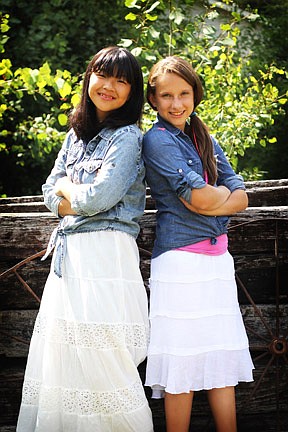
Kotomi, a 13-year-old girl from Osaka, Japan, stayed with the Parish family in Rhinelander for four weeks.
Amanda Parish said the family prepared for the visit by learning the Japanese names for household items (they placed cards on items around the house to remind them) so they could use some words that were familiar to their guest.
"We knew how to say a few phrases like 'thank you' and 'you're welcome' and 'hello' and (my daughter) Grace learned the alphabet - there are 50-some characters and it's really, really hard," said Parish.
Parish said the family's attempts to speak Japanese helped break the ice when Kotomi arrived.
"She was pretty shy, she didn't really talk a lot so I think the main thing we did to get over that shyness was we just kind of laughed a lot," Parish said. "I think laughing was a good way to break the ice and I think that's why she opened up so much. We kind of knew that we were going to mess it up and they don't like to mess up things at all and so that's why they don't talk. It's because they don't want to mess up what they are saying. So we knew that if we tried to speak Japanese and we messed it up it would make her laugh and then we could laugh at ourselves and it worked like a charm," Parish said.
Learning the language was a bit difficult because of the large quantity of characters and the pronunciation.
"If you have two consonants you have to say them each separately so like soap is 'sekken,' so if you say 'seken' it's a totally different word," Parish said.
The county fair was in town when Kotomi arrived and the Parishes participated in the 4-H booths. Kotomi jumped right in and helped with chores, Parish said.
She was impressed that Kotomi helped without being asked and participated like the other 4-H children.
"She was just very respectful and I think that's something that our kids nowadays don't have as much and I'm not sure why that is but I try to instill that as much as I can in my kids and I think that her being here, showing it, just really reinforced it and I hope that they see that I appreciated it and I hope that they saw that and it reflects on them," she said.
Kotomi and the Parishes learned a lot about the differences in lifestyle between the U.S. and Japan, from the willingness to help out, to school and family dynamics.
Coming from Japan's second largest city, Kotomi learned about life in a small town.
"She had never seen the stars before, she had never seen a shooting star," Parish said.
There was a meteor shower while Kotomi was in Rhinelander and Parish kept an eye out for it so her guest could experience it.
The sight of the stars sparkling in the night and zipping by amazed Kotomi.
Other things that she got to experience for the first time include horseback riding, seeing cows, eating cheese and brats - which she loved - and going to the lake.
"I'm not sure if she had been to a lake, we went hiking around Hanson Lake over here and we just jumped in and I don't think she ever had an experience like that before," Parish said.
Parish's daughters learned that there is a lot more studying in Japan and that Japanese family life can be quite different than U.S. children experience is.
It is quite common for grandparents to live with the family, according to Parish.
"Their parents don't really talk with [their child], it's considered sort of invasive for their parents to sit and ask them about their day like we do at dinnertime," she said.
Parish said it was her impression Kotomi would prefer that her family dynamic was more like what U.S. children experience.
Throughout Kotomi's visit, the Parishes explored Japanese culture by eating many of their meals with chopsticks.
Kotomi made some meals for them, such as an breakfast dish with eggs, soy sauce and sugar. Parish said she enjoyed the dish, which is not much different than an omelet.
The family is happy that they hosted Kotomi and thought it was a great experience.
Kotomi's program is called Labo International Exchange.
Parish said the children go to Labo nearly every day to learn English through songs and riddles.
"The parents are always thinking about [the children's] future, like [the children] have to take a test to get into high school, I mean they are very, very focused on the child's future from day one," Parish said.
4-H and Labo try to pair children based on likes and age. Parish's daughter Grace, 12, connected with Kotomi quickly.
"[Grace and Kotomi] very quickly became best friends, I mean it was like within the first couple of days they were joking around and hugging each other and doing everything together, they were attached at the hip right away," Parish said.
After forming a close bond everyone agreed the four weeks went by really fast and it was hard to see Kotomi leave.
Many tears and hugs were shared when Kotomi had to return home.
The Parishes are hoping to have contact with her in the future and maybe play chess via FaceTime.
Parish wishes local schools incorporated more information about other cultures into the curriculum.
"I think, especially living in the Midwest, I think we can be really closed off from other cultures and I think that's kind of why I wanted to do this," she said.
With technology making the world smaller, Parish said she wants her children to know how important it is to know about other cultures and be openminded.
"I guess we just take for granted that everyone is kind of Americanized, I guess you could say, or knows English but that's not the case," she said.
Life has gone back to normal in the Parish household. Grace and her sister Sophia, 7, miss Kotomi and they continue to use some Japanese words and occasionally eat meals with chopsticks. The cards with the English and Japanese words still remain up though.
Grace is interested in learning more Japanese and would love to visit Kotomi in the future.
Kayla Breese may be reached at [email protected].

Comments:
You must login to comment.