August 18, 2014 at 3:53 p.m.
The night that changed a sport
Local racers offer unique perspective on tragic accident at N.Y. racetrack
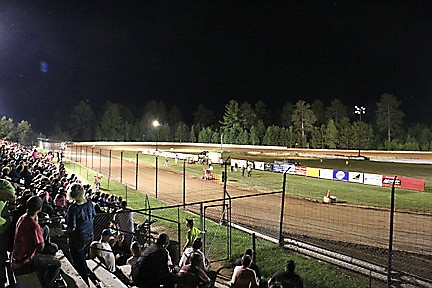
The night that changed a sport
That changed in a blink of an eye Aug. 9 when an unfortunate chain of events resulted in Ward's death and put the sport - and one of its biggest stars - under the microscope of national scrutiny.
Here's what we know for sure. The sprint cars driven by Ward and NASCAR champion Tony Stewart made contact on the racetrack, which sent Ward's car into the outside retaining wall. Ward, visibly agitated, climbed from his disabled vehicle and stormed toward the racing groove as the field slowed under the caution flag. Ward, 20, wearing a black firesuit and black helmet while walking on a dimly-lit portion of the track, was struck by the right-rear tire of Stewart's open-wheeled machine and was hurtled several feet down the track.
Ward laid face up on the clay surface as rescue workers rushed to his aid. By the time he was transported to the hospital, he was dead. Blunt-force trauma was the official cause, an autopsy would later determine. At that moment Stewart's checkered racing career entered its darkest hour, while a sport grieved and began to ask the most difficult question of all - why?
Local drivers react
The accident was a main topic of discussion on Friday at Eagle River Speedway as local weekend warriors brought their machines to the track for another night of racing.
There's been plenty of speculation from those inside and outside the industry since the accident. Was Ward in the wrong for getting out of his vehicle? Did Stewart recklessly use his car in a demonstrative manner when Ward confronted him? Was there anything that could have been done to prevent this tragedy?
It's indisputable that this accident has shaken the sport of auto racing to its core, said Eagle River's Guy Carley, a 14-year veteran of the WISSOTA Midwest Modified and IMCA Sport Modified divisions.
"I'm really sad in a way, and I said this earlier to some friends, because when you lose a fellow racer, even though you don't know him, he's a member of a brotherhood," Carley said. "I don't know him and it hurts to know that somebody got killed tragically on something that was totally avoidable."
Ryan Glembin operates Eagle River Speedway, a track his grandfather built over 40 years ago. He also races in the WISSOTA/AMSOIL Street Stock division, one of six classes that race weekly during the summer on the bullring that sits just inside the Oneida County line.
Glembin said the accident was all most people wanted to talked to him about last week. As for what happened, he said there are so many variables, it's hard to know for certain.
"There's been drivers coming up to me already about last Saturday with the Tony Stewart deal and, you know, you can only take (Stewart's) word for it, because in racing, you don't know if he's looking at his gauges," said Glembin, whose father raced winged sprint cars around the Midwest for decades. "You've got blind spots in race cars. He's got side visors on his race car. He's got a front wing on his car. You just don't know."
Reaction was mixed among the drivers. Several drivers had difficulty grasping what happened or placing blame on one person.
"I watched the video (of the accident) and, honestly, I wish I wouldn't have, but he was wearing a dark suit on a dark track in a corner," said WISSOTA Street Stock racer Jordan Kurtti of Bruce Crossing, Mich. "It's hard to judge. Only Tony knows what really happened there, but as a driver, I don't think there's any driver out there that would intentionally do that."
Jered Cech of Sugar Camp races in the Micro Sprint class at Eagle River Speedway. The motorcycle-powered winged sprint machines reach only a fraction of the speed their bigger-bodied 360 and 410-cubic inch engined counterparts (which Stewart and Ward were racing that night) hit. He said the responsibility was on Ward to stay in his automobile.
"In my opinion, he should have stayed in his car and not got out. (If he did) it would have never happened. It's just a bad deal," Cech said.
A victim of his reputation?
An investigation into the incident is ongoing. Authorities in Ontario County, N.Y. have said so far they have no evidence that points to criminal intent and have no plans to charge Stewart at this time. But that has not stopped the court of public opinion from deliberating, regardless of how much knowledge each juror has on the sport.
Stewart grew up racing sprints and wingless midgets on the short tracks in Indiana. That led to a brief career in the fledgling Indy Racing League before he bolted for NASCAR's top division in 1999. He won the series championship in 2002, 2005 and 2011, making him one of only a handful of drivers who have claimed at least three titles. But there have been times along the way where Stewart's temper has gotten the best of him.
There was the time in 2001 when he kicked a tape recorder away from a reporter at Daytona. In 2002, he got into an altercation with a photographer at Indianapolis. There was the infamous helmet toss in 2012 at Bristol, Tenn. where Stewart got out of his car, walked down pit road and chucked his helmet at Matt Kenseth in retaliation for an on-track incident. In 2013, he and Joey Logano got into a shoving match after a race in Fontana, Calif. Those are just a handful of the well-documented instances where Stewart's anger has boiled over.
Fairly or unfairly, his temper has been called into question again in the wake of this accident. Did Stewart rev his engine near the accident scene? Was he trying to intimidate Ward by driving right alongside him? Or - worse yet - did Stewart hit Ward on purpose?
Those accusations have flown freely on social media in the wake of the accident. Eagle River's Ryan Valeria, who drives in the Street Stock class, said while he doesn't believe Stewart intentionally hit Ward, he can understand why some believe foul play was involved, given Stewart's history.
"It's easy to point the finger at Tony Stewart because of his reputation," Valeria said. "It is unfortunate when you don't know what it's like to drive and just jump to conclusions. When you have a reputation like Tony Stewart's, it's just going to haunt you like that, I guess.
"I don't think Tony Stewart hit him intentionally, that's for sure. But, his reputation follows him and he's been a hothead and known for starting stuff."
Fairly or unfairly, this story has taken national prominence, Glembin said, because of who was involved.
"It was Tony Stewart (who's car struck him), a high-profile name," he said. "If it was anybody else, like myself or another person, it would not be that big of a (story)."
The fateful moment
The incident that caused Ward to crash was run-of-the-mill stuff around the short tracks, the drivers said. It was a simple matter of two drivers wanting the same piece of real estate on the track, which led to contact between the two vehicles.
"That accident that (caused the caution and eventually) took that young man's life, in the sprint cars, that's not an uncommon sight," Carley said. "That was just incidental contact. That wasn't two drivers banging on each other for a long period of time. It was incidental contact. That happens."
"I didn't think it was anything intentional, it was just a racing incident," Valeria added. "I don't know if the guy was mad because it was Tony Stewart and he thought he was roughing him up or what, but I don't think anything was intentional as far as the wreck goes."
A scene that has played out plenty of times over the years at tracks big and small was repeated following the wreck. Driver A, believing Driver B has wronged him, is bound and determined to make his displeasure known. Sometimes it comes in the form or retaliatory contact on the track. Sometimes it involves a post-race shouting match. This time, it meant Ward climbed out of his car while vehicles were still moving. That's where the drivers say things took a turn for the worse.
"It's kind of a tough deal. A driver should never get out of their car," Kurtti said.
To Valeria, the onus was on both drivers to avoid an on-track confrontation.
"On both parts, it was a lack of professionalism, how they reacted to it," he said. "Obviously Tony Stewart could have done more to avoid it. The other guy (Ward) shouldn't have gotten out of his car. That's why I say they're kind of both at fault."
Once Ward approached Stewart's vehicle, what happened and who was responsible becomes less clear.
Did Stewart see Ward coming? Drivers inside sprint cars don't have much visibility between full containment racing seats, and wings on the from and roof of the car - all of which create a smaller field of vision. Couple that with races that are typically run during twilight or darkness and the challenge increases, said Cech.
"There's good visibility in them (but) you fight the sunlight and the dark conditions," he said. "When it's dark out at night, it's a little bit difficult, but that's why I have a white car. The dark cars are hard to see. The first couple years I raced with some black cars and you don't see them very well on the track. That's why my car is white."
What's more, Cech said there are a number of things a sprint car driver is doing under caution while idling between 40-50 MPH. Any slower and the cars, which have no clutch and a single gear, could stall.
"You might be able to adjust the wing or the shocks a little bit while you're riding around, but you're catching your composure," he said. "You're getting set in the seat, making sure your belts are tight. You're adjusting your body in the seat, basically getting comfortable again."
Then there's the issue of lighting. Multiple reports stated the accident occurred on a dimly-lit portion of the track, something that is not uncommon on short tracks across America.
"There's dark spots on every track," Glembin said. "Eagle River here, there's a lot of dark spots. If there's guy in a black jumpsuit standing out there and you're going 50 MPH, which those sprint cars are going 50 on their pace lap, things happen so fast, you just don't know."
What about the safety vehicles? Could they have arrived on the scene sooner and prevented Ward from charging down the track? Glembin said the answer's not that simple.
"At that point in time, a safety crew is worried about their safety, about another sprint car hitting them ... Imagine 25 sprint cars going 40 MPH under caution," he said. "You're bobbing and weaving, trying to get through these guys. It's easier for us, but I can understand why they didn't go out there. They're worried about their own safety."
Cech said all of these variables are difficult to comprehend, unless you actually sit behind the wheel of a race car.
"You can't pass judgment on them if you're not in the cockpit," he said. "You don't know what goes through his mind. You don't know what went through the other driver's mind. Unless you are those two people, you don't know exactly what happened."
Why race in the minors?
Another question asked in the days following the accident is why Stewart was at Canandaigua Speedway in the first place.
To some Tony Stewart racing at short tracks is like Ryan Braun moonlighting in a weekly tavern softball league or Aaron Rodgers playing a pick-up flag football game at the Y.
Stewart suffered a severly broken leg following a horrific sprint car crash one year ago, an injury that kept him out of any race car until this past February. Many questioned why he'd continue to risk his safety in events that hold such little financial reward.
Because, Carley said, Stewart is a racer and racing is a passion that few who have never strapped into a race car can truly understand.
"Until you do it and get it in your blood (you don't understand), I know this sounds stupid, but it's like a drug," he said. "It is truly a drug. It's so addicting. I'm not a young man. I'm 58 years old and my girlfriend, who's the same age as I am, said to me, 'When are you going to stop doing this?' I don't know when I will. I love it this much. I know what it's got to be like for Tony. A man who races as much as he does and as many places as he went to, how do you not love this sport this much? It's crazy the addiction, it really is."
Carley grew up racing snowmobiles and transitioned to dirt modifieds in 2001. The night of his biggest triumph - a feature victory at TNT Speedway in Three Lakes - was also the night of one of his greatest losses. A good friend, and the man who sponsored his car, suffered a heart attack in the bleachers moments after the victory and passed away.
That might have been enough to drive some away, but Carley still spends most of his free time and disposable income on racing, banking on moments like Friday night, where he led more than half of the Midwest Modified feature and finished a very respectable third.
"I'm a 40-hour working man and I spend 80 percent of my free money - and what I mean by free money is money that I'm not using to pay bills - 80 percent of it, all year long goes back into my race car," he said. "Now how stupid is that? It is truly a stupid sport, but it's that addiction. When things go good, like they did tonight, I have a good, solid run and the car goes on the trailer undamaged, there's no feeling like it. None whatsoever."
Where the sport goes from here
Already the sport is taking reactionary steps to prevent an accident like this from happening again. In the days following Ward's death, several short tracks across the country put in place language in their rulebooks about drivers leaving their vehicles and walking on the track while a race is ongoing. On Friday, six days after the accident, NASCAR beefed up its rulebook to address the issue. In essence, unless the disabled vehicle is smoking or on fire, NASCAR now mandates that a driver must stay in his or her car with the harnesses buckled until directed to unbuckle by an official or emergency works. In addition, drivers should not approach any portion of the racing surface or another moving vehicle. NASCAR said penalties for violating the rule will be handed out on a case-by-case basis.
At the local level, rules posted on Eagle River Speedway's website do not specifically cover drivers leaving their vehicles under caution. However, the track does have rules in place regarding fighting in the pits, which comes with a minimum one-week suspension.
In addition WISSOTA, the sanctioning body for the two of the top divisions at the track, states in Rule 1.11.2 of its 2014 rulebook, "no participant shall engage in improper behavior on or off the track ... Any driver who gets out of his or her race car or any participant who verbally assaults or threaten [sic] any WISSOTA official, track official, track employee, sponsor or another participant my be suspended for up to two weeks from the date of infraction, may be fined up to $500 and may lose all WISSOTA points."
Glembin said fines and suspensions are the best tools tracks and sanctioning bodies have to try to curb this behavior.
"We tell the drivers don't take your belts off," he said. "Wear your helmet, your gloves, everything until that car is in the pit area and shut off. It's the safest thing for you ... Stay in your cars until an official tells you to get out during an incident. It's the only thing we can do is help prevent it. But if they come out (of their car) all hotheaded, all we can do is try to penalize."
Keeping calm in the heat of the moment is easier said than done for drivers who are passionate about their sport.
"They have to protect us from us, because it's such a passion and so addicting, it drives you so hard that you do things that you wouldn't normally do," Carley said.
Several drivers said it is on them to show restraint, a fact the Ward-Stewart accident put into perspective.
"As hard as it is when you're mad, you've got to remember to keep your cool," Valeria said. "It's just a race. It's not the end of the world if a car gets wrecked."
Kurtti added, "It just kind of wakes you up a little bit that this stuff can happen. You don't want to see it happen ever, but it makes you think a little bit before you put on that helmet."
Beyond that, who knows what will happen next. Stewart has not climbed into a race car at any level since that fateful night and the NASCAR race team he co-owns and drives for, Stewart-Haas Racing, says there's no timetable for his return.
There were several variables in play that night. Beyond what caused the accident, whose fault it was and what could have been done to prevent it, the fact of the matter is a 20-year-old aspiring racer is dead and the future of the 43-year-old racing superstar whose car hit him is up in the air.
What started as a simple racing incident turned into a tragedy that could change the sport forever.
"In this case here, it took a man's life," Carley said. "And that is truly sad."
Note: In the interest of full disclosure, River News associate editor Jeremy Mayo was employed as the track announcer and reporter at Eagle River Speedway, under different ownership, from 2002-2007. He was also the track announcer and reporter at TNT Speedway in Three Lakes from 2002-2013.
Jeremy Mayo may be reached at [email protected].
Comments:
You must login to comment.