August 1, 2014 at 1:14 p.m.
Rhinelander Historical Society Museum is a time capsule of city's past
Rhinelander Historical Society Museum is a time capsule of city's past
By Kayla Thomason-
The little yellow house with a blue peak at 9 S. Pelham Street is a time capsule full of items from when Rhinelander was a bustling logging town.
Guests can take note of the high ceilings, the narrow floorboards, floral wallpaper and boardering, dark trim and rosettes that frame entryways.
In the dining room sits simple but elegant dining room furniture, crafted by the Rhinelander Boat Company which existed in one form or another from 1903 through the early 1950s, according to "History Afield: Stories from the Golden Age of Wisconsin Sporting Life" by Robert C. Willging.
A dark fireplace, decorated with candles, a picture and a clock, occupies an inner corner of the room between two entryways.
Off the dining room guests can wander into the kitchen or living room.
The kitchen cabinets are white with a cream countertop. A mint green and tan icebox sits next to the counter, its doors ajar so the compartments and ice block are displayed.
Older visitors to the museum may look under the ice box for a tray. When they were children one of their chores would have been to empty it.
Blocks of ice used to be cut out of Boom Lake and packed into an icehouse with sawdust, which was very easy to find in a logging town.
"The ice man would go around and he would deliver blocks of ice maybe once a week or whatever the people needed," said museum volunteer Bill Vancos.
If the children were good the ice man would shave off bits of ice for the children as a treat, Vancos added.
Also in the kitchen is a wood stove with clawed feet. It is surrounded by typical 1900s kitchen supplies such as clothes irons, a tea canister, tins and dishes as well as a box of logs.
"Some people like to come and just look at the old furniture and dishes, the stove and things like that and others get interested in the ties to old businesses," Vancos said. "Usually there's something for everybody."
In one of the rooms guests can see silver Eugene Shepard, creator of the Hodag, had engraved with "Hodag."
The living room has a red velvet sofa and chair, a fainting couch, a phonograph and an upright piano, among other decorations.
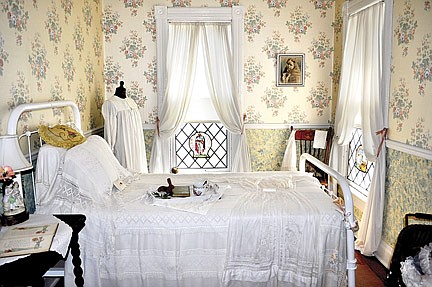
Upstairs in the "typical" bedroom, the walls are covered in the common floral wallpaper. White lace curtains let in the mid-afternoon light.
The bed, made up with a delicate comforter, appears shorter and narrower than modern beds.
A mannequin displays a nightgown that women would have worn.
The typical bedroom sits in contrast with the military bedroom.
In that room the bed is a bit longer but it's just as narrow. An American flag, folded into a triangle, lays on the pillows and a thick brown blanket is folded at the foot of the bed.
Running from one end to the other is a black-and-white photo of Rhinelander soldiers from World War I. Their names are displayed next to the image.
A big, dark wooden chest is located at the foot of the bed. A plush green chair is tucked in a corner.
Military-related photos hang on the pale pink walls.
Down the hall another room features displays about old Rhinelander businesses such as a photo of the old Rhinelander firehouse on Thayer Street, Wabash screen doors, "Shorty" bottles from the Rhinelander Brewing Company, a collection of calendars and more.
"It has a lot of old history that ties back to older businesses," he said.
In the old days, before cars were used frequently, every neighborhood had its own grocery store and Rhinelander had three cigar companies.
A big drum from the paper mill band is on display. The paper mill had 1,400 employees at the time.
In the same room a large city map from 1928 hangs on the wall.
An interesting tidbit of information is that the Chicago & Northwestern Railroad used to be what is now Courtney Street.
Vancos knows a lot about Rhinelander's railroad history and is happy to share it with guests.
Another room on the second floor contains old medical supplies from Dr. Daniels, an early physician who, with his son, opened Daniels Manufacturing which became today's Printpack.
Also in that room is an old wooden wheelchair and a thank-you letter from former President Eisenhower to the Taylor Beverage Company for some Coca-Cola the company gave him. The president liked to fish and would take a train ride to get to Rhinelander, according to Vancos.
"People from the community were just extremely generous and donated items that their parents or grandparents may have had so everything in here has been donated by people in the area," he said.
The building, which was once a boarding house, wasn't always as glorious or filled with such treasures.
It was in rough shape when theRhinelander Historical Society purchased it in 1991 and remodeled it.
The indoor bathroom and front porch are not original to the house and the staircase was moved to foster a more natural flow.
"Everybody has to come and everybody kind of zones in on something different that they find cool," Vancos said.
The museum is open Tuesdays and Thursdays from 10 a.m. to 4 p.m.
It is free to the public.
Kayla Breese may be reached at [email protected].
Comments:
You must login to comment.