April 23, 2014 at 2:58 p.m.
New logging-focused community event brings back memories of Rhinelander's origins
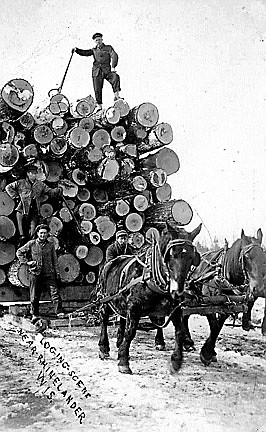
New logging-focused community event brings back memories of Rhinelander's origins
The Rhinelander Area Chamber of Commerce recently received a $10,000 grant from the state Department of Tourism to help promote the inaugural event, which will include a lumberjack competition, live entertainment, children's activities and different stations for members of the public to try their hand at lumberjack events like log rolling and cross-cutting.
It is no mystery where the idea for a large-scale community event centered around logging came from. It was integral in the early development of Rhinelander, as it was for many northern Wisconsin communities.
"The three decades between 1870 and 1900 is a period generally regarded as Wisconsin's 'golden age' of logging," recounts T.V. Olsen in his book "Birth of a City: The Rhinelander Country Volume Two." "From Wausau in mid-Wisconsin northward to the state's boundary with upper Michigan, log drives on the Wisconsin River and its tributaries would reach feverish proportions. The business of cutting and driving and milling pine logs swelled to an unprecedented frenzy that would wipe out Wisconsin's great northern timberwealth in half the lifetime of a man."
Rhinelander was at the center of that frenzy. By 1892, a decade after Rhinelander was officially founded, the city was the central headquarters for 40 logging camps and had eight sawmills along Boom Lake cutting several million feet of timber every year (so it's appropriate that the Log Jam will be held at Hodag Park along the shores of Boom Lake).
In "Our First Hundred Years: The Rhinelander Country Volume Three," Olsen writes that trains were running in and out of Rhinelander daily bringing in supplies and hauling out large loads of lumber.
It all began two decades earlier when Anderson Brown and Anson Vaughn made their first journey up the Wisconsin River into the Northwoods. Brown's father, Edward Brown, a Stevens Point lumberman, had charged the two men with traveling the northern part of the state to identify tracts of pine timber that could be purchased from the federal government. It was in 1865 that the federal government completed its survey of northern Wisconsin and established a price of $1.25 per acre including timber and mineral rights.
Brown and Vaughn found more than pine timber. They saw an opportunity to develop a city.
In his chronology of Rhinelander history, Olsen describes what the two men likely saw:
"On a day in the early 1870s, two men stood on a high, wooded bank of the Wisconsin River and looked down at a foaming stretch of whitewater. It was an impressive sight, roaring through a broad cut of glacier-gouged rock that had formed the root of an ancient mountain. It created a fall of 22 feet in a hundred rods - which meant water power to spare. Power for sawmills and factories."
Logging was not only key to the development of Rhinelander, but also played a role in the myth of the hodag that has become ingrained in the city's identity. The man responsible for concocting the legend of the hodag, Gene Shepard, was a timber cruiser who first laid eyes on the future site of Rhinelander in the early 1870s on a return trip south after scouring the Eagle River area for prime logging locations. He ultimately decided to make his home in Rhinelander and the legend of the hodag soon followed.
Though the hodag as it has become known was a Gene Shepard creation, the word itself appears to have originated in logging camps. According to Olsen, "hodag" was slang for a grub hoe or mattock - tools of the logging trade.
Just as quickly as the boom era of logging rose, it faded way. Olsen recounts that in 1899, four of Rhinelander's eight sawmills shut down.
"In the following year, the turn of a new century saw a final dying effort of its predecessor: the last drive for a downriver mill passed through Pelican Rapids. The great pine stands of the Rhinelander country were gone," Olsen writes.
Logging companies then began turning to the hardwood trees that had largely been ignored.
Olsen describes the resonance that time period still has though the landscape has greatly changed:
"Today the ax and saw are still. The magnificent pines that a man could not circle with his two arms, into whose making went the energy of untold man-lives, are gone. Where the deer and the bear, the wolf and the Chippewa, stalked dappled trails, cars race over the paved arteries of busy highways. Yet the legends of wood and river still ring with the lusty echoes for those who will listen, who will hear. And those who remember."
Kyle Rogers may be reached at [email protected].


Comments:
You must login to comment.