June 20, 2012 at 5:45 p.m.
Pop Warner football limits practice contact
Local coaches, parents, medical providers applaud move
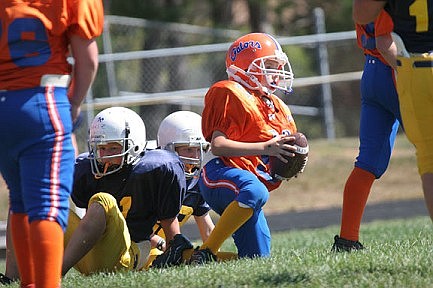
Pop Warner football limits practice contact
Pop Warner Little Scholars Inc., the sanctioning body for many youth football programs in the United States, including Rhinelander's, is implementing two major changes for the 2012 season that limit the amount and type of contact that can occur during practices.
The amount of time youth teams can spend in full contact drills has been capped at either 40 minutes or one third of a team's practice time, whichever is less. And when contact drills take place, the players involved must be lined up no more than three feet apart.
"There are times when people and organizations have to evolve, and this is that time," Dr. Julian Bailes, a neurosurgeon and chairman of the Pop Warner Medical Advisory Board, told ESPN.com when the rule changes were announced. "For the future of the sport, we need to morph it now and take the unnecessary head contact out of the game."
Locals react
Local coaches, parents and medical professionals are applauding the new rules.
"I like the rules," said Bill Makris, who runs Rhinelander's Pop Warner football program. "I can't speak for how much contact other teams are doing, but they're good rules and they're rules that we've been following for years.
"If there are (teams) who haven't, and this has brought up the whole issue, then this is good for everybody."
Dr. Kent Jason Lowry, a physician at Northland Orthopedic Associates in Rhinelander, said the rule changes reflect increasing awareness about the risk and effect of football-related concussions.
"Getting parents educated, on board and participating in the process of indemnifying and respecting a head injury at all age levels is critical," said Lowry, who also serves as medical adviser to Rhinelander High School's Athletic Training Service team.
School District of Rhinelander nurse Kerri Schmidt agreed.
"I think that it is a positive response from Pop Warner," said Schmidt, whose three sons played football in Rhinelander. "They have a medical advisory committee and they are basing their decisions on the current brain-trauma research."
The rule changes, she added, "will help protect the developing child's brain, as well as be a talking point for parents, coaches and fans to become educated in the continual need for safety at all levels of football."
Mark Steinmetz, a local youth football coach and the parent of a youth player, agreed.
"I think the rule change is a great idea," he said. "Focusing more on technique will help keep injuries down now and in the future for our players."
Medical concerns
The Pop Warner organization acknowledged the changes come "in light of developing concussion research."
One such study, titled "Head Impact Exposure in Youth Football," found that young players are at considerable risk for head injuries.
The joint effort of Virginia Tech and Wake Forest universities studied youth players ages 6 to 9. By putting impact sensors in the players' helmets, researchers measured the impacts the youth players were experiencing.
"(They) were noticing that the force of those hits was as high as a collegiate-level football player - the forces they were seeing in their helmets," Lowry said.
When those impacts occurred was equally disconcerting.
"One of the things they were observing is that a lot of those high-force hits were happening during practices at the youth level and not necessarily during games," Lowry added. "There was this realization and recommendation to limit that opportunity for injury occurring during practice."
Another study, released earlier this year, is the highly regarded Sports Legacy Institute's hit count "White Paper." The paper, co-authored by Dr. Robert Cantu of Boston University and SLI cofounder Chris Nowinski, called for a hit count on young athletes, similar to pitch counts imposed on youth baseball pitchers.
"We believe that the fastest and most effective path to safer youth sports is to regulate the amount of brain trauma that a child is allowed to incur in a season and a year," Cantu and Nowinski write.
They pointed to multiple factors leading to their recommendation.
"The fact that the data indicates youth athletes are exposed to brain trauma with high frequency and severity is concerning, as most experts agree that the young brain is more vulnerable to trauma than the mature brain," they say. "...
Evidence is accumulating that sub-concussive impacts, or impacts that do not produce any clinical concussion symptoms, may still be damaging to the brain, both in the short and long term."
In the paper, Cantu and Nowinski go so far as to suggest that children under the age of 14 not partake in contact sports.
Said Lowry, "I think the question that's still out there - that we don't know the answer to and I think is coming with more research - is if those rule changes went far enough."
What it means this season
Makris, who heads the local Pop Warner program, said that while the changes will benefit the sport, folks in Rhinelander will not see a noticeable difference in how practices are conducted.
"We just don't have an issue with it within our program," he said. "I read the rules from Pop Warner regarding how much contact we can have. We've been under that (limit) forever. We just don't have that much contact. It's a lot of skill and technique training in our program."
Makris added that his teams, which have players in grades one through eight, spend just 20 to 30 minutes in live contact and typically conduct blocking and tackling drills with kids in padding beyond their standard football equipment.
In addition, instead simply lining up players to block or tackle, Makris stresses fundamentals by taking a form block or tackle and dissecting it backward, beginning with the moment of impact.
"We just teach proper techniques," he said. "We do explanation (and) demonstrations. Then we have a progression where we start from the whole when they're up on an individual, blocking or tackling, and then we work back to where they are getting into their stance and they block the individual. ... there's no contact helmet-to-helmet at all."
Gary Freund, who has a son in the Rhinelander Pop Warner program and is entering his 11th year as a coach, concurred.
"Our players are taught from grade one, when they start playing, proper technique," he said. "I believe this helps eliminate helmet-to-helmet contact or leading with the head during a tackle or block.
"You're not always going to eliminate all helmet contact, but I believe we teach the proper techniques, which does help."
While concussion awareness has increased over the past few years, Makris said local parents have not expressed more concern about their children. Part of the reason, he said, is that the program already does a good job of minimizing the risk of head injury.
"We're not going to err with not having a helmet fit properly, too loose or whatever," he said. "We're very careful. The parents are there when they try the helmets on, and it's a slow process. It takes a long time and you've got to get it just right. Sometimes you need to order helmets or make a few adjustments on them to make them fit properly."
Some 125 children will take part in Rhinelander's Pop Warner football program this season. Practice begins in early August.
Jeremy Mayo may be reached at [email protected].

Comments:
You must login to comment.