July 13, 2012 at 3:24 p.m.
A call to the hall
Rhinelander resident to induct wheelchair great into International Tennis Hall of Fame
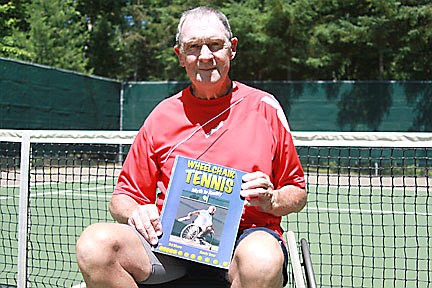
A call to the hall
The 76-year-old tennis coach will give the induction speech for Randy Snow today at the International Tennis Hall of Fame in Newport, R.I. Snow is in this year's hall of fame class with former grand slam champions Jennifer Capriati, Gustavo Kuerten, Manuel Orantes and tennis industry innovator Mike Davies.
Snow had an incredible tennis resume - former No. 1 player in the world, 12 grand slam singles titles, nine grand slam doubles titles, two gold medals - all from the seat of his wheelchair.
Snow is only the second wheelchair tennis player to enter the International Tennis Hall of Fame, and he's the first to go in as a player. Brad Parks, one of the pioneers of the game, was inducted as a contributor in 2010.
Moore, who has a summer residence with his wife, Marcha, on the Moen Lake chain, said Snow's induction breaks down one of the final barriers segregating wheelchair players from their able-bodied counterparts.
"Wheelchair tennis is the last minority, and in the past few years they are on an even keel with able-bodied tennis," he said. "They're (now) welcomed to play in the four grand slams."
Sadly, Snow, a native of Terrell, Texas, will not be there to accept the award. He died in 2009 at the age of 50 after suffering a heart attack while volunteering at a wheelchair tennis camp in El Salvador.
"It's a little bittersweet, the fact that he should be here to do it himself," said Snow's father, Thomas, who will deliver the acceptance speech in his honor. "I'm just going to try to say what he would have wanted to say, and at the same time recognize the people I think had a great bearing on all the awards he got and success and so forth."
The birth of a friendship
A stroke of fate brought Snow and Moore together in the late 1980s.
Snow was an accomplished junior athlete in 1975 when a farming accident left him paralyzed from the waist down. In the blink of an eye, a once-promising sporting career seemingly vanished.
"I had a very difficult time accepting my disability, and felt my accident was absolutely the worst thing that could ever have happened," Randy Snow wrote in "Wheelchair Tennis, Myth to Reality," a book he and Moore co-authored in 1994.
Snow came to accept his injury and eventually embraced it, joining a wheelchair basketball team in 1977. In 1980, he met Parks and discovered wheelchair tennis at the National Wheelchair Games in Champaign, Ill.
"Brad said, 'Come on over and hit some serves,'" Moore recalled. "Randy hadn't hit a ball in five years. He started serving and started acing people. Brad went crazy and said, 'You've got to play this game.' It fired Randy up."
It kindled a long career in wheelchair tennis that included seven U.S. Open singles titles in the 1980s.
Moore had a long career as a collegiate coach, first at the University of Kentucky, where he served as head tennis coach and as an assistant basketball coach under hall of famer Adolph Rupp. After a time as an assistant at Western Kentucky, Moore moved to the junior college level, taking the head position at Jefferson State College in Birmingham, Ala.
Moore was near the end of his 25-year tenure at Jefferson State in 1989 when a chance meeting changed his life, and Snow's.
Jefferson State's tennis courts were in the process of being resurfaced, forcing Moore's team to practice at nearby Lynn Park. One day after practice, six men in wheelchairs quickly occupied the courts Moore's team had just vacated. One of the men was Snow, who was the assistant athletic director at Lakeshore Rehabilitation Hospital in Birmingham.
"It just really grabbed my attention because they were going so fast. I had never seen wheelchairs go so fast ... They went out, started hitting the balls and Randy was feeding a lot of the balls," Moore said. "We just stood there for almost an hour, Marcha and I, and watched.
"When he came off, I began to question him. I said, 'Where do you play wheelchair tennis?' and he said, 'Well, there are tournaments. There's a U.S. Open in California and everything.' I said, 'Why don't we have dinner and talk a little bit?'"
Those conversations eventually led Snow to the Moores' summer home in Rhinelander.
Snow in Rhinelander
After Moore left Kentucky, he and Marcha, a Minnesota native, moved to Wausau in 1964, where Marcha had accepted a teaching position. Five years later, the Moores bought property on the Moen Lake chain.
They didn't see the property much, however, spending their summers in New York coaching at Raquette Lakes Camps.
"One day in 1980, coming back from New York, Marcha and I looked at each other and said, 'We've got this nice place here on the lake. Do we really need to continue to go out to New York?'" Moore said.
The Moores' residence is typical fare for lake homes in northern Wisconsin - a well-landscaped log cabin, one acre of land, swimming frontage and a nice view of the lake. However, it has something many lake homes do not - its own tennis court.
Snow arrived to this scene in the summer of 1989. He said in "Wheelchair Tennis, Myth to Reality" that he was skeptical of Moore's motives at first, but said, "We bonded from that point."
"We took him skiing," Moore said. "He just laid on the tube. He saw the area and played tennis twice a day. We talked about it a lot. Before he left he said, 'I'm playing a tournament in Grand Rapids (Mich.) in a couple weeks. Why don't you come?' So I did, and he won the tournament."
Moore, who holds a master's degree in kinesiology, sought to take his knowledge and Snow's ability and revolutionize the sport.
"I began to formulate in my mind ways to improve his game. I could improve Randy," Moore said.
Said Thomas Snow, "I've had many, many conversations with Bal and he was considering just retiring, and this just gave him new life, to get him into a new area of wheelchair tennis."
Moore and Randy Snow's partnership led to more than 50 camps instructing the game, and their book, which included 112 wheelchair-specific drills.
Defining moments
It also led to continued success for Snow on the court. He won both the U.S. and French Open singles titles in 1989 and 1990 and added his ninth U.S. Open singles title in 1991.
But when asked about the highlights of their time together, Moore pointed to the 1992 Paralympic Games and the 1993 U.S. Open.
The Paralympics, the Olympic Games companion for wheelchair athletes, recognized tennis as a medal sport for the first time at the 1992 games in Barcelona, Spain.
The Moores coached Team USA tennis at those games. Snow went on to win the gold in singles and teamed up with the man who introduced him to the game, Brad Parks, to take gold in doubles.
"It was a time when wheelchair tennis was transitioning to clay courts," Moore said of the '92 Games. "The wheelchairs were adapting to that. The tires were adapting to that. We went over eight to 10 days early and practiced.
"To win that on clay, a major title on clay, to me was spectacular ... Winning both the golds, (in) singles and doubles, was a tremendous feat."
After sitting out the U.S. Open in 1992, Snow came back to capture a 10th and final singles title in 1993. He defeated 1992 champion Steve Welch in three sets for the title.
Moore recalled how he and Snow had a pre-match ritual that included morning practice, but thanks to a rare October rainstorm in southern California (where the open was held at the time. It has since moved to Flushing, N.Y. and is played in conjuction with the tournament for able-bodied players), the two needed to come up with an impromptu plan to hit balls before the finals. The two found a nearby parking garage and went to work.
"We went in there, started hitting off the wall to one an other," Moore said. "All of a sudden a security guard came and said, 'You can't do this.' Then Randy got upset again. I said, 'Let's just leave.' So we left and went to another (parking garage). So we got our practice in."
Life after competition
Snow went on to form a motivational speaking company NO EQ's (No Excuses) and the honors started to follow.
He was inducted into the United States Tennis Association, Texas Section, Hall of Fame and the Wheelchair Sports Hall of Fame in 2002. In 2004, he was inducted to the U.S. Olympic Hall of Fame as the only athlete to win Paralympic medals in three sports - tennis, track and field and basketball.
Moore nominated Snow for the International Tennis Hall of Fame in 2006.
"When I put Randy up for that in 2006, he said 'Coach, I'll never get in.' It was unheard of that a wheelchair tennis player would go in the greatest tennis hall of fame there is," Moore said.
Six years later, Snow is finally receiving recognition as one of the best tennis players of all-time, able-bodied or otherwise.
"I think this would be the one that's kind of the icing on the cake," Thomas Snow said when asked what he thought Randy's feelings surrounding today's induction would have been. "It just can't get any better than this. I think he'd be very excited. It's very prestigious.
"They (the hall of fame electors) decided that wheelchair tennis was really parallel to able-bodied players playing tennis. Them doing that has enabled Randy to get all these awards. They finally recognized that.
"It would give Randy considerable self-satisfaction - putting them in with able-bodied players. It would be something that he would be very pleased about."
Moore called Snow the "ideal student," and said that Snow showed him the bounds of the human spirit are limitless.
"Nothing is impossible," Moore said. "I'm with pros all the time and they know that I coach wheelchair tennis and they say, 'How does anybody play in a wheelchair?' and my only answer is, 'You've just got to see it.'"
Despite the success they had together, Moore said today is solely about Randy Snow.
"It's about him. It's about the sport. I was just there along the way," he said.
Tennis fans will get to see Snow inducted into the International Tennis Hall of Fame. The ceremony will be carried live on the Tennis Channel, beginning at 11:30 a.m.
Jeremy Mayo may be reached at [email protected].
Comments:
You must login to comment.