April 6, 2012 at 3:08 p.m.
A local look at concussions: Part three
Awareness high among coaches at high school, youth levels
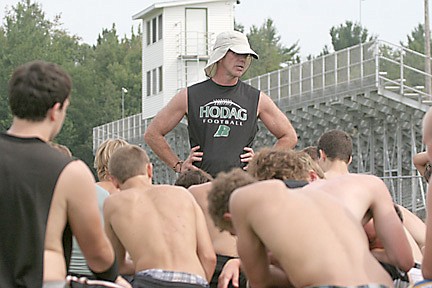
A local look at concussions: Part three
Improved awareness
Over the last several years, the awareness regarding concussions has dramatically increased. That seems to be the biggest change that coaches have noticed.
"I don't think back then, it was that much of a deal," RHS football coach Jim Moore, who played in the 1970s and began coaching at Wittenberg-Birnamwood in 1983, said. "If you got knocked out, or went to the wrong sideline or something, they took a look at you. Now, once you have a concussion, you have to get totally back and get the medical clearance. I think it's a lot better safety-wise to wait and get kids back in the game when they're ready."
"I think overall the public awareness has changed quite a bit, given the information that has been presented and put out there from all different sorts of agencies," RHS soccer coach Dan Millot added.
"Here in Rhinelander, we do an excellent job diagnosing concussions and staying in the forefront (of concussion awareness)."
It is an encouraging sign that the message about the seriousness of concussions is being received. Locally, one administrator said he is seeing a lot more students diagnosed with concussions than he used to.
"Working at the middle school, over the past year, we have dealt with more situations of head trauma than I did in the previous six years combined," said James Williams Middle School principal and youth sports coach Paul Johnson.
Johnson and Millot agree that a big reason in the increase of diagnosed concussions is greater awareness.
"I don't necessarily think more and more concussions are happening today," Millot said. "It's the fact that we are more aware, we are more educated as parents, as coaches, as players and we're making sure that we're taking the necessary precautions to make sure kids stay healthy."
"I'm not saying that we've had more incidents," Johnson added. "Maybe we have, and it's just a rash of incidents that have happened, but by getting the awareness out, people are treating them more seriously than they were in the past."
On the sidelines
A coach has a lot on his or her mind during the course of a game. How is the offense performing? How is the defense performing? Are there any adjustments in strategy or tactics that need to be made? Who needs to be in the game? Who needs a break?
But during this organized chaos, coaches are trying to keep an eye on their players, in case they have suffered an injury.
At the high school level, Millot said that the coaches have been made aware of the symptoms of a concussion and what to do if a concussion is suspected.
"We've all been trained and given sideline tests to administer," he said. "I practice caution. Again, it's a game. There are certain mandatory things. If a kid blacks out, they're not going back in. If a kid shows signs of dizziness or headache or the symptoms of a concussion, they're not going back in the game."
Part of the difficulty of spotting a concussion is that it may not always be obvious, like a player limping after turning an ankle. Also, players may feel pressured to hide their injury.
"The hardest thing is just educating the players themselves," Millot said. "There are players that don't want to disappoint their coach. They don't want to disappoint their parents. They don't want to let anyone down. They're going to go out and play whether they have a headache or not. I think it's up to us as professional staff to make sure we don't let kids talk us into letting them play. We've got to stick to our guns."
Both Millot and Moore said that by close observation, they are able to spot a player that has potentially suffered a concussion.
"There's a lot of stuff going on, but you can see if one of your guys is getting up slow and if he's shaking his head or just doesn't look right," Moore said. "As soon as you see that, you call for that replacement. He's going to hurt himself and he can't help the team if he's not 100 percent. We'll get him off, talk to him a little bit and if we're not getting the answers we want, we'll get the trainer to talk to him."
"During the middle of a game, that player is hard to spot, but you have opportunities," Millot added. "There is at least some point that you are zoned in on how that person is playing and can tell what level of play they are at. From my standpoint, it's not so much kids that get concussions from heading a soccer ball. That's the rarity. Kids in my sport get concussions from either head to ground contact or head to body part contact. You look at where collisions are happening on the field, where a kid may have gone down hard and make sure they are OK from what you see on the field and move on."
A few years ago, the RHS football team dealt with a situation where a player re-entered a contest after receiving a bell ringer and sustained another blow that caused him to be hospitalized.
"You don't have to be hit very hard to have this happen," Moore said when asked what he learned from that situation. "We looked at that hit over and over and over again. That second concussion is a very serious thing.
"The newest and latest helmets won't protect you. That's what he was wearing. Maybe the most important thing is to educate the kids and communicate with the whole team that we need to know if somebody's not right. Guys in the huddle might see that somebody's not right. We have to take care of each other and if there's a concussion we've got to get (that player) out of the game."
At the youth level
Wisconsin's concussion bill, which Gov. Scott Walker signed into law Monday, obligates coaches of any organized youth sport to pull an athlete from a practice or contest if they suspect the athlete may have sustained a concussion. It also dictates that the athlete may not return to play until being cleared by a trained medical professional.
While high school sport programs, like Rhinelander's, have protocol in place to meet these requirements, the law is designed to cover all youth sports, including those played outside the school setting.
"Youth sports rely on volunteer coaches and many of those are parents and they haven't had any formal coaching education and maybe are not up to speed on the current trends in how to handle those situations," said Johnson, who has coached youth basketball and Little League baseball.
However, most of these youth organizations have literature that addresses concussions.
Pop Warner, the sanctioning body of Rhinelander's youth football program, instituted new rules in 2010 that mirror Wisconsin's new statute. The head coach makes the first call and must pull a player from practice or competition if the coach suspects that the player has sustained a concussion. If a trained medical profession is on site, his or her call will supercede any decision made by the coach. If a trained medical professional is not present and the coach is the parent or guardian of the injured player, then the decision to remove a child from play will rest with the highest ranking Pop Warner official present. Any player removed from practice or competition cannot return to play without written clearance from a trained medical professional.
USA Hockey has similar concussion guidelines.
"It depends on each activity's sanctioning organization," Johnson said in regard to the current concussion procedures in youth sports. "In Rhinelander, baseball is Little League. Football has Pop Warner, Hockey has USA Hockey. I anticipate there will be more guidelines coming forth from those national youth sport organizations and that will drive the education part for the coaches."
Little League Baseball's website provides a link to coaches and organizations where they can take a free, half-hour online training course from the Center for Disease Control and Prevention.
While training may currently be varied for youth coaches, depending on the sport, Johnson said that, in general, coaches in the community understand the issue.
"The training that coaches get is probably very limited in scope," he said. "But my experience, the people I've coached with and the people have been coaching the activities my kids have participated in, I feel that in our community at least, we have individuals who place the health of the kid over the competitive end of the activity. To me, it's been refreshing to see that we have people leading these programs that appear to have it in perspective."
In the future
Wisconsin's new concussion law may be the tip of the iceberg. Moore said he suspects that limiting practices in full pads, like the NFL did last summer in reaching a new collective bargaining agreement with the NFL Players Association, will eventually funnel down to the high school level.
"It's usually a trickle down from the NFL and I see where the NFL is (practicing) in full pads once a week," he said. "I know that they're mostly in shorts and shoulder pads. They're really limiting how much hitting they are doing. I could see sometime them doing that here."
Moore added that his team typically does not conduct many full-contact drills.
"Once or twice a week, we might do a short little mini-scrimmage where we'll do 10, 12 plays or we'll work on our goal line (package), best on best and see if we can score," he said. "We won't do anything like 20 plays live. It goes back to being crisp and sharp and not having our heads have so much contact."
The way practices are conducted and the way concussion are treated will be shaped by continuing research, Johnson added.
"The data and the research has to drive our actions," he said. "If there is conclusive data out that shows that we are doing things that are putting kids in harm's way, I think we would have to look at adjusting how programs are delivered accordingly."
Jeremy Mayo may be reached at [email protected].
Comments:
You must login to comment.