November 13, 2017 at 3:38 p.m.
New foreman reports on streets
Mulhern: 'I know that the roads are in worse shape than previously reported'
New foreman reports on streets
Now, however, there is concrete proof the city's roadways are in need of improvement.
In a report to the city's public works committee Nov. 6, Rhinelander street foreman Dan Mulhern said he drove the approximately 65 miles of streets inside the city limits and learned that many more need urgent attention then was first thought.
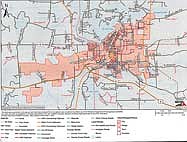
Mulhern also provided the committee with a map generated by the Wisconsin Information System for Local Roads (WISLR) grading all of the streets within the city limits on a scale from excellent to failed.
According to the Department of Transportation website, WISLR provides a system for local governments to report local road information (such as width, surface type, surface year, shoulder, curb, road category, functional classification, and pavement condition ratings) to the DOT. The system allows local municipalities to manage local road data to improve decision-making and to meet requirements set out in state statutes.
"I know that the roads are in worse shape then previously reported," Mulhern said. "You guys can just look at the colors (on the WISLR map) and see what is good, bad and otherwise on the streets."
Mulhern said he was presenting the information as a preliminary step and intends to come to the December meeting with some ideas on how to tackle the list of streets rated either 3 or 4 on the Pavement Surface Evaluation and Rating (PASER) system. Under the rating system, streets rated 3 and 4 are poor and in need of mill and overlay work.
The PASER system grades road pavement condition on a 1-10 scale. It was developed by the University of Wisconsin-Madison Transportation Information Center. The ratings are entered into the WISLR system and a map, like the one Mulhern provided the committee, is produced.
According to the map Mulhern provided, 37 streets within the city limits have a pavement rating of poor.
"We can put a worksheet together from this (data) with those that need the most work," Mulhern said.
In the absence of public works director Tim Kingman, interim city administrator Keith Kost offered additional information.
He noted that the Northeast Regional Planning has been using PASER for years and added that Mulhern collected the Rhinelander data himself.
"Which means that you drive every road by a state grid and you rate every road," Kost explained.
He said the WISLR is a relatively new addition to the way streets and roads are evaluated, and the data Mulhern gathered will go a long way in determining how the city can best repair the roads using premiere resort area tax (PRAT) revenue.
Kost referenced a graph in the packet of information the committee received that shows the city can expect a 8-percent rate of return on the investment if it spends $100,000.
"But when you start spending $300,000, you almost get a three-quarter rate of return," Kost said.
Also included in the packet was a breakdown showing how $250,000 spent on street repairs over a five-year period of time could be broken down between the seven levels of repair work ranging from simple sealcoating to full depth repair.
The rest of the report breaks down which roads should be addressed in each of those five years.
Kost said the report was just completed and Kingman and Mulhern expect to present a comprehensive plan for street repair at an upcoming meeting.
"I did some rough numbers, this month we should be getting the quarterly numbers from PRAT," Kost said. "But if we use Eagle River (which also has a PRAT tax), looking at this historically, this next month should be our largest payment. So if that's true, then for 2017, we'll have a little over $300,000 because we only have one month since we started in January."
He noted the payments are received not on calendar quarters but by tax period quarters.
Alderperson Mark Pelletier asked if only having one month in the first payment period of 2017 will mean none of the tax that will be collected on holiday sales from mid-November through December of 2017 would be included in that first payment.
"Correct," Kost said, before reiterating that Eagle River and Rhinelander are similar in economic makeup and so the PRAT receipts should track about the same.
"By May of next year, we should have about half a million dollars in the bank from PRAT," Kost said. "Once we get this next number, we'll really know. And I already gave you earlier borrowing scenarios, so that is what Dan and Tim are going to be coming back to you with is a combination of borrowed money, paying principle and interest, and other money that then flows into the PASER report."
"You're probably going to be looking at it in December and then making a borrowing decision in January or February and then you'll be ready to bid," he added.
Pelletier said it was probably beneficial for Mulhern, who was hired this summer, to do the ratings on all of the city streets.
"Now he knows what he's dealing with," committee chair Tom Gleason agreed.
In a telephone interview Friday, Mulhern cautioned the report is still preliminary and some additional work will be done on it before it has to be submitted to WisDOT by the middle of December.
Jamie Taylor may be reached via email at [email protected].
Comments:
You must login to comment.