November 9, 2017 at 4:19 p.m.
Golf course advisory panel hears from consultants
Final report won't be released until December
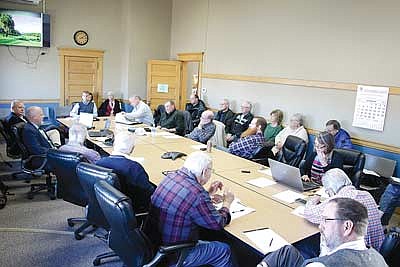
Golf course advisory panel hears from consultants
Matt McIntee, CEO of Green Golf Partners, along with John Rader, vice president of operations, provided an overview of their study of Northwood, along with some recommendations.
With the approval of the full City Council, the committee hired Green Golf Partners to accomplish three objectives: Look at the current management practices to see if they should be altered to achieve a positive financial impact, review and discuss the possibility of some kind of third party management arrangement and to also examine the potential economic impact os selling the course.
The city paid Green Golf Partners $10,000 to conduct the study.
McIntee said the staff and patrons of the golf course were very cooperative and "forthcoming about telling us how they feel."
"What we tried to do here is put a presentation together and try to keep it as simple as we could so that you could formulate questions, if you have any, prior to the report," he explained.
Northwood opened in May 1989 after the land was deeded to the city by Wausau Paper for the express purpose of building a municipal golf course. The course was designed by Don Herfort.
"It's a great golf course, bottom line it's a great golf course," McIntee said. "Golf Digest has rated it four-and-a-half stars, you were ranked as the number two municipal golf course in the country, which is saying something because there are a lot of city-built golf courses from '98 to 2003, and they built some really great ones. And you were ranked 16th in Golf Digest for courses $50 or less."
According to the executive summary of the presentation, Northwood is a "very unique project" due to the relationship between its quality, location and demographics.
"Without question, Northwood is one of the finer 18-hole municipal facilities in the United State," the summary said.
"The challenge is it was built in Rhinelander, Wisconsin," McIntee explained. "I love Rhinelander, but the surrounding demographics are not rich; you do not have half a million people and 40,000 golfers. The industry average for the state of Wisconsin for participation within a 20-mile radius, you're lucky if you have 38,000 total golfers. And of those 38,000, they play all the golf courses, so you're splitting that pie with a few people."
McIntee said Northwood's strength is that it is a highly-ranked municipal course and its weakness is the limited local demographics and the difficulty of the course. The difficulty rating for Northwood puts it in the top 15 courses in the state, he explained.
"One of the challenges of having a hard golf course is it impacts frequency (of play)," he said. "Sometimes people will get fatigued and they will play somewhere else. Some people simply won't play because it is too hard."
The consultants also noted the longevity of the course's leadership.
"If you look at the history of the club, there are some really rich elements of it, one of the neat things is the golf professional (Dan Buckley) is like the Bobby Knight of golf professionals, he's the only guy who has ever been there," McIntee said. "He is one of the longest golf professionals in the state."
Two major threats to the course are the area competition and negative press coverage of the losses the course has racked up in recent years, he continued. While the consultants did not dispute the accuracy of the media coverage, having the matter in the local media gives the average person a negative impression of the course, McIntee said.
"People are going to read into any article what they want to see," he said, adding that the reality is the golf course is in really good condition for its age. The only deferred maintenance of any visible note is the condition of the bunkers, he added.
Another thing that is hurting Rhinelander's golf course is the overall state of the golf industry, with municipal golf courses taking the hardest hits, he said.
"Two of the municipal golf courses that we have dealt with this year have a significant amount of loss, much more than you do," McIntee told the committee. "And in both cases they tried to make changes to their operations and were unable to do that due to pressure from the local community."
The golf industry was very robust until about 2007, when an overall economic downtown hurt many industries, he noted.
"If you couldn't make money before that it was either a demographic issue or you were running your property poorly," he said. "In the old days, you could be dumb and make money, today you can be smart and still lose money. More golf courses close every year then open. In fact, if there is one single new golf course in the United States for a year, it's the biggest news in our industry, where if you lose 150-200 golf courses a year (it isn't news)."
"The biggest reason is there are just too many darn golf courses," McIntee continued. "In 1990, the National Golf Foundation published a study that said in the United States, if we opened up a golf course a day for a decade, we would not meet the demand. At the time, there were 28 million golfers in the United States, and today there are 28 million golfers in the United States, so the pie got split up a lot."
The demand in golf hit bottom in 2013, but better number have been seen more recently in certain locations.
"It's still extremely hard work," he admitted.
Municipal golf courses have unique problems because they are taxpayer-subsidized and taxpayers are growing weary of footing the bill, he explained. To combat this, successful city courses have had to turn to other non-golf related activities to maximize revenue and change their management practices to make them more economically efficient.
"When I started in the '90s, it was kind of a 'build it and they will come' attitude," McIntee said. "Now if you're not a serious businessman, this is not a business that you should be in because every element of this business has increased tremendously in terms of cost."
In reviewing the various departments at Northwood, McIntee noted Buckley is responsible for all golf patron activity except for food and beverage service. McIntee said pro shop merchandise, which is considered working capital, is a concern and programming of events has been consistent from year to year. He noted that there is no formal customer service training for those employees who interact with customers while the resident rate is limited to those who reside inside the city limits.
"The golf department, think of it more as the heart and soul of a golf course," McIntee said. "Every patron comes through that department."
On a busy day, an average employee in this department could have 1,000 encounters with patrons, he added.
"The world of golf has changed tremendously and it has put the most pressure on golf professionals," he said, noting that social media is a double-edged sword as it can be used for marketing a course but is also a conduit for negative customer feelings.
"Every point of contact now is so important because if you don't get that right, there are so many more outlets with social media and everything else out there, the word will spread pretty quickly," Rader said. "And word of mouth is key. You have Instagram and you got Facebook, you've got every media outlet, so if you have one bad contact and the pressure is on. And you're going to get hit by that."
McIntee said the overwhelming number of Northwood patrons who responded to the Green Golf Partners survey said they learned about the course through word of mouth, which is a positive sign.
According to Rader service, price and product are the keys to a successful golf course.
"If one of those gets out of whack, you can have the best golf course in the world and someone would be willing to pay for it, but if they don't get the right service, they're not going to come back," he said. "It's as easy as that."
McIntee noted that course superintendent Joe Anderson has been employed by the city for a number of years and has comprehensive knowledge of the property and truly cares about the facility.
"Joe is a key component to the club's overall operations," according to the summary.
McIntee said Anderson is doing a great job juggling a number of responsibilities and still maintaining a high quality municipal golf course on a budget.
Turning to the food and beverage department, McIntee said while they were not able to observe Mulligan's operation during the peak summer period, the patron survey provided a wealth of information.
According to McIntee, 80 percent of those who took the survey want to see more on-course food and beverage service. In addition, there is no cohesive working or marketing relationship between Dave O'Melia, who has the lease for Mulligan's and Buckley, he said. Mulligan's also suffers from an overall lack of identity and marketing, he said.
"We spent a lot of time focusing on what it should be. I'll give Dave all the credit in the world, but it is not a full-service restaurant," McIntee said. "That is a tough row to hoe."
The consultants mentioned consolidating the food and beverage and golf operations under one manager and said they would not recommend a full service restaurant.
As they studied the structures and equipment, the consultants said they found that the golf course is in great shape. However, they did identify some capital improvements that are needed, such as improving the bunkers and fairway turf, updating the irrigation system and replacing aging golf equipment. A capital improvement plan that includes all structures and associated equipment should be developed if the city plans to continue operating the course, they said. At some point, the cost of maintaining equipment will exceed the cost of replacing it, McIntee noted.
In looking at the business operations, McIntee said standard operating procedures need to be developed for all departments and be enforced. He noted there is no employee handbook, no job descriptions, formal safety or service training, a lack of progressive discipline and no performance reviews.
"You really have no approach to (human resources)," McIntee said. "That's a challenge in today's world. I don't know if you want to continue to go down that path."
The summary also listed critical areas that need to be addressed immediately beyond standard operating procedures.
These include:
• Improve analytics of key performance indicators (KPI).
• Stabilize management and improve communication.
• Manage the gap between food and beverage operator and golf professional.
• Improve reporting.
• Utilize technology more efficiently.
• Maximize the use of the course's website.
• Enhancing financial reporting.
• Better utilization of the point of sale system.
McIntee again stressed the immediate need to create standardized operating procedures as a way to tackle the list of needed improvements.
On the financial side of the operation, it was noted that revenue at Northwood is down $80,000 from 2013-16 while expenses are down $95,000 for the same time period. However, McIntee noted that $45,000 of that decrease was due to a decrease in depreciation.
"You have reduced spending on minor equipment," McIntee said. "What that tells us is you are spending more on true expenses."
He also said that the percentage of spending based on income is high for course operations, the clubhouse and pro shop. This is due to a compressed revenue stream, but there has not been a glaring increase in expenses in any of those operations, he added.
"Develop a plan to address increasing revenue, reducing expenses or sell the club," the summary recommends.
"I'd like to make it sound brilliant, but it's not; it all comes down to simple math, 2+2," McIntee said.
Also hurting revenue, McIntee said, is the lack of a marketing plan beyond what is being done by the chamber.
McIntee said the committee should develop a marketing plan now for the 2018 season that targets both the local and tourist market.
A local pricing structure should be created that would improve revenue while creating goodwill with the community, while the overall pricing structure should be examined to look for opportunities for competitive separation and promote this with the marketing plan, he added.
Part of the consultants' study involved having a golf course broker evaluate how much money Northwood would bring in if it were sold. This process was made difficult because nationally the market for golf courses is limited, McIntee said.
"It truly is a buyers' market," he noted. "All of the major sources of financing for major golf course acquisitions are gone."
There would certainly be interest in Northwood, due to the quality of the course, but based on the broker's analysis, the value of the club would be between $500,000 to $750,000, he advised.
"You guys have to come up with a plan of action," McIntee said. "Your results are your results, this isn't Enron, if you continue to go down the same path, you have some idea of what to expect."
He then listed the city's options as follows: run the course as it is now, make some changes, bring in a third-party to run the course, or sell it.
Alderperson Steve Sauer said the uncertainty surrounding the course's future may be contributing to the revenue problem.
"I know a lot of people who would buy memberships, but they're saying 'I'm not going to buy a membership if the thing isn't going to be there next year,'" Sauer said. "Dave is running into the same thing with booking Christmas parties (at Mulligan's)."
If the city decides to keep Northwood, McIntee said it would be imperative to expand to include winter activities and hiking and biking trails so the course becomes a destination for people who don't golf.
"Every operator who is very good at this point is not focused solely on golf," he said.
No matter what option the city chooses, hard decisions will have to be made, he concluded.
Ten years ago, the people of Rhinelander would have been demanding the city keep Northwood at all costs to provide a recreational opportunity at the best possible cost "but in today's world, I'm seeing more and more people agonize. Even the ones who love to golf are starting to really agonize," McIntee said.
After the presentation, Kelly was asked for his thoughts on the consultants' summary.
"I'm still trying to process it all," Kelly said. "We don't even have the report yet."
Jamie Taylor may be reached via email at [email protected].
Comments:
You must login to comment.