July 24, 2017 at 3:51 p.m.
City defends PRAT referendum info
Mayor Johns says state miscommunicated; DOR says all information available on its website
City defends PRAT referendum info
Proponents of the tax reiterated that message when the City Council sought an exemption from the requirement that at least 40 percent of the equalized value of the taxable property within the county be used by tourism-related retailers.
The Wisconsin Department of Revenue and the state legislature granted the exemption and the tax has been collected since Jan. 1, 2017.
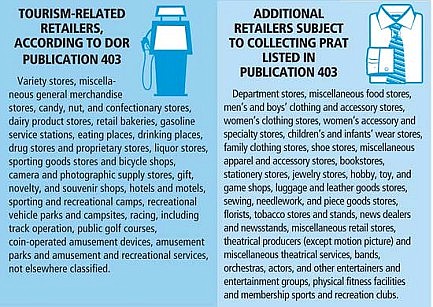
Shortly after the tax went into affect, residents noticed that the half-percent tax was being collected by a large number of city businesses on goods and services that appear to have little to no relationship to tourism.
The frequently asked questions section of the DOR website contains a detailed list of the Standard Industrial Classification (SIC) codes for all retailers that can collect the tax. These businesses are also listed in DOR Publication 403, last updated in August 2016, which includes comprehensive information about the PRAT.
The question is, did city officials know that the tax would be applied to such a wide variety of items? That question was posed to mayor Dick Johns and alderman Mark Pelletier, chair of the city's finance, wage and salary committee, both of whom were major proponents of the tax.
In an interview last week, Johns said he did not recall seeing an earlier version of Publication 403 when the PRAT was first being explored.
Johns said he worked with Pelletier, then finance director/treasurer Julie Ostrander and former city administrator Blaine Oborn on the PRAT proposal eventually approved by the council Nov. 17, 2014, and the information he was given was that only tourism-related businesses would collect the tax.
"That is all I ever got out of the Department of Revenue," Johns said, adding that there was some miscommunication in the early stages within the core group of himself, Ostrander and Oborn.
"I got some information that they didn't get and they didn't get some of the stuff I got," he said.
According to a DOR press statement in response to questions sent regarding the city's claims, Publication 403 was updated in August 2014 to reflect the addition of the village of Stockholm as a new premiere resort area.
"The publication dates back to February 1998 with updates since to reflect law changes. New business codes have not been added or amended since 2005 Wisconsin Act 25," the agency said.
The statement also said that the PRAT FAQ on the department's website has been online since at least Aug. 2, 2006.
Johns said the information he received from the DOR was not as comprehensive as it could have been. However, the DOR insists that all information on PRAT was available on its website when the city started exploring the idea of declaring itself a premiere resort area.
Interim city administrator Keith Kost stressed that the state makes the rules when it comes to the tax.
"You have to remember that is always evolving down at the state," Kost said. "The state controls who gets taxed and who doesn't. The city has nothing to do with that at all. So Menards and Home Depot don't get taxed, it all revolves down to the state and how they classify businesses."
The last update to Publication 403 was in August 2016 when it was announced that Rhinelander would start collecting the tax on Jan. 1, 2017.
The DOR clarified why Menards and Home Depot do not charge the PRAT.
"A business primarily engaged in selling lumber and a general line of building materials to the general public is classified under SIC code 5211, Lumber and Other Building Materials (home center stores) SIC code 5211 is not identified in sec. 77.994, Wis. Stats. Therefore, sellers classified under SIC 5211 are not subject to the Premier Resort Area Tax," according to the statement.
"All of the information we received on this was supposed to be kept confidential due to the people who are collecting this tax, they don't want that known," Johns added. "They don't want the four of us (himself, Kost, Pelletier or current finance director Wendi Bixby) to know who they are. We don't have to know."
In its statement, the DOR noted PRAT is a self-identify/report tax.
"Retailers who are subject to the PRAT self-identify/report and pay the tax, just as other businesses and individuals do for other types of taxes. We encourage municipalities to work with their area businesses to discuss whether the business falls within any classification subject to the PRAT," the statement said. "We commonly receive questions from customers, businesses, and municipalities related to the appropriate tax rate a business must charge. We respond to these questions as we receive them."
Kost said that the city receives information on how much PRAT individual businesses collect, it just can't share that record with either the public or the media.
"We can actually get a list of businesses that are collecting it so that we can address if there is any discrepancy," Kost said. "But there is a confidentiality agreement, by state statute, that even has possible criminal prosecution attached to it, that can't be disclosed."
Kost added that the information is considered privileged.
"It's just like someone's tax return," he said. "By state statute, that information is not public."
DOR officials confirmed this by providing the applicable statute, Section 77.61(5)(a), which prohibits disclosure of confidential taxpayer information.
While the tax is being collected on items that may not be considered "tourism-related," that is missing the point of the city's designation, Kost added.
"Remember, it is the premiere resort area," he said. "It's because we are a resort area, it's not just on tourist items. It's because we're a resort area that we can do the tax. It was never intended to be just on tourist items, it's because we're a tourist area that the tax is imposed."
While the half-percent PRAT that Rhinelander has is the same as the cities of Eagle River, Bayfield and the village of Stockholm. The city of Wisconsin Dells and neighboring village of Lake Delton both charge 1.5-percent PRAT.
"Down there, they are saying they could pay their taxes out of them, they cut their taxes with all they got to control down there," Johns said. "I also think they are handling it differently than other areas of the state."
Before the first article on the list of retailers charging the tax appeared in the July 18 issue of The Northwoods River News, Kost said he had received only one PRAT-related phone call. Johns also said he received only one call. Both men reiterated that the PRAT receipts are extra money available to the city that is dedicated to infrastructure repairs above and beyond what the city funds through property taxes.
"Nobody is complaining that we're hearing," Kost said. "My one call was from someone who had been in an establishment and they weren't charging the tax and (the caller) felt they should. After I talked to (last) Friday, I did receive another call from a local bookkeeper who said they have two businesses who haven't paid that tax yet they collected it, how do I do that? I told them to go to the (DOR) website."
Kost said that the premiere resort area designation means there is increased traffic on the major streets in town.
"We are a city of a little less than 8,000. On a daily basis, 22,000-25,000 (cars) come here every day. And during the summer, what is it, 30,000-35,000 or more on a daily basis? If you have 35,000 people coming on your two major arteries, beating the roads down, this allows you a way to collect some money to fix that infrastructure," he said.
Johns said he was contacted recently by a city official in Minocqua who had questions about how to implement a PRAT there.
"They asked me how I did it and I said you need a referendum," he said. "And that was the end of the conversation. I didn't give them any more information because I can't."
In a separate interview, Pelletier said he became involved in the push for the PRAT after the ball had been rolling a while and was shocked when he saw the story published July 18. He agreed with John's assertion that everybody had parts of the puzzle and there was never a point where everyone put everything together to get the whole picture.
"The real part of the puzzle that was always missing was the state's, the state's input as far as what qualified and what didn't," Pelletier said. "You knew it was 100 percent under their control, you knew that every business has a code number depending on what it is that they sell and what it is that qualifies, and yet they never really came forward until we actually got rolling on the true impact."
He admitted to being surprised by some of the merchants listed in the July 18 story as collecting PRAT.
"We were never provided that information," Pelletier insisted.
As the operator of a print shop, Pelletier said he sells items, such as maps, that could be considered subject to the PRAT.
"Yet, according to according to the state, we have nothing," he said. "Our code number is not the right one."
Pelletier said he thinks the lack of clear information the city received in the run-up to the referendum is a function of bureaucracy.
"I don't think they intentionally held anything out, because there was nothing for them to gain out of doing so," he said.
He added that he thinks the increase in the number of municipalities looking to declare themselves premiere resort areas may have prompted the DOR to make the information more complete online.
"Sturgeon Bay is looking at it, Minocqua is looking at it," Pelletier said. "I think communities are starting to jump at this, and we kind of led the way. I mean, there aren't that many (municipalities) out there that have done it."
He added that the businesses collecting the tax have to be the same for every community, so Rhinelander is not unique in unexpected consequences. Like Kost, he also stressed the ongoing benefits the city should see as a result of the tax.
"If there weren't all these stores on Lincoln Street drawing in all these people into town, we wouldn't have a five-lane out there," he said. "The locals wouldn't have to support paying for a five-lane. It's something good because if a Target ever wanted to come to town, the city would have to do a lot of extra work on it - and that's not a bad thing - but what is gained out of it?"
While the addition of a box store would not add that much to the property tax base, it would bring a lot more $9 an hour jobs, he added.
"And the extra money that is gained (from the tax) can be used to fix the roads," Pelletier added. "So there is something good to gain out of this."
Jamie Taylor may be reached at [email protected].
Comments:
You must login to comment.