July 17, 2017 at 4:25 p.m.
Gov. Walker's opioid abuse task force meets in Minocqua
Larson: 'We just do not have enough treatment'
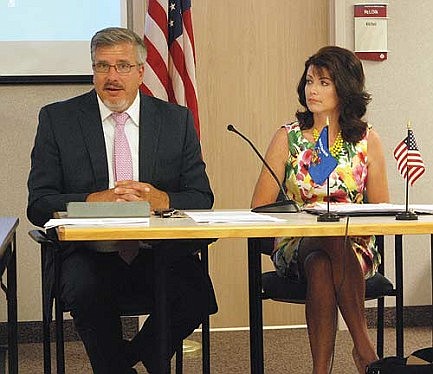
Gov. Walker's opioid abuse task force meets in Minocqua
Kleefisch and Nygren are co-chairs of Governor Scott Walker's Task Force on Opioid Abuse and the stated purpose of Friday's meeting, according to task force officials, was to continue its work on ending that epidemic.
The topics included substance abuse in tribal communities, national substance abuse trends, federal legislation and grants.
Not enough treatment
Dr. Michael Larson, a clinical psychologist in pain management at Marshfield Clinic, opened the meeting.
"I thought about how I interact with opioids on a daily basis in my job," he said. "I work in a pain clinic. We prescribe opioid medicines. What we've found is opioids for chronic non-cancer pain don't seem to make people better. And so, we have started to reduce opioids in our program and we have found that when we educate patients and we support them and when we teach them about the body, mind and spirit and the power of those things, people can get off opioids and do a wonderful job."
Larson said the opioid prescription rate has been reduced by 87 percent since 2011.
"That's a massive reduction," he said. "You can imagine how difficult it is when you go into a room and tell a patient who has been on opioids more than 10 years that 'I'm going to take you off those opioids and you're going to get better.' That doesn't fly very well. It's a tough job."
Larson said strategies have been devised to educate patients and by doing that, they've gotten better.
"We've done it over a thousand times since 2011," he said.
Larson is also the director of scheduled medicine for the Marshfield Clinic Health System.
"So, I oversee opioid prescribing for the entire system," he said. "One of the things I'm aware of is how much we prescribe, how little we prescribe, who prescribes well, who prescribes not so well. And we are down 14 percent since 2015 because we are taking our role in this problem seriously."
Larson said one thing he's done recently is train over 700 providers and staff at Marshfield Clinic facilities in new state guidelines pertaining to the opioid problem.
"They are excellent guidelines, by the way, in terms of how we should be prescribing opioid medicines for chronic non-cancer pain," he said. "One of things I heard consistently from all those people at those centers is every community is impacted by opioid addiction."
Larson said he's also heard every community lacks treatment resources.
"We just do not have enough treatment," he said. "That's our concern today."
Larson said he also works with the HOPE Consortium, a network of providers in Vilas, Oneida, Iron, Price and Forest counties and three tribal communities "to work on the issue of opioid use disorders, which is a term we use for a person who has developed an addiction to opioids."
"Whether prescription opioids or heroin," he said. "That HOPE grant we received came through Representative Nygren's exceptional leadership and that's been one of the impressive things throughout is the state of Wisconsin is not waiting for somebody else to do the service. Our state is doing it ourselves and giving people and communities the resources and tools to get better."
Larson said what's been done with the HOPE Consortium is tie together treatment resources and providers throughout the system to work on prevention.
"Work through our counties to make sure whenever a person requires treatment for an opioid use disorder, there is no closed door," he said. "Every door is open. Wherever they go they will get treated."
Larson said a care coordination model has lso been established.
"It's incredibly important," he said. "When a person has an opioid use disorder, what ends up happening is lives are shattered. It affects every part of their life. It impacts their family life, their support structure, their jobs. It influences their parenting and their financial status. When they come into treatment, they need help. They need the counseling and the medicine to support that, but more importantly they need that person there to support them, get them in touch with the resources to get transportation, get child care, get a job again, get back to living because they are struggling. We have made differences there."
Addiction and recovery
Larson's other position is with the Marshfield Clinic's addiction and recovery center for its Family Health Center.
"That started in the fall of 2016 when we realized we were lacking treatment resources in our area," he said. "What we see in our program is people come in with this horrible disorder and their lives, are, again, shattered. They need help, they need the true treatment, the AODA counseling."
AODA refers to alcohol and other drug abuse.
"We also use medication-assisted therapies to support that treatment," Larson said. "We can't just prescribe medicines, we can't just prescribe our way out of this problem. We have to have more AODA resources. Within our program, they have access to that care coordination."
Every person in the HOPE Consortium's coverage area, the five counties and three tribes, has access to that treatment.
"We want people to get better," Larson said. "When we see people recover, there's an energy. We can see their lives coming back together. That's critical for us to see because we need to see. We need to get people better."
Larson said the Lakeland Area Drug Abuse Task Force was formed in 2011.
"It was a tense first meeting," he said. "We brought together tribal officials. We had law enforcement, medical providers, treatment experts. In that room, at that first meeting, we had a lot of blame. We had a lot of anger. People's friends and family members were being effected by opioid use problems."
What had to be done, Larson said, was eliminate the anger and "fear of each other and break down walls."
"We did that pretty effectively," he said. "What we did was we started to do basic initiatives that showed that we could work together and start to reduce the prescription opioid abuse problem. Of course, when we did that, other things came to fill that supply. But we were successful in that."
Just at the Marshfield Clinic's Minocqua center, Larson said opioid prescriptions for chronic non-cancer pain are down 72 percent since 2011.
"This area has been leading and we're glad to see that but we have a lot of work to be done," he said. "As we heard from our law enforcement members of the task force, the second we reduced the (opioid) prescribing, then came heroin. And now methamphetamine. And now we have a big issue and a big problem. We have to realize these medicines or substances have a very powerful effect on the brain. They're influencing people from that first use. When a person experiences that severe euphoria, they're changed."
They'll use again and again, Larson said, and the use will soon disrupt the person's body so much they don't get a high but have to use to feel normal.
"When they don't use, their cravings are so intense, they're willing to do anything to access that substance," he said. "That's the problem that leads to shattered lives. Huge problems. If the craving is there, are they going to worry about their parenting? Or the food on the table? Or their job? Absolutely not. That craving is too intense. That's the problem we have in front of us. Once people are exposed to these substances, they cause massive problems. So, we have to do everything we can in prevention efforts to be sure we stop that first exposure."
That first exposure, Larson said, could be through pain medication for surgery or pain medication that might be in someone's medicine cabinet.
"Or actual use on the street," he said. "We have to get away from this philosophy that a medication or a substance is required to make us feel good. Because we've gotten really bad into that in our society. A medicine is needed for everything and I can tell you a medicine is not the answer for this problem. We have to treat our way out of it and we have to prevent our way out of it."
Some new laws for the issue
Kleefisch said she was astounded by the opioid abuse reduction numbers Larson mentioned.
"These are bold," she said. "Your movement on the forefront of combating opioid abuse is significant and noted."
Kleefisch gave a lot of credit to people like Larson and noted their efforts resulted in Walker signing 11 new laws Thursday.
Nygren said the bills, which passed both the state senate and the assembly, include those that deal with increasing treatment and diversion funding, and expanding the good samaritan law to the overdoser "which is a positive step."
"We have a civil commitment bill, which can be a little controversial," he said. "But when you have a loved one or family member who's struggling with addiction, it may not be the first resort you want to head to to be able to protect them from themselves. But I think it's an important lever we have in Wisconsin once it's signed into law."
A charter school for children in recovery will also be created by a bill signed by Walker.
"Going back to the same environment that they came from is often times detrimental to long-term recovery," Nygren said. "So, supporting them with counseling and ongoing peer support is what we believe will be helpful."
Also signed into law was a bill that he said will create two or three more HOPE centers like the one at Minocqua "depending on the actual cost."
"We changed the language so it's not just rural anymore," Nygren said. "It could be anywhere in the state."
He added the language in that bill was also changed to reflect it wouldn't pertain to just opioid addiction as there's been in increase in methamphetamine abuse in the state.
"There might be different treatment protocols but we believe providing the resources providing that treatment is important," Nygren said.
The bill signings took place in Green Bay, La Crosse and Wausau.
Brian Jopek may be reached via email at [email protected].
Comments:
You must login to comment.