August 25, 2017 at 3:44 p.m.
StreetSmart
Parents ask questions about new curriculum, tour mock teen bedroom
StreetSmart
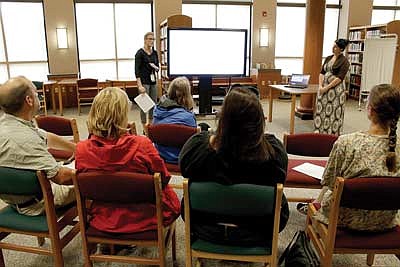
The school board approved the new curriculum in July. The two instructors, Maria Otterholt and Meagan Otto, community health specialists at the Oneida County Health Department, hosted a community introduction to the course Monday evening in the RHS library so that parents could learn more about the lessons to be taught and ask questions.
According to Otto and Otterholt, some of the benefits to the Street Smarts program, in comparison to traditional health classes, are that it is more personalized and students will have an opportunity to practice the skills they are taught. The curriculum is designed to arm young teenagers with the knowledge they need to make informed decisions while remaining true to their own core values and beliefs, the educators said.
The almost two-hour presentation started with a tour of a mock teen bedroom, provided by the Taylor County Drug Opposition Partners, so the parents could learn how some teens hide drug and alcohol use in plain sight.
Lori Duginski led the small group through the room, which featured many containers that appear to be common products but are actually used to conceal drugs and alcohol. Other common items in the display could be used for using drugs. Also on display were signs and other indicators parents could look for that are subtle messages that teens are using drugs.
Duginski said the health department invited her to present the display during the parent session.
"The TCDOP has toured the bedroom to several northern communities recently," she said.
After allowing the five parents in attendance to walk through the display, and pointing out the many not-so-innocent items, she answered questions for about 10 minutes.
One mother said an item that appeared to be an ordinary commercially- marketed bottle of water, but is actually used for storing drugs, would have completely slipped her notice. She asked where teenagers learn about these products.
"They learn from their friends, the internet, magazines," she replied.
Otterholt and Otto then ran through the presentation they made to the board of education at the panel's July meeting. This included a listing of the lessons and what would be taught in each. After the presentation, they took questions from the parents in attendance, some of whom said they were representing some of their friends who could not attend.
The health educators explained that the class is taught in a small group setting and they don't stand in front of the class lecturing. Instead, they sit with the students in a circle and interact with them in a more casual way.
The biggest concern the parents' raised was related to the third lesson which deals with safe sex and birth control.
One woman said she and her husband have frank conversations with their son about sex and the importance of abstinence while he's young and wouldn't want him to attend that portion of the class.
"When I read the newspaper article, it did say this course is all or nothing, so you can't opt your child out of just this part," she said.
"The program builds upon itself, so you would not be able to pick one piece out because that's not how the evidence behind which this is based is set up," Otterholt replied. "So it is an all or nothing with the opt out."
"There are a lot of themes that are woven through all of this that we want them to be confident with their peers," Otto said. "If we're talking about sex, we want to make sure that they're confident communicating to their boyfriend or girlfriend that they don't want to, that they want to wait. We want to make them confident in wanting to say that. Or, if they are ready, we want to make sure that they are confident enough to talk to their partner about wearing a condom and really making it a safe experience."
The educators confirmed that part of the lesson will involve teaching teens the correct way to put on a condom. An anatomically correct dummy will be used during that lesson, they added.
After the educators demonstrate the proper method, the students will have an opportunity to put condoms on the dummy.
"There is no way around that, they do get to try things out," Otterholt said. "I think the main point about that is, if you open a male condom, we'll use that as an example, and you were to put on the condom and not leave a little bit of room at the top so when the male ejaculates there's not enough room for that. That is how a lot of condoms are breaking and that leads to unintended pregnancy. So it might sound scary to think about opening one up and trying it on but, again, the goal is to have them just know it. Because if we don't teach it to them, who is? Who is talking to them about this stuff?"
Data gathered through surveys of high school students indicates that no one is teaching teens this information, they added.
However, the educators stressed that no student would be forced to do anything that would make them feel uncomfortable or go against their beliefs.
One mother said she could see that the class would be good for "at risk youth" who don't have caring adults in their lives, but not necessarily appropriate for those students who do.
She said she didn't want her son feeling awkward about learning about the material in lesson three, especially in a co-ed classroom, and would have him opt out for that reason.
"That became kind of a hot word for me, 'at-risk,' because any student is at risk because they are hearing the wrong information just coming at them left and right," Otto replied. "And any student is at risk to make a bad decision. So there is not just a specific youth. Some are at higher risk, I guess, but this program does an awesome job of reaching each student where they are at."
In the after-school version of the class the educators have been teaching, some students who were not doing drugs and even some who were "were very open about talking about it with us," Otto added. This also extended to those students who were not sexually active.
"When we started this a few years ago, we had the same thought processes that you did," Otterholt added. "But it was not until we made it through our very first round, all eight sessions, that we realized that 'Oh boy, we made a mistake. This is for everyone.' It was mentioned by two or three (students) that I can remember that were in that class that said why isn't everyone learning this?"
If a student who is a star athlete comes into the class knowing that drugs could derail their career and a chance at a college education, they come away with heightened awareness of the risks of doing drugs after completing the course, she added, noting the same effect is also common in those students who are not yet sexually active.
"It's a value that they probably already have, but it is so engrained in them that they would never even think to do it," Otterholt said.
At the end of each semester the students will take surveys that will help the educators fine-tune the class for future semesters, Otto and Otterholt said.
After the presentation, Otterholt said this would most likely be the only education session for parents about the Street Smarts program, unless a lot more questions arise before spring semester.
Otto said she has received about five phone calls at the health department about the class. Otterholt said she hasn't received any.
"It was a couple people saying they are glad we are doing this while a couple had a few questions about the class," Otto said, adding that she is optimistic that the lack of complaints and the low turnout for the parent meeting will lead to a very smooth introduction of the curriculum this fall.
"I think the community is very receptive. Before we even thought of bringing this program, we did a community readiness assessment and through that data we saw that our community was ready to take this on," she said. "So we kind of knew this would be pretty seamless."
Otterholt said the parents' concerns about safe sex and birth control are understandable, but the students are already getting this information from other health classes.
"This is just another method by which they are hearing it," she said. "And they are hearing it everywhere, we're just giving them the right information, the correct information."
Jamie Taylor may be reached via email at [email protected].

Comments:
You must login to comment.