August 21, 2017 at 3:35 p.m.
A tale of two Stevens Street parking lots
Parking Advisory Board discusses options for both
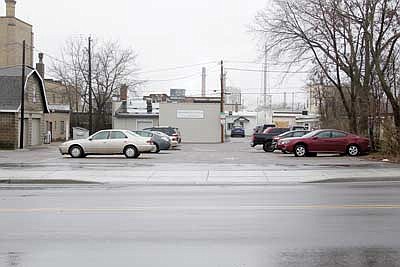
A tale of two Stevens Street parking lots
The committee discussed that difficult decision Aug. 9, as well as plans to redo the parking lot on North Stevens Street across from the library, as part of the process of seeking bids for the street projects the city intends to fund using premier resort area tax (PRAT) receipts.
Despite a minor delay, public works director Tim Kingman said the Kabel building came down as planned.
"It went well, we're actually cutting a check to the contractor after council approval," Kingman said. "They are on budget, there was a couple extras, but this is all working out fine."
The committee opted not to remove the majority of the basement walls and floor on the Kabel Auto building, just as it did with the dry cleaner building, and thus the project was less costly then expected, Kingman said.
Kingman then presented the committee with a preliminary design for turning the two parcels of land into a standard parking lot with 34 spaces.
"As you recall, the Rhinelander Community Foundation was in here and they have some ideas on what a parking lot should look like, as well," he said. "They like a little more green space."
Kingman said his preliminary design includes two prominent features.
"One, you are maximizing the number of stalls that can be used in its present state, which is 34-35," he said. "However, the other thing that's here that is not as intuitive is that on the west side of this lot presently there is power poles in there. You've got to drive around those, the way this is. If that were extended out further, you could actually get the parking lot to five or six more stalls."
Talks are underway with the utilities serviced by the poles to have the lines moved underground, he added.
"What we know is that WPS is able to do this for about $15,000 and there is private utility costs otherwise," Kingman said. "So there is a number of hurdles here that could maximize the number of parking spaces, or use of the space better."
He later said ArtStart also has some ideas for using its space differently, if the power lines were to move underground.
"They would like a stage or back area where they can do more functional things and that would require landscaping which would require taking the power poles down and stuff like that," Kingman said.
It is hoped that all sides will reach an agreement with the city this fall or over the winter in order to get the lines underground. The city's share of the costs would be subject to negotiation, he added, noting that he has only started negotiations with WPS and has no idea what the starting point with the telephone or cable company will be.
Committee chair Mark Pelletier said the city's final cost may not be borne by parking advisory, but it is too soon to tell.
Alderman Steve Sauer said the "private money" involved would be the business customers serviced by WPS from the poles who would have to alter the wiring of their buildings to be able to access the line coming from underground.
"Which is a pretty big hit (financially) right now," Sauer said. "(That's) why it's probably not a good time to ask just yet."
Sauer also noted that the diagram Kingman passed out includes the private alleyway on the back of the lot.
"Is it the intent to try to get easements along those properties so that is opened up?" Sauer asked.
"There is no intent on any of it yet," Kingman replied. "But this is how you hope to resolve this. I have a feeling that there will come a time where we'll have to consider if this should be right of way. So far it's been close to private land use and we've been able to shoehorn a parking lot into the space."
Sauer said that this lot serves an important purpose for parking in the downtown area, especially since some spaces were lost as a result of the downtown project.
"But I really like the ideas that the community foundation is coming forth with, and it may cost us some spots, and it may cost us some actual parking spaces," Sauer said.
While there is no commitment of funds from the foundation to help make the new lot more aesthetically pleasing, Sauer said "they are a group that makes grants to make things happen." He pointed to the new docks at the beach at Hodag Park as a recent donation the group made to the city.
"The expense of doing it this way (gesturing at the diagram) is what we're looking at," Pelletier said. "If anybody wants above and beyond..."
"They're going to have to pay for it," Kurt Hildebrand interjected.
"Pretty much," Pelletier agreed, adding that McDonalds may chip in some funds for the upgrade of the space.
"This is right across the street from them, they wanted it down as much as anyone did," he said.
The space is currently uniformly covered in gravel and will settle until next spring before any work will be done. This gives the committee, the foundation and DRI time to explore all options for finishing the space. Kingman said some members of the community foundation have already submitted preliminary designs for the space that would include parking spaces, but at the same time would also interject some green space and multi-functional elements.
"It couldn't be any better that the land needs to settle because that lets a lot of the dust settle on what can be done and what can't be done and what financially can't be done," Pelletier said.
"We're trying to keep our options open," Kingman agreed. "It's a complicated project for the amount of space we got here, but it's the end goal to get the max use out of it."
On the North Stevens Street parking lot, the committee has been discussing subtly changing the contour of the lot, along with adding a storm water drain in the middle to alleviate drainage and flooding problems. The committee was previously given an estimate of $10,000 to use street department personnel to repave the lot.
Kingman's recommendations would be in the neighborhood of three times that much, based on the plans he presented last week.
"The city has gone out and taken bids for all kinds of street work," he said. "One of the things we added on there as an alternative that could be selected by the city is paving this lot. It involved more than was originally envisioned."
Kingman said the storm water concern is that water runs along the back of the buildings behind the parking lot, down the alley that runs behind the State Theater.
"That is not desirable," Kingman said. "So what would be done is the parking lot will be dished out between 6 inches to a foot so that the water could be collected more effectively. Coming down that alley, it will take a left-hand turn and into an inlet set in the middle of the parking lot."
The storm water line from the lot would meet up with a pipe placed on that side of the street after an inlet is added to it, he added.
If the lot is done according to the plans drawn up by MSA as part of the bid seeking process, there will be 18 parking spots with a one-way traffic flow through it. The curb work and driveway entrances were already put in place as part of the downtown project.
"They priced this out with 3-inch pavement. A lot of parking lots are done with 2-inch pavement and over time it does not hold up well," Kingman said. "Three inches is probably the best thing to do."
The $74,000 total bid, as presented to the committee, was divided between utilities, streets and the parking advisory committee, he added. The contribution to the project from the parking advisory committee would be $33,276.
"I just did a division here, I don't know if it will be the right one," he said. "But what you have here is some streets will be repaired in the form of alley, some being repaired as part of parking."
"But we wouldn't have to pay that full amount, the city will pick up some of it?" Hildebrand asked.
"It would be presented to the city," Kingman replied.
Sauer said his biggest concern is the advisory committee accepted the lot based on the $10,000 cost of repaving it.
"I know the numbers are necessarily finite, but when you look at that $33,000, even if that is a rough guesstimate, for 128 stalls, when we're doing the math here we're now talking $2,000 a stall," Sauer said.
"I'm just saying this is a valid proposal," Kingman replied.
Hildebrand asked for clarification that the entire project with the alley and everything involved would be $72,000, with the committee having to contribute just over $33,000.
"Yes, that is what I'm saying," Kingman replied.
"That would be like if we took responsibility for the storm sewer?" Pelletier asked.
"That is not what's being said," Kingman replied. "The storm sewer is an improvement that is done under the utility."
He said the shares are based on the percentage of the street, utility and parking lot in the entire project.
"From the standpoint of the city context, the utility and right of way combined is up in the range of $40,000," he added.
Sauer and Kingman then got into a discussion about whether the work should be done by a contractor or the city crew. For several meetings, Sauer has been pushing for the city crew to do more parking lot work.
"When we took this on it was with the understanding that it would cost $10,000 to get it repaved," Sauer repeated. "When you're talking about paying a contractor to do something that doesn't have to be done, when we're pushing something that doesn't have to be done necessarily..."
"You're having problems with the storm sewer, so it kind of has to be done," Hildebrand interjected.
"I'm just giving you a price for doing it right. Whatever price you were given in the past, I didn't tell you that," Kingman said. "And it was based on the minimum amount of money that it would take. And you'll be replacing that parking lot sooner In the context of 10 years versus 20 years, I did what is correct engineering on it."
Sauer asked if the board is in a hurry to get the lot repaved or fixed at a price that is almost three and a half times higher than what it had originally planned.
"Second, are we moving to a point where the city crew is no longer going to be doing the work because every other project we've ever done has been at a cost of asphalt only, materials only?" Sauer asked. "Because the city crew came in and did the work. If we are moving away from that, then it definitely changes the dynamic."
"And that begs the question, what is the city crew doing?" Hildebrand asked.
"They have plenty of work to do," Kingman pointed out. "That's part of the reason we're exploring other avenues, because there isn't enough time in the day for our crew to do all this work."
Sauer said he understands that this year has been hectic with a lot of tree damage that has had to be cleaned up, but the parking lot really doesn't need to be replaced at this time.
"I'm not in a hurry to do it at a higher cost," Pelletier added.
Kingman added that the board's share of the project could change if it decides to do things differently.
"I did this based on the square footage, and that's a widely used technique and here we are. It's more money then you wanted to spend, but it's higher quality then what has been used in the past," he said.
Since the board had an original bid of $10,000, Howard Backe suggested the group determine how much above that figure it would be willing to go.
"Double, two-and-a-half times, stay at $10,000? That's what we need to present to the City Council and see if they'll pick up the balance," Backe said.
Kingman said the project was added to the list of street projects in order to get it designed and some bids on what it would cost.
"We want to do it right. We don't want something that we're going to have to redo in 10 years," Hildebrand said.
Sauer said there are parking lots downtown that are higher on the list for repaving and a schedule has been worked out to accomplish this.
"And those numbers were all based on material. As I sit here, right now as part of this committee, I say we just need to step back and take a minute," Sauer said. "As part of the City (Council), I say when it comes to spending PRAT money, I don't think people are going to jump real quick on putting it into a parking lot versus putting it into a repaved street."
"PRAT money can't be used for a parking lot anyway," Pelletier replied."But it could be used for the alleyway," Sauer pointed out. "That is the city's share. That's what I'm saying, when the city is looking at a limited amount of PRAT money as it is, I don't see it being this year at least."
It appears, however, that Pelletier's statement was incorrect. See related story about the use of PRAT money for parking lots.
Because the bids the city received for street work to be paid for with PRAT money came in higher than expected, the public works committee is facing the possibility of not completing everything it had planned this year, Kingman explained.
"The prices came in heavy on concrete, which is usually what the city (crew) does," he said. "The city doesn't pave streets, it hasn't for years. I would recommend that we didn't because what you get is you have to own your own paver. And if you're not running that paver 24/7, you are losing money. So there are some dynamics here where it does lend itself to others doing the job more economically at times. And when you are challenged for time to do the concrete, you get high prices. You're in a dynamic where it isn't good to award work."
He noted that the city crew could do the pavement markings, which would lower the cost of the board's share of the overall project. The price could be lowered further if the markings are done in paint rather than epoxy, he added.
"There are ways to maneuver here to get the better cost figure," Kingman said. "This is a start, this just gets it out in black and white."
In order to get the best economy on the street projects that still might be squeezed into the dwindling construction season, the city crew is going to have to do the concrete work in combination with the contractor, he added.
Kingman said it would take between two and three weeks to complete the parking lot project with all the surrounding work.
In the end, the board decided to take no action at this time, opting to revisit its options again in the spring.
Jamie Taylor may be reached via email at [email protected].

Comments:
You must login to comment.